China’s economic slowdown has left local governments cash-strapped and unwilling to absorb losses on behalf of residents, and ordinary people are paying for it. In Chengdu, homeowners have faced extortionate property management fees and unaddressed safety hazards. In a Yunnan resettlement estate purpose-built for villagers relocated under the Party’s poverty-relief program, a suddenly imposed parking charge has proved the last straw. When official complaint channels produced nothing, residents in both cases turned to the street.
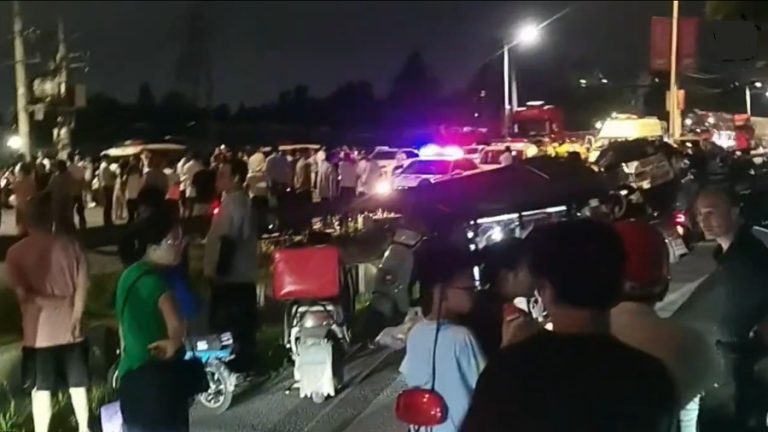
On the night of June 22, hundreds of homeowners at the Shimao Yunjing residential compound in Pidu District, Chengdu, blocked the road outside their development to protest property management fees they considered extortionate, along with a string of unaddressed safety hazards that included the absence of traffic lights at the compound entrance. Police moved against the crowd; several residents were beaten and detained on the spot, and at least one was taken to hospital.
A user identified as “YesterdayBigcat” posted an account of the confrontation to the social media platform X on June 23, sharing video footage of the standoff. Multiple residents confirmed to the account that they had filed complaints with local government authorities on numerous occasions before resorting to the road blockade. None of those complaints had produced results.
Sichuan homeowners stripped of urban registration rights also took to the streets last month
The Chengdu episode followed a similar incident in Leshan, Sichuan, on May 9 and 10, when more than a thousand residents across four housing developments near Sanhaoquiao staged collective demonstrations. Their target was a local government decision to reclassify their household registrations from urban to rural status. Some protesters briefly blocked road traffic; several were detained by police.
The residents said they had purchased their homes specifically to obtain urban household registration, which in China determines access to city schools, hospitals, and social services. The reclassification stripped their children of the right to attend urban schools.
Success
You are now signed up for our newsletter
Success
Check your email to complete sign up
Feng Chongy, an associate professor at the University of Technology Sydney who studies Chinese political economy, argued that the Sichuan protests reflected three compounding crises hitting China simultaneously: a collapse in the property sector now entering its fifth year, mounting stress on banks exposed to developer debt and local government borrowing vehicles, and a fiscal crunch at the local government level driven by the collapse of land-sale revenues that provinces had long depended on.
With local governments effectively out of money and no credible mechanism to bail out the property market, he said, the adjustment costs were falling on ordinary households, particularly rural migrants who had moved to cities, accumulated modest savings, and now found their wealth tied up in depreciating or unfinished properties.
Yunnan poverty resettlement estate erupts over sudden parking fee
According to YesterdayBigcat, at the Maojia Bay resettlement estate in Zhaotong, Yunnan Province, local government officials backed down under crowd pressure in May after days of confrontations. The estate, which the Party’s official media have promoted as a showcase of its so-called poverty-alleviation relocation program, houses more than 39,000 villagers relocated from five impoverished counties, including Ludian and Qiaojia, in the mountainous Wumeng highland region.
The relocation program forced a more complicated reality on most residents than Party publicity acknowledged. Villagers who had subsisted through farming lost their land and their primary means of livelihood when they were moved to urban housing blocks. Without stable employment or transferable skills, many households have survived on day labor, minimum subsistence payments, or irregular income. City living brought costs that had never existed in their rural lives: property management fees, utilities, insurance, and school tuition.
When community managers and the property company announced in May that a new monthly parking fee of 360 yuan (roughly US$50) would take effect immediately, residents erupted. For households already stretched thin, the charge was unmanageable. Residents also pointed to years of neglect: leaking rooftops and broken facilities had gone unrepaired, with the property company citing unpaid management fees as its excuse. Now, with no supporting documentation and no authorization letter from any supervising government body, the same company was adding a new charge.
On May 6, confrontations broke out at Block Three. Police attempted to tow away vehicles belonging to protesters; residents climbed onto the tow trucks to block the operation, and the towing stopped.
The following day, the situation escalated at Block Two. After several residents were denied entry to the compound by car, a crowd of more than a thousand people gathered at the main gate. Riot police were deployed. In the clashes that followed, one resident was struck on the head and injured. The officer responsible retreated to a police vehicle; the crowd surrounded it and refused to let it leave.
By that afternoon, local authorities gave ground. A government official addressed the crowd through a loudspeaker and made three commitments: the compound’s access barriers would be removed immediately, with a deputy police chief assigned to supervise compliance; all collection of parking fees and property management fees would be suspended effective that day; and a special working group would be established to hold community-level meetings on grievances related to livelihoods, employment, and property management.
Social media users were pointed in their assessments. “The CCP is the biggest landlord of all,” wrote one commenter.
“These officials sit in their offices all day thinking about how to squeeze the last cent out of ordinary people. They don’t serve the public; they prey on it.”
Another wrote: “Poverty alleviation had nothing to do with helping the poor. It was about finding ways to extract money.”
Residents who cannot return to their home villages, because those villages were demolished in the name of improving their lives, are now fighting for the right to park in the urban developments that replaced them.