The Chinese Communist Party has never acknowledged the June 4, 1989, massacre in Beijing’s Tiananmen Square, in which the military killed hundreds or possibly thousands of pro-democracy protesters. Thirty-seven years on, the regime still treats public remembrance as a crime.
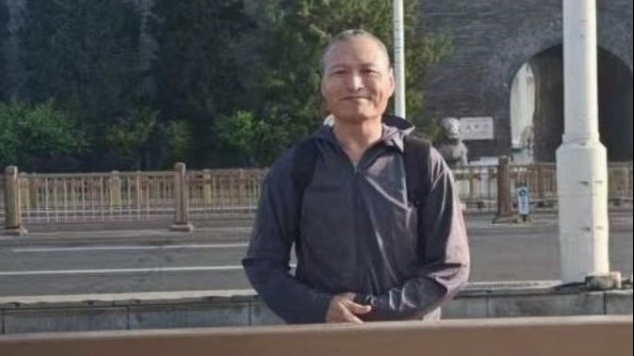
According to a blog post on weiquan.net, a human rights information center that monitors political detentions across mainland China, Zhang Chao, a Shandong-based labor-rights activist who once worked in a Communist Party central government compound, traveled to Beijing’s Tiananmen Square on June 4 this year, photographed the square’s perimeter fencing, and posted the image to WeChat alongside a memorial poem he had written for the victims of the massacre. His WeChat account was blocked within minutes. The following morning, plainclothes officers from the domestic security police in Zaozhuang, his home city in Shandong province, took him from Beijing. He is now held on criminal detention at the Zaozhuang No. 1 Detention Center in Yuelou Village, Shizhong District, under the jurisdiction of the Shanting branch of the Zaozhuang Municipal Public Security Bureau.
The detention was confirmed by Weiquan.net.
From Party chef to dissident
Born in 1970, he held a job as a pastry chef at a facility run by the General Affairs Bureau of the Central Committee of the Chinese Communist Party on Wanshoulu — the administrative unit responsible for the day-to-day logistics of the Party’s most senior organs, including housing, catering, and transport for top leadership. His conversations with colleagues about democracy, constitutional governance, and checks on power eventually cost him that job.
In June 2014, Zhang received a termination notice from his employer stating that he had “spread anti-communist and anti-Party speech, incited the masses, and disrupted unit management order.” The same year, he was held by police for 37 days after alerting petitioners in Beijing about an imminent police sweep. After his release he shaved his head and adopted an itinerant monastic life, traveling between Buddhist temples while continuing to distribute political information online and assist fellow activists in distress — until each temple, in turn, expelled him under apparent pressure.
Success
You are now signed up for our newsletter
Success
Check your email to complete sign up
In July 2019, Zhang purchased a round-trip ticket to Germany; before he could board, Zaozhuang’s Shanting district police arrested him on charges of “picking quarrels and provoking trouble,” the catch-all criminal provision the Party uses to detain dissidents and rights activists without a specific crime to allege. He served one year and eight months and was released in 2021.
Nanjing activist jailed for demanding June 4 remembrance in public
On June 3, 2016, Shi Tingfu, a rights defender from Nanjing who had worked as a factory employee, was stopped at the Shenzhen border checkpoint while attempting to travel to Hong Kong for a June 4 anniversary event and was forcibly returned to Nanjing, where he was held for four days in a cage cell measuring one square meter. On June 4, 2017, he delivered a public speech in front of the Nanjing Massacre Memorial Hall wearing a blood-red shirt bearing the words “Never Forget June 4,” posted the video online, and was arrested the following day. Formally arrested on July 6 of that year, he was released in February 2018.
Human Rights in China, an overseas advocacy organization that documents abuses on the mainland, published an account of Shi’s case on its X account on June 4 this year. His most recent detention came in January 2024, after he helped transmit a petition from fruit farmers in Akesu, Xinjiang, to foreign journalists. Convicted again of “picking quarrels and provoking trouble,” he received a three-year sentence that runs until Jan. 14, 2027. He is currently held at Shahe Prison of the Xinjiang Production and Construction Corps First Division.
Regime tightens June 4 censorship as public refuses to forget
On the 37th anniversary of the massacre, the censors swept terms including “Crazy Thursday” — a meme associated with Thursdays that coincidentally fell near June 4 — and “June 6,” along with countless other oblique references. Live-streaming platforms reportedly issued instructions prohibiting loud speech and banning phrases including “I’m sorry” and “I love you,” apparently to prevent any commemorative gesture from slipping through.
Chen Jing, a commentator writing in Kan Zhongguo, put the stakes directly: in a totalitarian state blanketed in lies, she wrote, remembering true names and true history is the highest form of defiance available to those who refuse submission. June 4, she argued, is an unresolved psychological nightmare for the CCP regime, one it cannot escape. Every crackdown, every restriction the Party imposes around the anniversary, she wrote, functions as an involuntary tribute to the people killed.