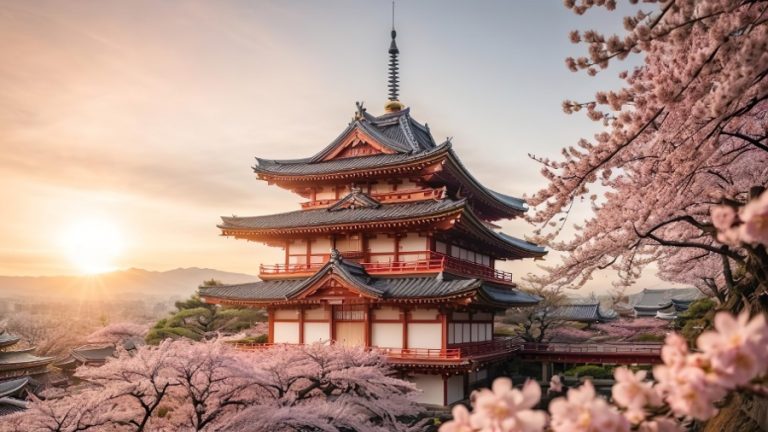
Deep within the quiet, tree-lined landscapes of Japan’s Kansai region, there once stood a historic temple that carried the spiritual devotion of generations of local worshippers and bore witness to countless lives and the passage of time.
In spring, cherry blossoms drifted through the temple grounds like snow; in autumn, maple leaves blazed red like fire. For several generations of local residents, it served as a spiritual sanctuary where they could seek peace and clarity of mind.
However, this temple complex was suddenly brought to an end through a commercial transaction.
Local believers were never informed, nor were neighboring residents given any explanation. Overnight, the temple’s Main Hall (Daxiong Hall) was reduced to rubble by heavy bulldozers and demolition equipment, leaving behind only broken tiles and barren earth.
The historic temple had reportedly been purchased for $927,646.65 USD (150 million yen), and its “new owner” was said to be a speculative buyer from China.
Success
You are now signed up for our newsletter
Success
Check your email to complete sign up
The fate of this Kansai temple is just one especially stark and heartbreaking example of a broader trend in Japan: a growing wave of temples being bought up and demolished.
This trend is forcing Japan’s traditionally reserved and understated society to confront what it portrays as a silent struggle extending into Japan’s religious sphere and eroding the foundations of its traditional culture.
‘Inactive religious corporations’ amid population decline
To understand why historic temples have become targets for cross-border acquisitions, one must first look at the dramatic changes in Japan’s demographic structure.
As Japan’s aging population and declining birthrate become increasingly severe—particularly as rural populations continue to concentrate in major metropolitan areas—many small and medium-sized temples and shrines that once depended on support from local communities and parishioners through the traditional danka (parishioner-support) system have faced a crisis of survival. Many have reached a point where there are no successors to maintain them.
According to official data, Japan has nearly 180,000 registered religious corporations. Among them, more than 5,000 are described as “dormant religious corporations” (referred to by the Japanese government as “inactive religious corporations”), meaning they conduct little or no religious activity and in some cases have effectively become shell organizations or are left unattended.
For local temple priests, shrine managers, and their surviving family members, the high cost of daily maintenance, heavy restoration expenses, and the sharp decline in the number of worshippers have made it increasingly difficult to sustain traditional religious institutions.
As a result, some brokerage firms have reportedly identified a business opportunity. They package temple corporations—including their land, historical assets, and even denominational affiliations—as commercial products and list them for sale on brokerage websites, with prices ranging from tens of millions to hundreds of millions of yen.
Chinese buyers possessing substantial amounts of capital and seeking what it describes as a secure “fallback option” have consequently flocked to purchase these temples, acquiring institutions that were traditionally expected to remain separate from ordinary commercial interests.
Three major motivations: asset transfers, tax advantages, and an immigration platform
Are the Chinese wealthy individuals, bloggers, and intermediaries who travel across the sea to purchase Japanese temples genuinely seeking spiritual fulfillment—or pursuing other objectives?
Kazuyoshi Shimoya (Kazuyoshi Shimoya), a former senior employee of TV Tokyo and a well-known public-relations expert made these revelations on his YouTube channel that purportedly exposed the motivations behind these transactions.
He argues that the primary reason Chinese buyers compete to acquire such properties is not religious devotion, but rather the substantial practical benefits associated with owning a religious corporation.
1. Circumventing China’s foreign exchange controls and transferring assets overseas
As Chinese authorities have in recent years imposed increasingly strict controls on capital outflows and private wealth—and have at times frozen or scrutinized funds under anti-corruption or financial-regulation campaigns—many wealthy Chinese have become concerned about protecting and moving their assets abroad.
The unique legal status of Japanese religious corporations can be used as a vehicle for asset transfers.
It claims that intermediaries advise buyers to characterize large sums of money as “temple preservation contributions” or “charitable donations.” Through these channels, funds can allegedly be presented as religious donations and transferred into Japan’s banking system, thereby facilitating the movement and concealment of assets overseas.
2. An exceptional tax haven through religious-corporation privileges
Religious corporations enjoy significant historical privileges under Japanese law.
Donations and offerings made by believers for religious purposes are exempt from taxation. Land owned by religious corporations may receive favorable tax treatment and certain exemptions. Religious corporations also operate under a special legal structure distinct from ordinary commercial corporations.
Because religious corporations do not function like shareholder-owned companies, their internal finances and fund flows can be difficult for outsiders to scrutinize. Such organizations may become attractive vehicles for individuals seeking to shield assets from scrutiny.
3. A convenient pathway for immigration
For several years, Chinese social-media platforms such as QQ have featured guides explaining how purchasing a Japanese temple can facilitate settlement and business opportunities in Japan.
After acquiring a religious corporation, a buyer can appoint themselves as the corporation’s representative officer (the effective head of the organization). They may then use this position as evidence of managing and operating the religious institution when applying for a business-management visa from Japan’s immigration authorities.
Unlike conventional businesses, religious organizations are generally not required to demonstrate the same level of commercial viability. They are not expected to produce marketable goods, compete in highly competitive industries, or continuously meet demanding profit targets. This translates into a substantially lower regulatory and operational burden while offering a more stable basis for renewing residency status.
Consequently, individuals associated with such organizations may enjoy a significantly smoother path toward permanent residency—and in some cases even naturalization as Japanese citizens—than entrepreneurs operating ordinary businesses such as ramen shops or guesthouses, whose immigration status often depends on the continued commercial success of their enterprises.
Material prosperity and a ‘deficit of faith’
In the eyes of certain Chinese speculators who purchase historic temples, religious beliefs and traditions have become little more than antiques of limited value. Years of exposure to materialism, pragmatism, and utilitarian thinking have eroded traditional notions of reverence toward religious institutions.
This has produced a deficit of faith and a moral blindness accompanying rapid material wealth accumulation.
When a person’s concerns are reduced solely to money, profit, exchange rates, and residency permits, they lose the ability to appreciate sacred things. Within this worldview, once someone has paid ¥150 million for a property, ownership rights are regarded as overriding all other considerations.
Consequently, if an old temple’s traditional wooden architecture and intricate joinery cannot generate sufficient financial returns, demolishing it and replacing it with dense housing developments or tourist-oriented high-rise buildings may appear entirely rational from a purely commercial perspective.
This is a combination of atheistic ignorance and extreme self-interest, asserting that some individuals are willing to sacrifice the spiritual heritage of others for personal security, profit, or opportunities abroad.
Japan’s response: Closing legal loopholes and launching investigations
Such practices have provoked growing concern in Japan. The perceived commercialization of religious institutions and the treatment of sacred sites as real-estate assets have angered many members of the Japanese public.
Kazuyoshi Shimoya (Kazuyoshi Shimoya) said on his program: “If this is left unchecked, it is not only a celebration for those operating beyond the reach of the law through tax avoidance and money laundering; it is also an erosion of Japan’s spiritual and cultural heritage. This is a serious social issue that concerns all citizens.”
These appeals and the exposure generated by numerous independent media commentators triggered a major political reaction in Japan.
Japan’s government, including the Agency for Cultural Affairs (Agency for Cultural Affairs), the Ministry of Justice of Japan (Ministry of Justice), and other government bodies, came under increasing pressure to act.
Japan’s Agency for Cultural Affairs convened an emergency policy meeting on April 27 focused on so-called “inactive religious corporations” that lack substantive religious activities and may be vulnerable to misuse by investors or intermediaries, reported TBS News.
This represents the first nationwide effort led by the Agency for Cultural Affairs to conduct a comprehensive review of Japan’s approximately 180,000 religious corporations.
Authorities have indicated that dormant religious organizations that have effectively lost active management or are suspected of being used primarily for commercial transactions could face legal action, including applications to local courts for dissolution orders.
The government is currently advancing these measures and is considering new regulatory guidelines with stronger oversight and enforcement mechanisms.
Why are Chinese tourists often criticized for not following local rules?
Many people overseas, including some Japanese, are troubled by the behavior of Chinese tourists whom they perceive as disregarding local rules, according to The Straits Times. However such behavior does not reflect the essence of traditional Chinese culture.
China has historically been known as a “land of propriety and etiquette” and a civilization that emphasized virtues such as kindness, humility, respect, frugality, and consideration for others. Traditional Chinese thought stressed self-discipline and adherence to social norms.
What caused this perceived change to stem from the influence of the Chinese Communist Party (CCP) (Chinese Communist Party), atheism, materialism, and a “philosophy of struggle?”
After the CCP came to power, traditional cultural values were gradually eroded, resulting in a decline in cultural and moral standards among later generations. The root cause of these problems is the CCP rather than the Chinese people themselves.
“The CCP is not China.” The international community increasingly distinguishes between the Chinese people and the CCP. Chinese citizens should recognize what it characterizes as the harmful influence of the CCP and advocate distancing themselves from the party and its affiliated organizations.
This article represents the author’s views and does not necessarily reflect the views of Vision Times.