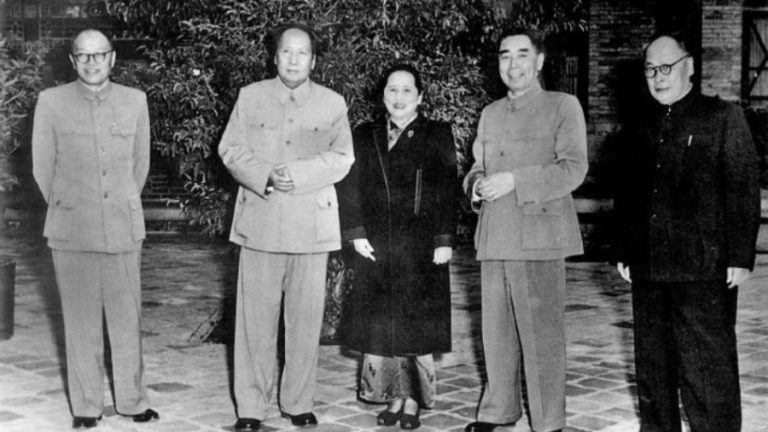
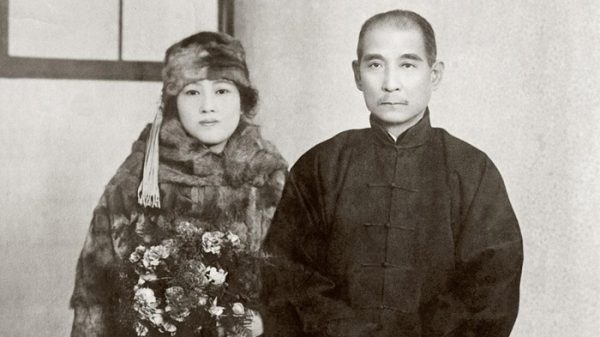
A story has been circulating on mainland Chinese internet forums for years: that Soong Ching-ling, the widow of republican founder Sun Yat-sen and one of the most celebrated figures of the early People’s Republic, wrote secretly to the Party Central Committee in 1957 to protest Mao Zedong’s persecution of intellectuals. The claim is a fabrication. Her published articles in the Party’s own flagship newspaper that year show her to have been among the campaign’s most aggressive public enforcers.
A fabricated letter and a durable myth
An article circulating under the author name “He Fang,” titled “Soong Ching-ling’s Previously Undisclosed Letters to the Party Central Committee,” quotes her as writing:
“The Party Central Committee called for a period of open criticism, so why has it now shut that down? The Communist Party was not afraid of the Nationalist Army’s eight hundred thousand soldiers, not afraid of American imperialism — so how can it now fear that the people will overthrow the Party’s leadership? The Party must be willing to accept criticism from people of all walks of life. Most of those who criticized are patriots who love the Party. Some democratic party members sacrificed family and personal interests for the liberation of new China. How could young intellectuals in their twenties and thirties possibly become anti-Party, anti-socialist elements overnight? I cannot understand this campaign. I have thought about it for more than two months and still cannot make sense of it.”
Zhengming magazine ran a feature on this letter in 2006, and the story has spread widely since — constructed after the Cultural Revolution by people close to her, designed to launder her reputation.
Success
You are now signed up for our newsletter
Success
Check your email to complete sign up
Soong Ching-ling’s June 1957 attack on Party critics
On June 21, 1957, Soong Ching-ling published an article in the People’s Daily, the Party’s official organ, under the headline: “To deny the leadership of the Communist Party is to seek to plunge the entire nation back into slavery.”
She opened by attacking critics of the Party’s monopoly on institutional power: “I emphatically cannot agree with some of the absurd arguments that certain people have put forward. For instance, some critics have said, in effect, that we have done nothing right. Proceeding from that view, they go on to raise the question of whether Communist Party representatives and Party committees in positions of decision-making authority within various institutions are even necessary. They say this restricts democracy and leaves non-Party members with titles but no real power. They say Party members, not being technical experts, are unqualified to lead.”
“To deny the leadership of the Communist Party is, in objective fact, to seek to reverse the course of history, to restore capitalism, and to plunge the entire nation back into slavery.”
By the standard of comparable anti-rightist speeches by senior Party figures at the time, her pitch was among the highest.
Soong Ching-ling’s July 1957 denunciation of a targeted dissident
On July 13, 1957, she published a second article in the People’s Daily, this time directing her attack at Zhang Bojun, a senior democratic politician who had proposed what he called a “Political Design Institute” to serve as an independent advisory body placed above both the Party and the Party-controlled legislature. The proposal made Zhang one of the campaign’s primary targets; he was stripped of all positions and labeled the country’s number-one rightist.
Soong Ching-ling joined the assault without hesitation: “For example, someone has advocated a ‘Political Design Institute,’ whose purpose is to place it above the two leading institutions — the Communist Party and the National People’s Congress elected by all the people. Some people have used unforgivable methods, such as distorting certain historical facts. At the same time, reactionary elements have intimidated non-Party individuals who firmly stand on the side of the Communist Party, using anonymous threats and other despicable tactics. This conduct has provoked widespread indignation and revulsion.”
She went further, attacking the concept of democratic pluralism outright: “This small minority of people says our country has restrictions. I would ask them: which country has none? When people speak of democracy, there are only two kinds: bourgeois democracy or socialist democracy. There is no third road, just as there is no ‘third force.’ State power is held either by capitalists or by workers. Does this small minority want bourgeois democracy? If so, they are demanding the restoration of capitalism in China.”

Soong Ching-ling’s call for women to ‘crush the bourgeois rightists’
On September 9, 1957, Soong Ching-ling delivered a speech at the Third National Congress of Chinese Women in her capacity as honorary chairwoman of the All-China Democratic Women’s Federation, a Party-controlled mass organization. Nothing on the agenda required her to address the Anti-Rightist Campaign.
She devoted 314 of her 768 words to praising it: “Bourgeois rightist elements have launched a frenzied assault on the Party, on the people, on socialism. Their aim is to overthrow the Party’s leadership and restore capitalism — in other words, to reimpose on women the shackles that had just been thrown off, shackles that had been worn for thousands of years. We must overcome sentimentality and thoroughly crush the bourgeois rightists. We must resolutely follow the Communist Party down the socialist road. There is no middle road here!” The speech was published in the People’s Daily on September 10, 1957.
How another celebrated democratic figure fired the opening shot
He Xiangning, widow of the Nationalist martyr Liao Zhongkai and, like Soong Ching-ling, celebrated as an embodiment of principled Chinese womanhood, holds a specific distinction in the campaign’s chronology. In his history of the Anti-Rightist Campaign (The Full Story of the Anti-Rightist Campaign, Qinghai People’s Publishing House, 1995, pp. 190–191), historian and journalist Ye Yonglie documents that she was the first person to use the term “rightist” publicly in the press. The Party’s directive of May 20 had instructed that “the voices of left-wing figures should be gradually increased,” and He was chosen to signal Mao’s intentions to the wider public.
On June 1, at a forum convened by the Party’s agency for managing non-Communist political figures, Chu Anping, a liberal editor and publisher, delivered what became one of the campaign’s most famous speeches. Chu argued that the Communist Party had monopolized all power in China, coining the phrase “Party empire” (党天下) to describe a system in which every appointment, at every level, required Party approval. He Xiangning contradicted him openly: “First, I hope the very small number of rightist elements will thoroughly remold themselves. So if the leading party now unites with us left-wingers, wins over and helps the middle elements, and educates and criticizes the rightists, that can only benefit our democratic parties — we welcome the leading party doing exactly this.”
The posthumous myth-making that has attached itself to Soong Ching-ling, the private letters of conscience, the quiet resistance, is a fabrication. He Xiangning fired the opening shot. Soong Ching-ling wrote the most strident public defenses of the purge. The record is in the People’s Daily, dateable and verifiable.
(The views expressed in this article are solely those of the author and do not necessarily reflect those of Vision Times.)