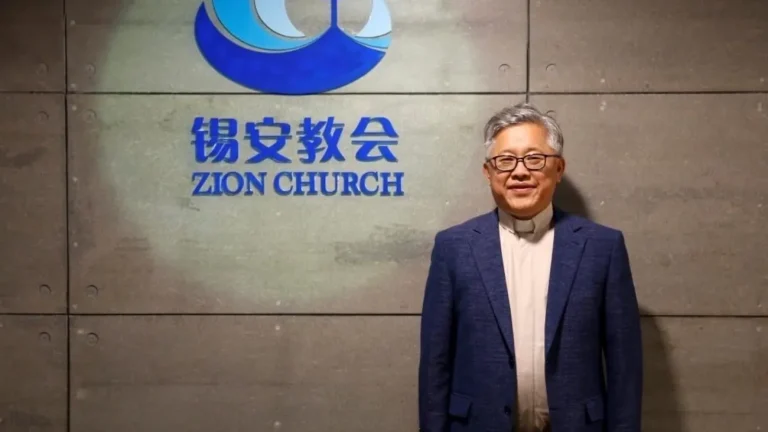
On July 4, pastor Ezra Jin Mingri, founder of Beijing’s prominent Zion Church, arrived safely in the United States and was reunited with this family after being released from detention in China.
Jin was arrested on Oct. 10, 2025, during a nationwide crackdown on Zion Church leaders. Authorities accused him of “illegally using information networks” after the church continued conducting online worship services outside China’s state-approved religious system.
Jin’s release came less than two months after U.S. President Donald Trump said he had raised the pastor’s case directly with Chinese leader Xi Jinping. The U.S.-based Christian advocacy group ChinaAid confirmed Jin’s arrival in Los Angeles, in a development that has renewed global focus on religious freedom in China and the role human rights concerns continue to play in U.S.-China relations.
RELATED: ‘Organized Criminal Activity’: US Senator Demands Action Against Beijing’s Transnational Repression
Church saw explosive growth
Jin founded Beijing’s Zion Church in 2007 with about 20 worshippers. Over the following decade, it grew into one of China’s largest Protestant house churches.
Success
You are now signed up for our newsletter
Success
Check your email to complete sign up
Unlike churches affiliated with China’s state-sanctioned “Three-Self Patriotic Movement,” the government-controlled Protestant church system, Zion Church refused to register with authorities and continued to operate independently. After Beijing officials shut down the church’s main venue in 2018, the congregation continued meeting through smaller gatherings and online services.
When Jin and 17 other church leaders were detained by authorities last year, observers described it as one of the largest crackdowns on a single house church in recent years. The arrests prompted calls for their release from members of Congress, international religious freedom advocates, and human rights organizations.
Pressure on Xi
Trump says he personally raised the case During his visit to Beijing in May, noting that he had “personally discussed” Jin’s detention with Xi. Speaking to reporters aboard Air Force One, Trump said he believed Xi was “seriously considering” the pastor’s case.
RELATED: Who Gained the Upper Hand at the Trump-Xi Summit? Analysts Weigh In
Trump also said he had raised the case of jailed Hong Kong media entrepreneur Jimmy Lai, though he acknowledged that securing Lai’s release would likely be more difficult. Lai was prosecuted under Hong Kong’s Beijing-imposed National Security Law (NSL), a sweeping law enacted in 2020 following months of pro-democracy protests.
Now, Lai is serving a 20-year prison sentence in Hong Kong on national security-related charges, a case that has drawn criticism from the United States, Britain, the European Union, and numerous international human rights organizations, which argue that the NSL has been used to suppress press freedom, erode civil liberties, and political dissent.
Following Jin’s release, his family thanked the Trump administration for its efforts, saying they believed the outcome “would not have been possible” without Xi’s direct approval. The family also expressed hope that the case could become “a positive signal” for improving religious freedom in China and for broader U.S.-China relations.
Religious freedom under siege
Rights groups cautioned that Jin’s release does not signal a broader improvement in China’s treatment of religious believers.
The U.S. Commission on International Religious Freedom (USCIRF), the U.S. State Department’s annual International Religious Freedom Report, and numerous human rights organizations have repeatedly documented restrictions targeting a wide range of religious communities, including Protestant house churches, Falun Gong practitioners, Uyghur Muslims, Tibetan Buddhists, and other faith groups.
Rooted in the principles of Truthfulness, Compassion, and Forbearance, Falun Gong, also known as Falun Dafa, focuses on moral self-improvement and meditation exercises. Despite being peaceful in nature, the Chinese Communist Party (CCP) launched a brutal campaign to eradicate the practice in July 1999. Since then, thousands of practitioners have perished at the hands of Chinese police, with many today still undergoing routine monitoring, arbitrary travel bans, and arrests.
Similar concerns have been raised regarding the treatment of unregistered Christian churches and other religious communities. Observers say Jin’s release is welcome but does not fundamentally alter China’s broader religious freedom landscape, where numerous pastors, Falun Gong practitioners, and other prisoners of conscience remain behind bars simply for refusing to renounce their faith.
Continued pressure needed
Human rights organizations welcomed Jin’s release while emphasizing that many members of Zion Church remain detained. Brian Tronic, who leads the political prisoners initiative at Freedom House, said Jin’s freedom is encouraging but noted that several church leaders and congregants remain imprisoned or continue to face criminal charges. He urged the international community to maintain attention on their cases.
Bob Fu, founder and president of ChinaAid, thanked Trump, Secretary of State Marco Rubio, and other U.S. officials for helping secure Jin’s release. He also called on Washington to continue making religious freedom and the release of all prisoners detained for their beliefs a priority in future engagement with Beijing.
Meanwhile, the Inter-Parliamentary Alliance on China (IPAC) likewise welcomed Jin’s release, saying it was “deeply relieved” by the news and expressing gratitude to the diplomats who worked behind the scenes to help secure his freedom.
While Jin’s release has been celebrated as a rare positive development, rights advocates stressed that it represents only one case amid a much broader pattern of religious repression. They say meaningful progress will ultimately be measured not by the release of individual prisoners, but by whether China’s religious communities are able to practice their faith freely without fear of detention or persecution.