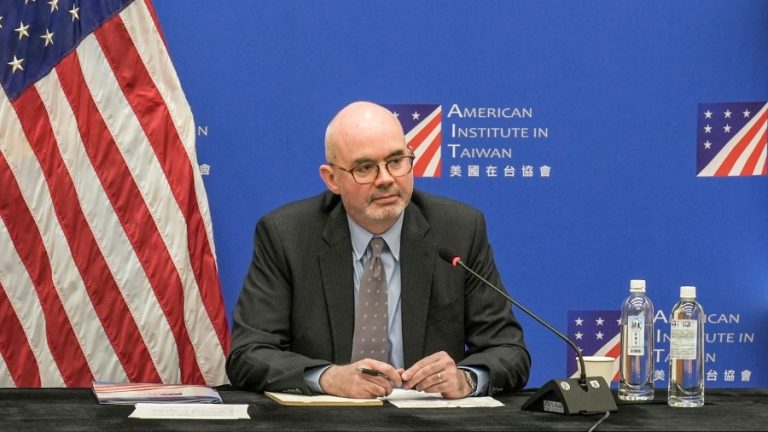
China’s Taiwan Affairs Office (TAO) on Thursday, July 2 took an apparent swipe—without naming him directly—at Raymond Greene, director of the American Institute in Taiwan (AIT), accusing him of “running around stirring up trouble” and of “publicly complying while privately defying” U.S. President Donald Trump’s statements on Taiwan.
Taiwan Foreign Minister Lin Chia-lung criticized the remarks as an example of “wolf warrior diplomacy,” saying the TAO was effectively “teaching children to do wrong,” reported Taiwan’s LTN media.
A scholar also blasted the office, asking, “Other than barking at a passing train, what is the TAO actually capable of?”
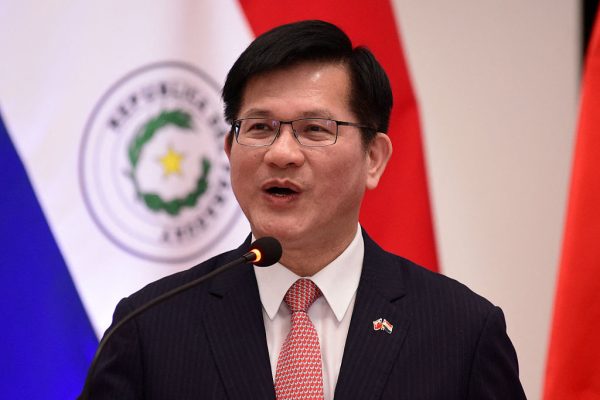
Lin Chia-lung: TAO is ‘teaching children to do wrong’
According to Taiwan’s Liberty Times, AIT Director Raymond Greene recently said in a media interview that 70 percent of Taiwan’s public supports maintaining the status quo, providing an excellent foundation for dialogue between Taiwan’s democratically elected leaders and Beijing. He also said that the Chinese Communist Party’s attempts to sow division within Taiwan would not achieve their intended results, emphasizing that “U.S. policy toward Taiwan remains unchanged, and arms sales to Taiwan have not been suspended.”
The remarks angered Beijing. At the Taiwan Affairs Office’s regular press briefing on July 2, spokesperson Zhu Fenglian responded by accusing “certain individuals” of “publicly complying while privately defying” President Trump’s statements on Taiwan. She said these individuals were creating discord over the Taiwan issue, smearing and vilifying China’s Taiwan policy, and acting with malicious intent, adding that “we firmly oppose such actions.”
Success
You are now signed up for our newsletter
Success
Check your email to complete sign up
In response, Taiwan’s Foreign Minister Lin Chia-lung said in an interview that the Taiwan Affairs Office’s emotional remarks were an example of “wolf warrior diplomacy,” warning that such rhetoric would only prove counterproductive. He urged the office to communicate in a civil manner rather than resorting to personal attacks and character assassination, saying that such behavior was essentially “teaching children to do wrong” (a Taiwanese Hokkien expression meaning setting a bad example). He added that this style of wolf warrior diplomacy often portrays diplomatic relations as being on the brink of confrontation, making it highly unconstructive.
Lin called on all parties to work together to safeguard peace and stability across the Taiwan Strait and the broader Indo-Pacific region, saying Taiwan remains willing to engage in dialogue with the Chinese Communist Party authorities on the mainland. He noted that this is also a position repeatedly emphasized by the U.S. government—that the Beijing authorities should engage in dialogue with Taiwan’s democratically elected government and refrain from manipulating Taiwanese public opinion.
Lin further stated that Taiwan is a diverse democratic society with a wide range of opinions. Nevertheless, he said, there is broad consensus when it comes to defending democracy. He stressed: “It is impossible for us to allow Taiwan to become part of the People’s Republic of China, because without sovereignty, there can be no human rights, nor can there be property rights.”
RELATED:
- Taiwan Delegation Visits Pentagon and White House; US Reaffirms Commitment to Taiwan
- Two-Thirds of Americans Say Taiwan’s Security Is Vital to US Security and Prosperity: Poll
Yeh Yao-yuan: The Taiwan Affairs Office does nothing but ‘bark at a passing train’
Meanwhile, Yeh Yao-yuan, Professor of International Studies and Chair Professor at the University of St. Thomas, wrote that the “certain individual” referred to by Zhu Fenglian was in fact Raymond Greene, the senior U.S. diplomat stationed in Taiwan and the official representative of the U.S. federal government in Taiwan. As such, Yeh argued, the “certain individual” was effectively the U.S. government itself.
Yeh said that while the Chinese Communist Party is free to oppose the AIT director or the United States, this does not mean Beijing has the ability to unilaterally alter the existing relationship among the United States, China, and Taiwan. He criticized the Taiwan Affairs Office, asking, “Other than barking at a passing train”—an idiom meaning wasting one’s efforts on something that has no effect—what else is it actually capable of? He added jokingly that he himself had long been among those targeted under the PRC’s Ethnic Unity Promotion Law.
Raymond Greene: Seventy percent of Taiwanese support maintaining the status quo
Taiwan’s United Daily News published an exclusive interview with Raymond Greene, Director of the American Institute in Taiwan (AIT) on June 22. According to the report, Greene noted that most people in Taiwan support maintaining the status quo, and that this framework and broad consensus have remained consistent from the administration of former President Tsai Ing-wen to that of current President Lai Ching-te.
He said: “Whichever political party governs in the future is likely to maintain this consensus, because it enjoys the strong support of more than 70 percent of the Taiwanese people.”
Greene said the Chinese Communist Party has consistently insisted that certain preconditions must be met before dialogue can take place. In reality, however, engagement without preconditions is the best way to avoid miscalculation and offers the greatest opportunity to find peaceful ways of resolving differences.
He added that the United States continues to urge Beijing to engage with Taiwan’s democratically elected leaders because Taiwan has a strong consensus in favor of maintaining the status quo, making it an excellent foundation for dialogue.
“Given the broad consensus within Taiwan, attempts to sow division in Taiwanese society will not produce the results Beijing hopes for.”
Greene also said that the overwhelming majority of Taiwanese support maintaining the status quo, with only a small minority holding more extreme positions. Addressing the argument that “the best way to preserve peace is to accommodate the Chinese Communist Party and weaken Taiwan’s own defenses,” he said this view assumes that Beijing’s objective is to preserve the status quo.
“Based on what I see Beijing doing today, I don’t see evidence that this is its objective.”
Greene further commented that Kuomintang (KMT) Chairman Cheng Li-wen’s visit to the United States presented a valuable opportunity to explain the party’s views to U.S. officials, while also allowing the United States to convey its own perspective.
“That is, the importance of investing in defense capabilities, which is an essential prerequisite for maintaining peace across the Taiwan Strait.”