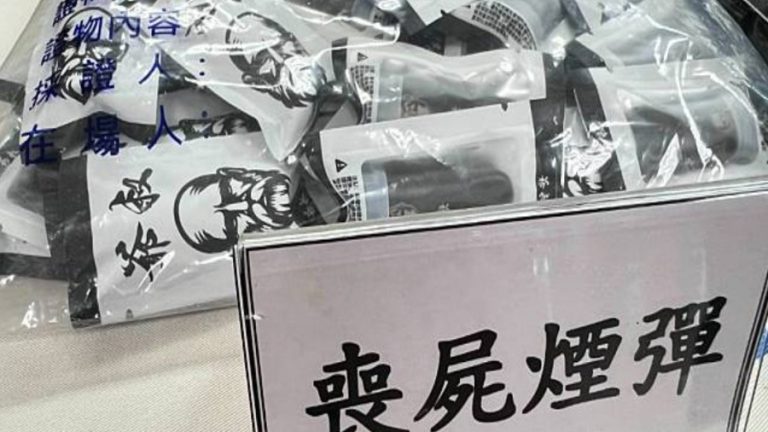
Impaired driving accidents caused by so-called “zombie vape drugs” have become increasingly serious in recent years inside Taiwan. Taiwan’s National Security Bureau (NSB) said on July 3 that the precursor chemicals and finished products for certain emerging drugs smuggled into Taiwan—including the Schedule I narcotic etomidate (and its precursor materials)—mainly originate from China, India, and Malaysia.
Among them, China is the primary source of the precursor chemical Etomidic acid, while India and Malaysia are the main sources of the finished powdered form of the drug.
According to Taiwan’s Central News Agency (CNA), amid growing public concern over drug-impaired driving and narcotics, the Legislature’s Foreign Affairs and National Defense Committee invited NSB Director-General Tsai Ming-yen, along with officials from the Ministry of the Interior and the Ministry of Justice, to deliver a report on “The Integration of National Security Intelligence and International Anti-Drug Cooperation in Combating Emerging Drug Smuggling.”
Representatives from the Coast Guard Administration under the Ocean Affairs Council, the Customs Administration under the Ministry of Finance, and the Military Police Command under the Ministry of National Defense also attended the meeting and were available to answer lawmakers’ questions. The NSB’s written report has already been delivered to legislators’ offices.
According to The Epoch Times, in its report, the NSB noted that drugs such as ecstasy (MDMA), “one-pill sleep aids” (a colloquial term referring to certain illicit sedative-hypnotic drugs), and “fairy water” were previously prevalent in Taiwan. In recent years, however, drug trafficking syndicates have increasingly focused on smuggling etomidate (including its precursor chemicals) and other specific emerging narcotics. The report states that both the finished etomidate product and its precursor materials largely originate from China, India, and Malaysia. China is identified as the principal source of the smuggled precursor Etomidic acid, while India and Malaysia are the primary sources of the finished powdered drug.
Success
You are now signed up for our newsletter
Success
Check your email to complete sign up
Regarding the Schedule III narcotic ketamine, the National Security Bureau (NSB) stated that both the finished drug and its precursor chemicals primarily originate from Thailand, Myanmar, and Laos. Because the penalties for manufacturing, trafficking, possessing, and using Ketamine are relatively lenient, its abuse has become widespread.
The NSB added that 4-methylmethcathinone (4-MMC), another Schedule III controlled substance, is mainly sourced in both finished and precursor form from mainland China, Hong Kong, and Macau. It is often mixed with ketamine and disguised as instant coffee sachets or tea packets to evade law enforcement detection.
Channels for smuggling
The NSB also identified three main channels through which drugs are smuggled into Taiwan: Concealment in sea and air cargo containers; Ship-to-ship smuggling operations; and International parcel delivery.
Regarding sea and air cargo shipments, the bureau said traffickers often import drugs under the guise of legitimate goods, falsely declaring narcotics or precursor chemicals as ordinary industrial chemicals, or concealing them inside imported products in an attempt to pass customs inspections. Because of the enormous volume of cargo entering Taiwan, this has become the most common channel through which drug seizures are made.
Regarding ship-to-ship smuggling, the National Security Bureau (NSB) said traffickers use small vessels to transport narcotics, waiting for opportunities to approach Taiwan’s offshore and coastal waters before smuggling the drugs ashore to evade inspections at official ports of entry. For example, transnational drug trafficking syndicates use so-called mother ships to transport drugs such as ketamine from the Golden Triangle region to known smuggling hotspots, where the cargo is transferred to smaller vessels operated by accomplices for delivery to Taiwan.
As for international parcel delivery, traffickers commonly employ a strategy of breaking shipments into small quantities and mailing them in multiple batches through cross-border postal services. This reduces the risk that any single seizure will result in the loss of a large quantity of drugs. They also use fraudulent sender contact information and instruct unsuspecting individuals to collect the packages, creating investigative dead ends for law enforcement.
Regarding countermeasures, the NSB said it will strengthen its intelligence-sharing and joint defense mechanism by integrating intelligence-gathering resources to combat criminal channels including illegal maritime transshipment, smuggling through sea and air ports, and body concealment of narcotics. It also plans to identify drug-related individuals and networks both inside and outside military installations to ensure the armed forces remain drug-free, thereby enhancing the overall effectiveness of Taiwan’s national security intelligence agencies in combating narcotics.
READ MORE:
- Taiwan Delegation Visits Pentagon and White House; US Reaffirms Commitment to Taiwan
- Taiwan Investigates Suspected Smuggling of Nvidia AI Servers to China
Cooperation with international partners
In addition, the bureau said it will continue to deepen cooperation with international partners by sharing drug-related intelligence, periodically hosting or attending meetings with allied counterparts, organizing international anti-drug conferences, and exchanging information on global drug trafficking trends and major narcotics investigations. These efforts are intended to improve the national security intelligence community’s ability to detect, identify, and intercept drug smuggling, preventing narcotics from entering Taiwan.
The NSB emphasized that it will work closely with the national security intelligence community to analyze seized drug cases, including the origins of emerging narcotics, smuggling channels, and trafficking routes. By organizing intelligence from various drug investigations and building a comprehensive picture of trafficking networks, authorities aim to achieve the goal of “striking at the source” of the drug trade.
So-called “zombie vape cartridges” containing etomidate produce powerful hallucinogenic, anesthetic, and muscle-spasm effects. The NSB said drivers who use the drug suffer severe impairment of cognition and reaction time, leading to catastrophic drug-impaired driving incidents such as driving the wrong way into traffic and high-speed rear-end collisions. The substance has become a major public safety threat on Taiwan’s roads in recent years.
According to CTI News, statistics from the Criminal Investigation Bureau’s Narcotics Enforcement Center show that the number of drug-impaired driving cases referred for prosecution has increased by more than 200-fold in just four years, with etomidate—commonly known as the “zombie drug”—playing a central role in the surge. Authorities referred to 43 cases in 2021 and 46 cases in 2022. The figure then jumped to 315 cases in 2023, nearly six times the previous year. In 2024, referrals surged again to 2,619 cases, more than eight times the 2023 total. By 2025, the number of drug-impaired driving referrals nationwide had reached 8,659, representing an increase of more than 200 times compared with 2021.
In May this year, Changhua County recorded three major drug-impaired driving accidents within just 20 days, resulting in four deaths and eight injuries. The most serious incident occurred on June 23, when a female parenting influencer allegedly crashed her vehicle into a motorcycle helmet shop in Taoyuan City after using a zombie vape cartridge containing etomidate while her three-year-old daughter was in the car. Prosecutors subsequently sought her detention pending investigation.