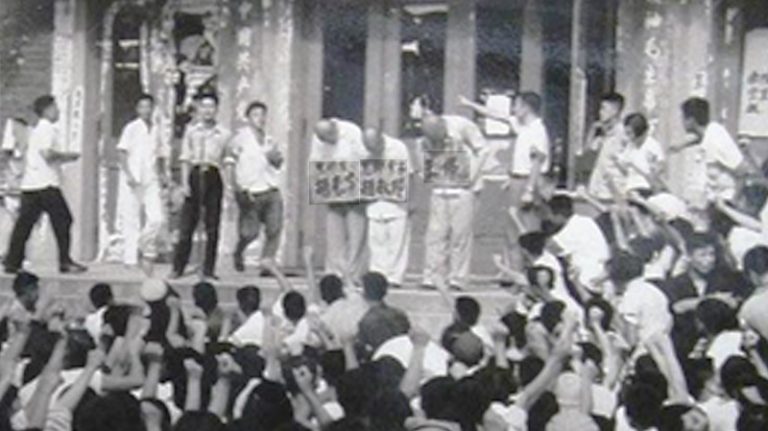
Hu Yaobang led the Chinese Communist Party as general secretary in the 1980s and became the face of its brief reformist opening, until Party elders forced him out in 1987 for refusing to crush student demonstrations. Less well known in the West is what the Party did to him two decades earlier. During the Cultural Revolution, Mao Zedong’s decade-long campaign of political terror, Hu was dragged before howling crowds and beaten, branded an enemy of the Party, locked in a makeshift prison, and sent to a labor camp for “reform.” According to those closest to him, Hu spent his final years still afraid that the Party’s campaign of “exposure and criticism” against him was not over, and that he had never truly been forgiven.
Red Guards whipped the future party leader until he rolled on the ground in pain
The details of Hu’s ordeal became public through the mainland writer Ye Yonglie, who in 2001 interviewed Hu Keshi, the official who had run the day-to-day operations of the Communist Youth League under Hu Yaobang, and through the published recollections of other witnesses.
At the end of 1964, Hu Yaobang was transferred to serve as second secretary of the Party’s Northwest Bureau and first Party secretary of Shaanxi province. He formally remained first secretary of the Communist Youth League, the Party’s organization for indoctrinating young people, but daily work at League headquarters passed to Hu Keshi.
In 1966, the Cultural Revolution’s opening months plunged Beijing into chaos. That December, Red Guards at a Beijing middle school beat a teacher to death during factional fighting. The Central Cultural Revolution Group, the radical body Mao had empowered to direct the purges, seized on the killing and blamed it on “incitement” by the work team that had been stationed at the school, a team dispatched by the Youth League’s Central Committee. Red Guards caught up in the era’s radicalism surrounded the League’s headquarters, chanting for the downfall of the “Three Hus”: Hu Yaobang, Hu Keshi, and Hu Qili, the League’s top officials.
Hu Keshi recalled being hauled out and struggled against several times, and beaten repeatedly. Then the mobs came for Hu Yaobang himself. Red Guards lashed him with leather belts until he rolled on the ground in pain.
Success
You are now signed up for our newsletter
Success
Check your email to complete sign up
Hu Keshi witnessed it all. “The men doing the beating had lost all reason,” he said.
By his count, Hu Yaobang was dragged out and struggled against roughly a dozen times. He and Hu Qili endured even more sessions.
The three men were imprisoned inside League headquarters in what the era called “cowsheds,” the improvised jails where the Party confined those it had labeled “ox demons and snake spirits,” its catch-all term for class enemies. At the Youth League, the “cowshed” was simply a large office room. Twenty or thirty prisoners slept on the floor of each one. The “Three Hus” were deliberately separated and held in different rooms.

Sent to a labor camp where overwork and hunger killed seven of his colleagues in under two years
In May 1969, Hu Yaobang was sent alone to the Huanghu Farm “May 7” cadre school in Huangchuan county, Henan province. These rural camps, named after a 1966 directive from Mao, existed to break disgraced officials through hard labor. Hu was stripped of his right to work and of his political rights.
The military representatives who ran the camp classified Hu as a “three-anti element,” meaning an enemy of the Party, of socialism, and of Mao Zedong Thought, and assigned him to Company One for supervised “reform” under tightened control. Company One consisted mostly of administrative cadres and workers from the Youth League apparatus, people from the “red five categories,” the family backgrounds the Party deemed politically reliable. The military representatives calculated that these loyalists’ “deep class feelings” would make them harsher enforcers of Hu’s “remolding.”
Inmates built their own housing. There was no drinking water; they dug wells by hand. They rushed to plant and harvest rice and wheat and dug irrigation ditches, all at a workload beyond normal endurance. Young cadres finished each day unable to straighten their backs, aching all over, according to the farm’s former Company One commander.
Hu suffered from hemorrhoids so severe that he experienced frequent rectal prolapse and bleeding. He kept working alongside everyone else. He carried a small basin to the fields each day, and while others rested, he scooped up water to wash his wounds, then returned to the labor. He took on every punishing job: molding mud bricks, hauling brick and stone, pushing grain across the drying yard, winnowing wheat, transplanting rice seedlings, cutting grass. A single mud brick weighed roughly twenty-five pounds. The strongest young men could mold fifty-odd bricks a day. Hu, straining to the limit of his strength, managed more than twenty.
Around 2,000 people from the Youth League and its affiliated organizations had been forced into the cadre school. Between the spring of 1969 and the autumn of 1970, less than two years, seven of them reportedly died at Huanghu from crushing labor and malnutrition, including Qian Dawei, a member of the League’s standing committee who had headed its international liaison department, and a writer identified as Wu Xiaowu.
READ MORE:
- Why Mao Zedong Really Launched the Cultural Revolution
- China’s ‘Dual-Peak Politics’: How Deng Xiaoping and Chen Yun Shaped the Tiananmen Crisis
- How Sun Yat-sen’s Widow Became One of Mao’s Most Vocal Enforcers in the 1957 Purge of Intellectuals
The army officers running the camp feasted while prisoners were punished for buying tofu
While inmates died, the military representatives roamed the farm with hunting rifles slung over their backs, counting the shooting of birds, ducks, and rabbits as their “labor.”
They imposed severe restrictions on the cadres’ daily lives, forbidding them from buying food at local markets. Parents who bought a piece of tofu for their children were denounced for harboring “capitalist thinking.” The officers themselves filled their canteens with liquor and sipped from them throughout the day.
The Company One commander once walked unannounced into the military representatives’ office to deliver a report and found them huddled around a stove, stewing a chicken. They regularly bought soft-shelled turtles at market, both to make nourishing soup for themselves and to ship home to Beijing. On one occasion, a military representative on home leave in Beijing sent a telegram to Xinyang demanding that live fish be procured and delivered to the capital for him.
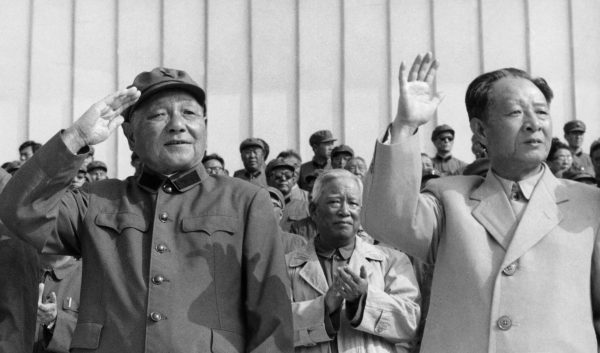
Even at the party’s summit, the fear never left him
In the autumn of 1972, prime minister Zhou Enlai had Hu recalled to Beijing for medical examination and placed him under protection. Once Hu was back in the capital, visitors began arriving at his home. The military representatives, hunting for grounds to convict him, twisted this fact into an accusation: they smeared his residence on Fuqiang Hutong as a “Petőfi Club,” the Party’s slur, borrowed from the intellectual circle blamed for Hungary’s 1956 anti-communist uprising, for any gathering it wished to paint as a counter-revolutionary cell.
Hu was eventually rehabilitated and rose to lead the Party itself. In January 1987, Party elders convened a “Party life meeting,” an enlarged leadership session devoted to days of denunciation, at which Hu was attacked for his tolerance of student protests and forced to resign as general secretary. According to those around him, the man who had survived the Cultural Revolution’s struggle sessions could not shake the sense that this new round of “exposure and criticism” was unfinished, that real forgiveness had never come, and that worse might still follow.
Liu Chongwen, Hu’s final political secretary, disclosed one measure of that estrangement in a 2009 article, “Hu Yaobang’s State of Mind in the Six Months Before His Death,” published in the journal Yanhuang Chunqiu. After the life meeting, Hu and his wife, Li Zhao, paid a single visit to Deng Xiaoping, the Party elder who had both promoted Hu and sanctioned his downfall. The conversation lasted about fifteen minutes. Deng was cold to him.