After more than a month, the Dalai Lama returned to Dharamsala following a long visit across Tibetan settlements in South India’s Karnataka state. The spiritual leader was heavily escorted as potential threats from China rose.
The Dalai Lama’s return was welcomed by Gyari Dolma — Central Tibetan Administration’s Department of Security Minister — and other members of the Tibetan Parliament. Figures of other faiths like Hinduism, Islam, Buddhism and Christianity also greeted him. Locals gathered in traditional clothes, gracing the Dalai Lama as he was led into his home of McLeodganj; the seat of the Tibetan government-in-exile, also called “Little Lhasa.”
At the end of his journey, the Dalai Lama was able to speak to 8,021 people, mainly Tibetans from the four Tibetan settlements in India — Bylakuppe, Mundgod, Hunsur, and Kollegal.
The Dalai Lama left Dharamshala on Jan. 3 to begin his visit, staying at Tashi Lhunpo Monastery, where the Panchen Lama in exile resided in Bylakuppe. He stayed there for one and a half months.
The leader visited many spiritual gatherings, beginning with a prayer service on Jan. 9, paying respects to victims of the earthquake that struck Dingri and other areas in the Shigatse region. On Jan. 18, he took part in a debate session of the Gelug Jamchoe and Rigtsog, where monks of several monasteries came together to debate in front of 3,000 people.
Success
You are now signed up for our newsletter
Success
Check your email to complete sign up
On Feb. 5 he attended a prayer ceremony organised by Sera Jey and Sera Mey colleges at Sera Monastery, before holding another on Feb. 12 in Tashi Lhunpo Monastery’s main assembly hall. The day after, he granted the White Tara long-life empowerment to 26,000 people at Tashi Lhunpo.
On Feb. 16, the Dalai Lama left Bylakuppe to Gyumed Tantric College in Hunsur Rabgayling Tibetan Settlement — visiting the college after a decade — where he was given an award for his long life of teaching and practice.
Almost 90 years old, the Dalai Lama is also set to release his new book in March titled Voice for the Voiceless: Over Seven Decades of Struggle with China for my Land and My People, which contains personal reflections on his ongoing battle with communist China and his dedication to preserving Tibet’s unique culture, religion, and history.
READ MORE:
- ‘Whoever governs China in the future must restore morality and faith’: Statements From the Tuidang Movement (December 2024)
- US Overtakes China to Become Germany’s Biggest Trading Partner for First Time in 9 Years
- Japan to Allow Residents to List Their Nationality as ‘Taiwan’ on Family Register
India’s security measures
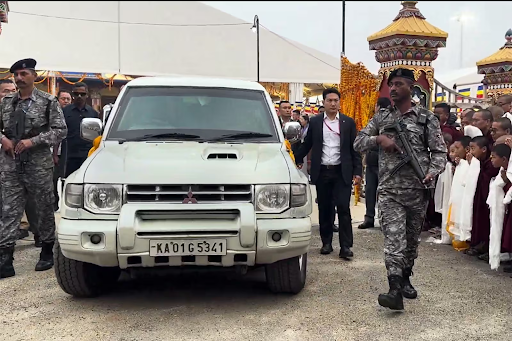
Throughout his visit, the Dalai Lama was granted additional security from the Indian government, placing his safety in the hands of the Central Reserve Police Force (CRPF), an anonymous source told Radio Free Asia (RFA). Commandos of the CRPF were seen escorting the leader’s vehicle.
India boosts Dalai Lama’s security amid threats | Radio Free Asia (RFA)
The Dalai Lama’s safety was designated under the third-highest level of India’s security coverage — named Z-category. This was below the security levels of India’s prime minister and his family — which was called the Special Protection Group — and Z+ category, the level for primary government ministers.
India has protected the spiritual leader since his exile from Tibet in 1959, watching over his home of Dharamsala. During his travels, security was arranged by the central government, with the state governments coordinating his protection.
Indian media reported that the CRPF’s VIP security wing was headed by the Indian Ministry of Home Affairs, making sure of the Dalai Lama’s safety with 30 commandos.
“Now there will be a massive security cover with commandos traveling with him in a multiple convoy and the possibility of additional state security cover,” senior Indian journalist Aditya Raj Kaul told RFA.
Succession under threat
The heightened security came as “potential security threats” emerged, with rising concerns from the Chinese Communist Party’s (CCP) long opposition to the Dalai Lama’s influence.
When the Dalai Lama turns 90 this July, he is expected to name his successor or give guidance on the matter. However, Beijing is keen to determine who will replace him.
According to Voice of America (VOA), Beijing wishes for the Dalai Lama to “return to the right path,” claiming that they are eager to discuss his future “as long as certain conditions are met.” One such condition was that the Dalai Lama renounced his stance on dividing the “motherland”, Guo Jiakun — spokesperson for China’s foreign ministry — told a press conference.
Guo’s comment came after the death of the Dalai Lama’s brother, Gyalo Thondup, who served as an unofficial envoy for his younger brother in meetings with Chinese officials.
Guo also called for the Dalai Lama to surrender to the claims that Tibet and Taiwan are rightful territories of the People’s Republic of China (PRC). However, the deputy speaker of the Tibetan parliament-in-exile, Dolma Tsering Teykhang, denied these claims.
“If they dictate that His Holiness should speak about Tibet being an inalienable part, that is a distortion of history. By distorting history, you cannot have a peaceful and amicable solution.”
The Dalai Lama still plans to answer matters surrounding the succession — if and where he would be reincarnated — once he turns 90. Speaking to Reuters in December, he said he could age up to 110 years.
“I’m very hopeful that His Holiness will visit Tibet, and he will go to his Potala Palace,” Teykhang said.