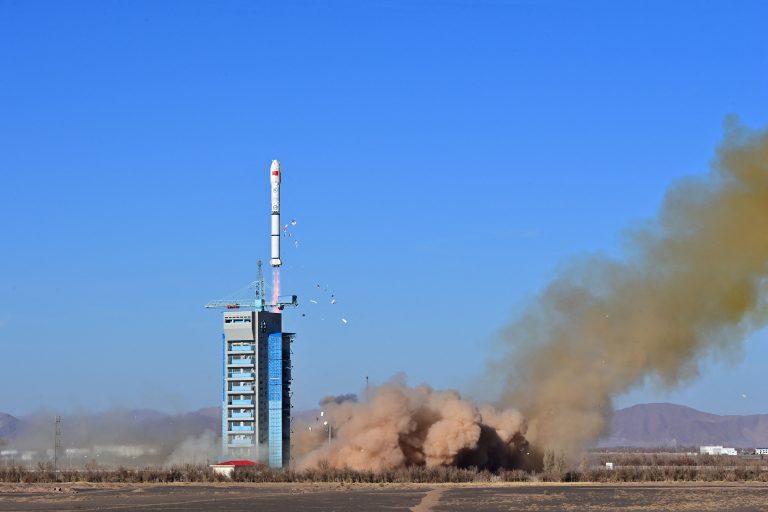
A recent report published by Reuters highlights China’s growing space alliances in Africa as it vies to become the world’s leading space power. There are also concerns over Beijing’s potential use of its investments for military purposes and the communist authorities’ motives remain murky.
According to the report, China has offered “donations of satellites, space monitoring telescopes and ground stations,” to a number of African nations.
Currently, Beijing has established 23 bilateral space agreements across the continent, funding satellites and ground stations for data collection, according to the think tank, the United States Institute of Peace.
China’s latest development is through an Egyptian satellite lab built with its funding to Cairo. The plant — essential to Egypt’s Space City project and conceived in 2017 — began operations in 2023, housing two of the most powerful telescopes in the world.
The facility also helped create three observation satellites; two of which were assembled in China, while the third satellite was made in Egypt.
Success
You are now signed up for our newsletter
Success
Check your email to complete sign up
Despite Egypt’s reliance on U.S. military aid, it has turned to China to drive its space-faring aspirations.
In September, during a meeting with African leaders in Beijing, Chinese Premier Xi Jinping claimed that its space technology was part of a $50 billion investment for Africa in the next three years, aimed to boost the continent’s efforts to catch up with the rest of the world.
The China Aerospace Science and Technology Corporation (CASC), China’s own military and space contractor, declared it would turn the country into the dominant space power by 2045, with plans to send astronauts to the moon by 2030, with a moon base and nuclear-powered space shuttles on the way.
READ MORE:
- US Spending Cuts in Motion: Where Government Spending Stands Now and Where It’s Going
- Countries Crack Down on Usage of Chinese DeepSeek AI App
- USAID Shutdown Threatens Efforts to Tackle Haze in Southeast Asia
Beijing’s growing network
Despite Beijing’s claims, concerns are rising over the potential threat of the communist government’s efforts to expand its surveillance network.
Reuters reported that China had been given access to data provided from its investments, further solidifying its presence with its African facilities, six sources familiar with its space projects in Africa claimed.
Nicholas Eftimiades, former U.S. intelligence officer who specializes in Chinese espionage, believes that the equipment given to other countries would expand a “global surveillance network.”
“China has democratized space to enhance its authoritarian capabilities… and it’s doing so very effectively.”
The Pentagon warns that Beijing could gather sensitive data, strengthen its military, and pressure governments reliant on its communications network.
Liu Pengyu, spokesman for the Chinese Embassy in Washington, called the U.S. “the world’s largest surveillance state,” adding that they are “not in a position to smear or defame China,” given America’s own espionage efforts.
It is believed that China’s technology and infrastructure could have military capabilities, despite its stated intentions for civilian usage. The telescopes could be used to provide data to help intercept missiles and scramble communications via anti-satellite (ASAT) weapons, a 2022 report by the U.S. Defense Intelligence Agency claims.
One of the satellites from Egypt’s Space City is said to possess “military-grade surveillance,” two people familiar with the subject said.
Military operations could also be conducted much easier with the data obtained from Beijing’s ground stations.
As such, the U.S. and its allies have stepped away from cooperating with China.
Though the China National Space Administration (CNSA) declined to comment, Yang Xiaoyu, director of the agency’s System Engineering Department, said China “has never, and will never” use the data it acquires for its military benefits.
‘Political motives’
Makram Ibrahim, professor of space physics at Egypt’s National Research Institute of Astronomy and Geophysics, insists that the collaboration with China is merely for scientific research but admits there could be political motives.
“There could be political motives, and you can do that analysis yourself on how they benefit politically,” Ibrahim told Reuters. “Secondly, they benefit scientifically because the data I get here, we both use it.”
Liu, the Chinese embassy spokesman, failed to comment on China’s specific motives for investing in Egypt’s space program, but did say that “supporting Africa’s development is a shared responsibility of the international community.”
China has also been active in Ethiopia, another recipient of space aid from Beijing.
Since 2019, China has launched two Earth observation satellites for the East African country and funded construction of a ground station there. China also funds data collection to help Ethiopia monitor floods and droughts, the country’s top space official, Abdissa Yilma, the general director of the Ethiopian Space Science and Geospatial Institute, told Reuters.
He said his nation is neutral and wouldn’t get drawn into the U.S.-China rivalry. But did say that the contest could help supercharge technological development, just as East-West competition did in the Cold War.
“It seems that the race has started again,” Yilma said.
Reuters contributed to this report