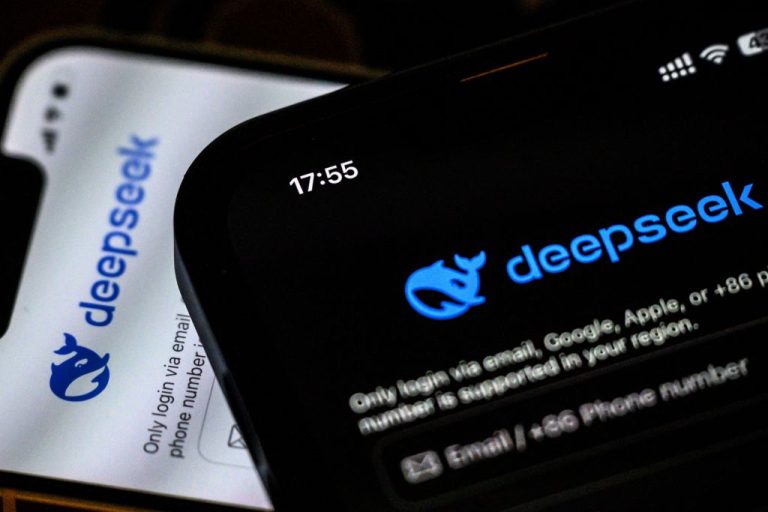
Recently, the Chinese artificial intelligence (AI) startup, DeepSeek, has been targeted by countries across the world as concerns over privacy and security arise.
DeepSeek launched its latest model, DeepSeek R1, last month, claiming to have spent $5.6 million to create it — a fraction of what the startup’s competitors spent to build their own AI models. This announcement caused share prices in U.S. tech companies to fall.
However, DeepSeek has caused a stir with some countries, mainly due to how it may bring security risks and how personal data of users will be stored by the group. This has led to attempts to ban the AI software for their respective employees.
United States
On Feb. 6, the Wall Street Journal (WSJ) reported that lawmakers in the U.S. planned to ban DeepSeek’s app from its government devices, citing Beijing’s ability to surveil populations and distribute misinformation.
Success
You are now signed up for our newsletter
Success
Check your email to complete sign up
Following the launch of DeepSeek R1, lawmakers introduced a bill called the “No DeepSeek on Government Devices Act,” which would prohibit federal employees from using the app.
This law would blacklist DeepSeek and apps made by its parent company, High-Flyer. However, there are exceptions for national security and research, which would allow federal employees to study DeepSeek.
“The Chinese Communist Party (CCP) has made it abundantly clear that it will exploit any tool at its disposal to undermine our national security, spew harmful disinformation, and collect data on Americans,” Democratic Representative Josh Gottenheimer of New Jersey — one of the lawmakers for the bill — said in a statement. “We simply can’t risk the CCP infiltrating the devices of our government officials and jeopardizing our national security.”
Gottheimer also warned that members of Congress should be informed on these surveillance capabilities and investigate them further.
Earlier, on Jan. 31, the National Aeronautics and Space Administration (NASA) banned DeepSeek from its systems and employees’ devices.
The U.S. Navy also emailed its members a warning against using DeepSeek due to “potential security and ethical concerns associated with the model’s origin and usage,” CNBC reported.
Republican Representative Darin LaHood of Illinois — the second lawmaker for the bill — said that the U.S. cannot afford to lose the “technology race with the CCP,” adding that Americans’ data must be protected.
Microsoft and OpenAI are currently investigating if OpenAI’s technology was acquired illegally by a group associated with DeepSeek, sources say.
Another bill by Republican Senator Josh Hawley — made to ban U.S. persons from advancing AI capabilities within China — could see users fined up to $1 million, while businesses would be slapped with fines up to $100 million, the Independent reported.
South Korea
South Korea has forbidden downloads of DeepSeek’s chatbot to employee devices following the group’s failure to answer an enquiry from a data watchdog investigating the usage of user information.
The chatbot was removed from local versions of the App Store and Google Play, though those who already downloaded the app prior can still use it.
In a statement, the country’s Personal Information Protection Commission claimed that DeepSeek agreed to pull downloads of its app.
“To prevent further concerns from spreading, the commission recommended that DeepSeek temporarily suspend its service while making the necessary improvements,” the commission said. DeepSeek is still given time to comply with the guidelines, but the commission added that it would “inevitably take a significant amount of time.”
Earlier this month, South Korea’s Ministry of Trade, Industry and Energy announced a temporary ban on DeepSeek for employee devices as well.
Australia
DeepSeek has also been banned from all government devices in Australia, citing national security risks as well.
In a statement by the secretary of the Department of Home Affairs, all government entities are required to “prevent the use or installation of DeepSeek products, applications and web services and where found remove all existing instances of DeepSeek products, applications and web services from all Australian Government systems and devices.”
Government departments and agencies are mandated to confirm to home affairs that DeepSeek’s app is no longer on any devices.
Home Affairs Minister Tony Burke said the ban was necessary “to protect Australia’s national security and national interest,” Australian media outlets reported.
“AI is a technology full of potential and opportunity — but the government will not hesitate to act when our agencies identify a national security risk,” Burke said.
Canada
The Canadian federal government has also banned the DeepSeek app, on the grounds of privacy concerns, Bloomberg reported.
Shared Services Canada, the agency responsible for the government’s information technology network, has already banned the app on all the devices it manages, chief information officer Dominic Rochon, said.
Rochon also warned other departments to “consider blocking the application and [DeepSeek’s] website” on their networks and devices.
Europe
Several European countries, including Ireland and France, had also questioned DeepSeek and its violations on privacy and security, having requested answers from the startup.
The Italian Data Protection Authority (Garante) declared on Jan. 30 that DeepSeek was restricted from processing Italian users’ personal data as the group did not provide clarity on how it might use it after being asked two days prior.
In the Netherlands, the independent privacy watchdog, the Dutch Data Protection Authority (AP), had issued a warning, adding that Europeans’ personal data could only be saved outside the country under conditions DeepSeek must abide by.
Taiwan
On Feb. 3, Taiwan banned its government entities from using DeepSeek’s apps, following their preexisting stance against them. This came from Taiwan’s overall suspicions of Beijing’s actions, given the hostilities between the island government and the CCP.
Taiwan Premier Cho Jung-Tai said in a cabinet meeting that the ban was made “to ensure the country’s information security.”
READ MORE:
- China’s DeepSeek AI: The Trojan Horse of CCP Censorship and Global Surveillance
- State Department Condemns CCP’s Intimidation Campaign Against Shen Yun
- Confusion Over Hong Kong-China Packages as US Postal Service Reverses Ban
Why is DeepSeek being banned?
DeepSeek’s privacy policy states that the data collected from users include:
- Personal information such as email, phone number, password and date of birth; all required to register for the app,
- Chat history, including text or audio input by users,
- Technical information of the user’s device and network, like IP address, keystroke patterns and operating system.
All this information would then be shared to service providers and advertising partners, keeping it “as long as necessary,” the company’s website claims.
Citing a report by Ivan Tsarynny, CEO of cybersecurity firm, Feroot Security — based in Ontario — ABC News reported that DeepSeek “has code hidden in its programming which has the built-in capability to send user data directly to the Chinese government.”
Tsarynny also informed ABC that the DeepSeek app has the ability to transmit user data to “CMPassport.com, the online registry for China Mobile, a telecommunications company owned and operated by the Chinese government.”
Though fears of user data being exploited by other AI companies are not uncommon, Eddy Borges-Rey, associate professor at Northwestern University in Qatar, told al-Jazeera that Chinese platforms like DeepSeek are “treated differently” since they are claimed to be conducted under Beijing’s jurisdiction, allowing China “state access to corporate data.”
“Western governments fear that user data collected by Chinese platforms could be used for espionage, influence operations or surveillance. Whether this is happening in practice is debatable, but the mere possibility is enough to justify the bans from a national security perspective.”
On the other hand, Western companies would not be seen as threatening; just problems that could be fixed without much scrutiny compared to Chinese ones, Borges-Rey claims.