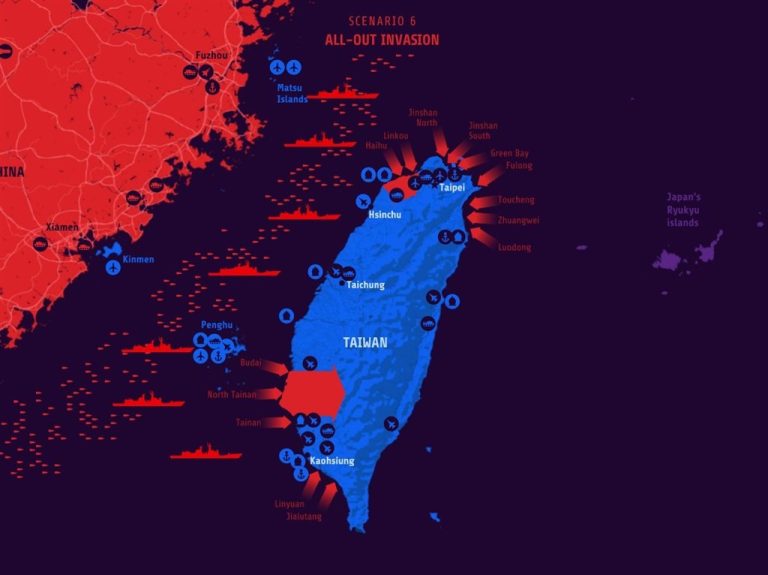
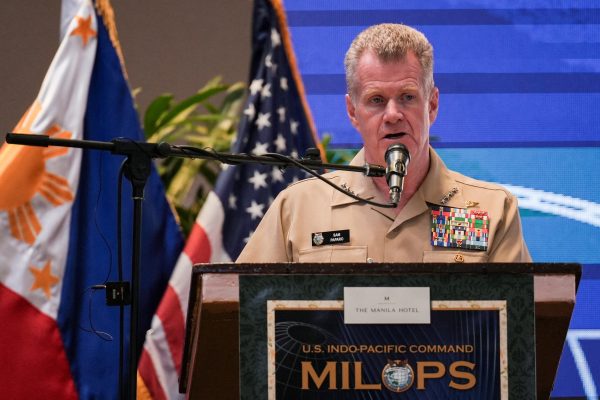
U.S. Indo-Pacific Commander Admiral Samuel Paparo recently told the Senate that should war break out over Taiwan, it would devastate the Asian economy, lead to nuclear proliferation, and cause around half a million “deaths of despair.”
As reported by USNI News (United States Naval Institute), Admiral Paparo told the Senate Armed Services Committee on Thursday, April 10 that a blockade of the Taiwan Strait, a vital global trade route, could cause economic damage even more severe than the Great Depression of the 1930s. He emphasized that the U.S. heavily relies on Taiwan’s semiconductor production, which is critical to U.S. economic modernization and growth.
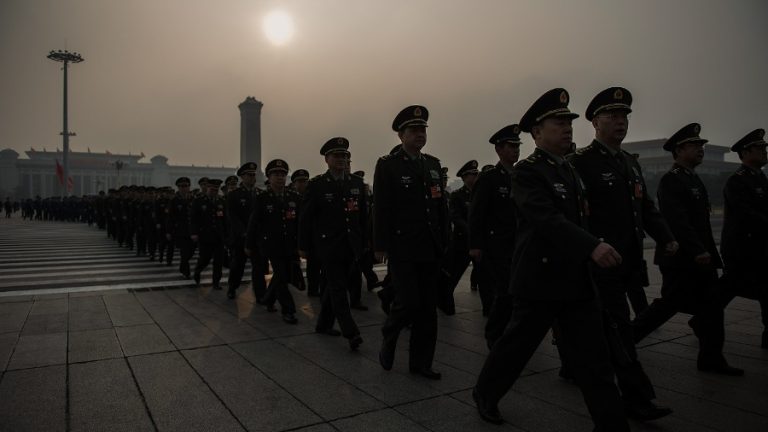
Paparo had previously emphasized that Beijing had increased military operations around Taiwan by 300 percent, adding that these were “not exercises but rehearsals” for a potential military invasion.
- Taiwan Expels Mainland Chinese Influencer Wives for Advocating Communist Invasion
- Removing Line on Not Supporting ‘Taiwan Independence,’ US State Department Takes Jab at Beijing’s ‘One-China Principle’
According to Paparo, a regional conflict could result in a 25-percent drop in Asian GDP, 10-12 percent of the U.S. GDP, 7 to 10 percent of American employment, and 500,00 deaths.
The communist People’s Republic of China (PRC), claims Taiwan, a de facto independent country, as part of its sovereign territory. The dispute arises from the founding of the PRC in 1949, which saw the communists take over the Chinese mainland but leave the island of Taiwan under the control of the U.S.-aligned Republic of China (ROC).
Success
You are now signed up for our newsletter
Success
Check your email to complete sign up
While a successful U.S. intervention against a PRC invasion of Taiwan would reduce losses in the conflict, the damage and human toll would still be immense, Paparo said.
Further, while staunch U.S. allies like Japan and South Korea would likely double down in defending against Chinese aggression, the hypothetical war could cause other countries to pivot towards Beijing.
Both Paparo and General Xavier Brunson, Commander of U.S. Forces Korea, stated that if the U.S. reduces its military involvement on the Korean Peninsula, in Northeast Asia, or around Taiwan, Japan and South Korea might consider producing and deploying nuclear weapons of their own.
Paparo and Brunson emphasized that if U.S. troop levels in South Korea fall below 28,000, North Korea may see an opportunity to invade, and U.S. forces may no longer be able to deter North Korea or prevent actions by Russia or China in the region. They stressed that Seoul’s contributions to Indo-Pacific security extend beyond the Korean Peninsula, and that North Korea’s military strength necessitates strong deterrence.
Paparo also called for enhancing capabilities in cyber, space, anti-space, and long-range strike operations across the Indo-Pacific. He noted that the U.S. Navy lacks adequate amphibious fleet resources and readiness, and that many ships are in poor condition. A pilot program to boost naval readiness will launch this year, with a goal of ensuring 80 percent of the U.S. Navy’s surface ships, submarines, and aircraft are combat-ready, to prevent the CCP from exploiting American vulnerabilities.
The admiral also advocated continuing the mission of USAID, the agency that promotes American soft power around the world. Paparo said that the Trump administration’s moves to downsize or eliminate the organization as a cost-cutting measure would ultimately benefit Beijing, which “would seize” the opening to spread its own global influence.
Taiwan officials: Stability in the east tied to US core interests
Taiwan’s Minister of National Defense Wellington Koo Li-hsiung said April 15 that Paparo’s statements underscores how prosperity and stability in the Indo-Pacific region are core U.S. interests, as reported by the World Journal, an overseas Chinese-language newspaper.
Maintaining the status quo in the Taiwan Strait is now a widely recognized global objective.
Citing a recent memorandum by U.S. Secretary of Defense Pete Hegseth, Koo said that it was impossible for Washington to stand by and allow Communist China to annex Taiwan.
The secret memo “focuses on deterring China’s seizure of Taiwan” while bolstering America’s own defenses, as reported March 29 by The Washington Post.
According to Taiwan’s Central News Agency (CNA), Cho Jung-tai, premier of the ROC Executive Yuan, led heads of various ministries to the Legislative Yuan on April 15 to deliver a policy report and take questions. Defense Minister Koo made the above remarks during a pre-session interview. Cho, who works with Taiwan’s president Lai Ching-te, is head of the ROC government.
Koo added that strengthening Taiwan’s self-defense and cooperation with allied nations are effective means of deterring Beijing’s potential aggression, and that these actions align with the shared core interests and common strategies of both the ROC and U.S.