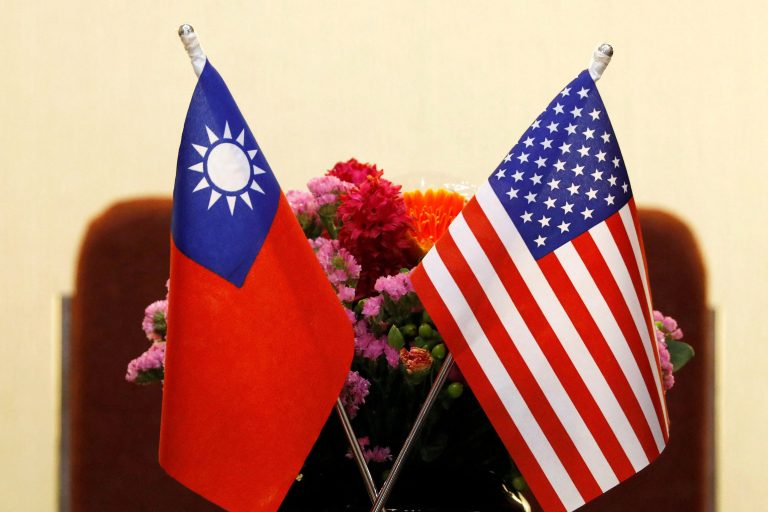
The U.S. Department of State has removed wording on its official website disavowing America’s non-support for Taiwan independence, a roundabout rebuke of Communist China’s claim to sovereignty over the island of 23 million people.
Like most other countries, the U.S. has no formal relations with Taiwan, but recognizes its passport holders and maintains unofficial diplomacy with its government.
The new wording on the State Department’s page, entitled “U.S. Relations With Taiwan,” continues to maintain America’s “one China policy,” which opposes attempts by either mainland China or Taiwan to unilaterally change the status quo.
In addition, the page adds language calling for greater Taiwanese participation in international organizations “where applicable,” as well as deepening defense cooperation with Taipei. The U.S. is bound by law to aid Taiwan in its ability to defend itself.
The Communist Chinese foreign ministry has rebuked the State Department for the revisions. In a press conference on Feb. 17, Beijing’s foreign ministry spokesman Guo Jiakun (郭嘉昆) called upon the U.S. to “rectify its mistakes,” calling the changes a “big step backwards” that send “a seriously wrong message to Taiwan independence separatist forces.”
Taiwan’s international status
Success
You are now signed up for our newsletter
Success
Check your email to complete sign up
Despite being a de facto independent state, Taiwan’s sovereign status is complicated by history. It is officially governed as the Republic of China (ROC), which ran all of China and was an ally of the U.S. fighting Japan in World War II. But the ROC was defeated in the subsequent civil war with the communists, who in 1949 established the People’s Republic of China (PRC) while the ROC government retreated to Taiwan, which lies 100 miles off the mainland Chinese coast.
In the 1970s, the United Nations stopped recognizing the ROC and turned its seat over to the PRC, leaving Taiwan’s sovereignty undecided. In order to maintain relations with mainland China, which maintains that Taiwan belongs to the PRC, the U.S. and almost all other countries have adopted varying versions of the “one-China” policy, whereby they do not officially recognize the ROC government or an independent Taiwan.
The Chinese Communist Party (CCP) regards these “one-China” protocols as recognition of its “one-China principle,” which in fact differs in that it explicitly spells out Taiwan as belonging to the PRC.
Another important dimension to the matter is that of Taiwan’s national identity — in recent decades more and more Taiwanese have come to see themselves as separate from China. This has been the position of the Democratic Progressive Party (DPP), Taiwan’s ruling party for the last nine years, though its leaders say there is no need to formally declare independence since Taiwan, as the Republic of China, is already an independent country.
Communist China has not renounced the use for military force to “reunify” Taiwan with the PRC, and frequently sends naval and aerial sorties to harass the island and probe its defenses.