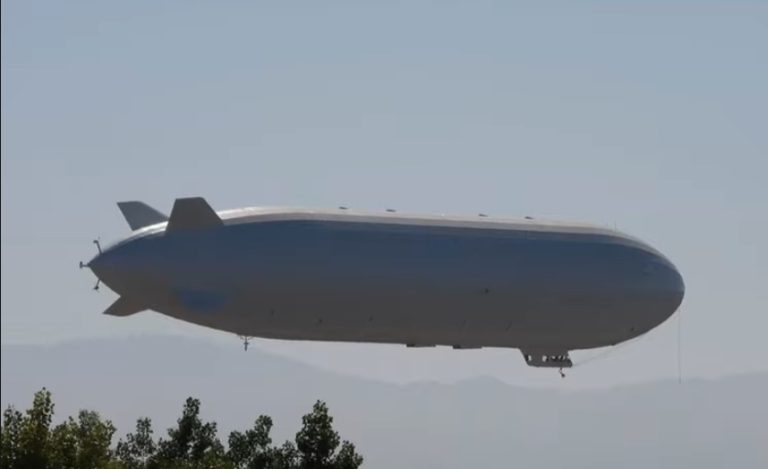
In late 2023 a prototype airship, the Pathfinder 1, developed by LTA Research was quietly revealed to the public when it rolled out of Hanger 2 at NASA’s Moffett Field in California. This was the first time the 408-foot-long rigid airship — funded by billionaire and Google co-founder Sergey Brin —was seen outside its hanger.
On the eve of the unveiling, LTA CEO Alan Weston told TechCrunch, “It’s been 10 years of blood sweat and tears. Now we must show that this can reliably fly in real-world conditions. And we’re going to do that.”
Brin’s brainchild was developed to address a number of issues, most notably humanitarian logistics and sustainable transportation.
He was reportedly inspired by the logistical challenges of delivering aid to remote or disaster stricken areas. Traditional aircraft and vehicles often struggle with rough terrain, or during natural disasters, destroyed infrastructure. The idea is that airships like the Pathfinder 1 can hover, land vertically, and reach isolated regions without needing runways. They can also carry thousands of tons of cargo for easy distribution to the front lines of a disaster.
In addition, unlike traditional aircraft, the Pathfinder 1 runs entirely on electric motors, powered by batteries, and uses non-flammable helium for lift. It’s constructed of lightweight, modern materials. Brin believes this is a way to significantly lower emissions for both human and cargo transport.
Success
You are now signed up for our newsletter
Success
Check your email to complete sign up
While he admits that airships like the Pathfinder 1 will not replace most modern forms of flight, they could serve a role in lowering emissions and fill logistical gaps.
Brin, funded the project through LTA Research, rather than through Google or Alphabet. This aligns with his philanthropic interests and long-standing curiosity about alternative technologies. He reportedly views the project as a low-profile moonshot: high-risk, high-reward.
As of May 2025 the Pathfinder 1 continues to undergo rigorous flight testing, including extended flights over the San Francisco Bay area. The tests aim to validate its performance and safety features, paving the way for future applications in sustainable cargo transport and humanitarian missions.
RELATED:
Technical specs
The Pathfinder 1 is a one-of-a-kind vehicle and the first of its kind since the 1930s. At 408 feet (124 meters) in length, it is the largest human made object ever to fly.
Its height is 66 feet (20 meters) with a diameter of 66 feet at its widest point. When in flight, it can contain as much as 14,000 cubic meters of helium which it uses for lift.
Earlier airships, like the ill fated Hindenburg, used highly volatile hydrogen for lift.
For propulsion, the airship uses 12 electric motors, affixed to propellers to aid in lift and manoeuvring, all powered by state-of-the-art lithium-ion batteries.
It can reach a maximum speed of around 70 mph (112 km/h) and can stay aloft for days if necessary and operates below 1,500 feet or around 457 meters.
In comparison, the Airlander 10, developed by UK-based Hybrid Air Vehicles (HAV) measures just over 298 feet (91 meters) in length, ~111 feet (34 meters) in width and ~85 feet (26 meters) high.
A hybrid vehicle, it’s powered by four 350 hp 4-liter supercharged V8 diesel engines with plans to replace two of its engines with 500 kW electric motors this year. The company aims for full electric propulsion by the end of the decade.
The Airlander 10 can fly at significantly higher altitudes than the Pathfinder 1, 20,000 feet, and can stay aloft for five days with crew and upwards of two weeks while unmanned.
READ MORE:
The case for airships
The case for airships — especially in the modern era — centers on efficiency, versatility, and sustainability. With recent advancements in materials, propulsion, and automation, airships are finding new relevance in a range of industries.
Because airships rely on buoyant lift rather than thrust, they use much less fuel than traditional airplanes or helicopters and they are ideal candidates for hybrid-electric ships like the Airlander 10 or fully electric propulsion like the Pathfinder 1.
By some estimates, for short-haul or regional cargo and passenger transportation, airships could cut carbon emissions by up to 90 percent.
Since airships do not require runways, can land in open fields, on water or hover to lower cargo, they are ideal vehicles to access remote or disaster stricken areas.
Airships are also being explored as possible solutions for surveillance and communication challenges in underdeveloped regions.
While slower than jets, they are much cheaper to operate due to how little fuel they use, and are ideal to distribute heavy, bulky and non-urgent cargo. They can carry everything from disaster supplies to modular housing.
Their ability to hover in areas for multiple days makes them great for patrolling borders, detecting forest fires and operating as high-altitude pseudo-satellites.
And of course, with the ability to carry upwards of 100 people, they are perfect for tourism and luxury travel. The Airlander 10 for example aims to turn airships into luxury cruise alternatives, with high-end cabins and glass floors.
READ MORE:
Key challenges
Despite their promise, modern airships still face several significant obstacles to widespread adoption.
First is their slow speed.
The Pathfinder 1 has a top airspeed of 70 mph. If passengers or cargo need to get somewhere fast, the Pathfinder 1 is not the solution. A Boeing 737 for example can reach speeds of up to 530 mph (850 km/h).
In a world where air freight thrives on speed, and where even slow cargo ships would beat airships due to established infrastructure, airships come up short and no amount of engineering will be able to solve the issue.
Large container ships are more efficient and consistent for long-distance global cargo transport. Airships may be faster point-to-point in some scenarios or under specific constraints, but they are not a replacement in terms of raw speed or capacity for ocean freight.
In commercial aviation a few hours delay means the difference between profit and loss, so airships, while irreplaceable in some scenarios, will struggle to compete in established markets.
Airships are also extremely vulnerable to wind, turbulence, and storms due to their large surface area and low density. While modern stabilisation systems are helping, airships are still far more weather-sensitive than heavier or traditional aircraft.
During landing or takeoff, airships are susceptible to strong crosswinds and their large profile makes hanger storage and ground handling complicated, particularly in storm-prone regions.
Limited windows of favorable weather often limits an airship’s ability to be deployed in the real-world.
For widespread adoption, airships would likely need better forecasting, automated piloting, and smart ballast control to navigate unpredictable conditions.
However, widespread adoption is not the goal of many airship producers including LTA Research, who instead are focusing on specific use cases like disaster relief and the delivery of non-urgent bulk cargo to remote regions.
READ MORE:
Regulatory ambiguity
Since airships are such unique vehicles — not quite airplanes or helicopters, and not traditional lighter-than-air craft like hot air balloons — they are often shoehorned into outdated or mismatched categories, resulting in regulatory uncertainty that stifles both innovation and their deployment.
Developers of modern airships face compliance problems that can make or break a project before it even gets off the ground.
Most countries base their aircraft certification systems on either the FAA (U.S.) or EASA (Europe) models, which primary cover fixed-wing aircraft and rotorcraft ike helicopters.
Currently, there are no unified standards for certifying modern airships that use advanced materials, electric propulsion, or autonomous controls.
Companies, like LTA Research need to negotiate one-off certifications, adding time, complexity and more risk to projects.
In addition, since airships fly much, much slower than traditional aircraft, and at far lower altitudes, air traffic control systems are not designed to integrate them with faster commercial traffic.
For flights, temporary airspace restrictions may be needed, especially during test flights and in congested areas like the U.S. East Coast or central Europe, where airships may be denied the ability to even take off to begin with.
Finding and training pilots and crew for airships also remains a significant hurdle to their deployment since there is a lack of certified airship training programs and no clear standards exist for autonomous or remotely piloted airships, which could be critical to scaling the industry.
Add to this ambiguous air traffic control protocols, and a patchwork of global rules, airships continue to face significant hurdles preventing their mass adoption and even regular flights.
RELATED:
What’s next for LTA and Pathfinder?
Currently, LTA Research’s Pathfinder 1 airship is undergoing a series of test flights out of Moffett Field, to test the craft’s systems, handling and performance. The Federal Aviation Administration (FAA) has granted LTA Research a special airworthiness certificate, allowing up to 50 flights at altitudes not exceeding 1,500 feet within a designated airspace around Moffett Field and Palo Alto Airport.
The testing program involves both indoor and outdoor flights.
Initial tests were conducted indoors, with a focus on structural integrity and systems functionality and outdoor tests have been conducted to assess the craft’s response to various environmental conditions.
Future flights over the San Francisco Bay area are booked to test the airship’s capabilities in diverse environments.
Building on the success of Pathfinder 1, LTA Research is currently developing Pathfinder 3, an even larger and more capable airship. Construction is underway at the Goodyear Airdock in Akron, Ohio, which LTA Research acquired specifically for this purpose.
The Pathfinder 3 will measure approximately 590 feet (190 meters) long with a payload capacity of up to 96 metric tons and a range of around 9,940 miles (16,000 kilometers).