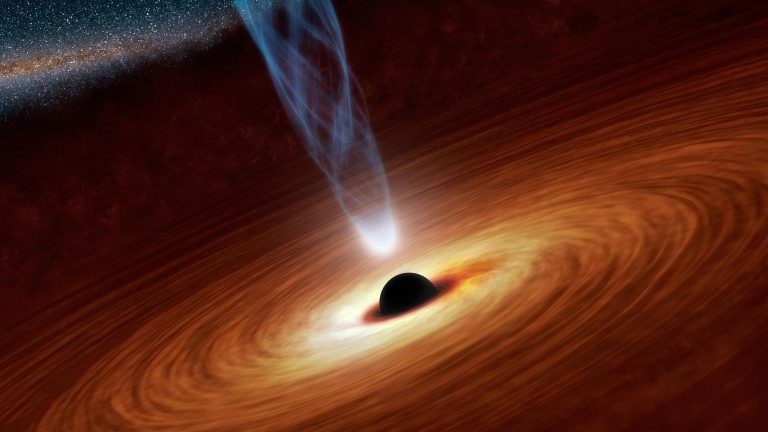
A group of researchers at the University of Southampton have claimed that they have successfully created a “toy model” of a theorized “black hol1e bomb” in a laboratory setting, Live Science is reporting.
A “black hole bomb” was first theorized in the 1970s by physicists Roger Penrose and Yakov Zel’dovich and involves boosting the energy of a black hole and trapping it with mirrors until an explosion occurs.
The concept was explored further by William Press and Saul Teukolsky in 1972.
The researchers from the University of Southampton harnessed what is called the “Zel’dovich effect” to simulate the conditions around a black hole.
Using a rotating aluminum cylinder surrounded by three layers of metal coils the researchers managed to get their intended outcome, creating a mini black hole in a laboratory setting.
Success
You are now signed up for our newsletter
Success
Check your email to complete sign up
The experiment is detailed in a March 31 draft paper available on the arXiv preprint server and is awaiting peer review.
Hendrik Ulbricht, a co-author of the research and University of Southampton physics professor, demonstrated how energy can be extracted and amplified through a positive feedback cycle.
They discovered that as the cylinder rotated faster than the magnetic fields it produced, there was an increase in energy of the field which inturn amplified the magnetic signal.
“Our work brings this prediction fully into the lab, demonstrating not only amplification but also the transition to instability and spontaneous wave generation,” Maria Chiara Braidotti, one of the researchers involved in the study, told Live Science.
READ MORE:
- Residents of Xi’an Spot Swirling ‘Dragon’ UFO During Heavy Thunderstorm
- US House Names China’s DeepSeek a Security Threat, Investigates Chip Origins
- Shanghai’s Population Crisis Deepens Amid Migrant Exodus, Dwindling Birth Rates
The Zel’dovich effect
The Zel’dovich effect is a theoretical phenomenon where waves, like light or sound, gain energy by scattering off a rotating object, potentially leading to amplification or even a runaway energy build up—like a “black hole bomb” in extreme cases.
The researchers managed to exploit this effect when coils around the system acted as reflectors, producing the intended feedback loop that trapped and amplified the energy. This resulted in an enhanced magnetic signal, successfully simulating the explosive energy release first theorized by Zel’dovich.
While the experiment was completely harmless, it allowed researchers a rare opportunity to study superradiance as it happened.
Superradiance is a process where waves — such as light, sound, or quantum fields — extract energy from a rotating object, becoming stronger after scattering off it.
The research will also allow scientists the opportunity to test theories involving exotic fields, including ones thought to be related to the ever elusive dark matter.
In their findings the researchers wrote, “This system directly meets the conditions predicted by Zel’dovich in 1971 and developed into the black hole bomb by Press and Teukolsk.”
The experiment simulates the energy gain that occurs in the ergosphere of a black hole, where objects can tap into its rotation, helping scientists study how black holes twist and accelerate the fabric of space-time.
“Although direct observation of black holes is not possible, it may be possible to learn more about the nature of black holes, one of the universe’s most extreme structures, through such experimental analogs,” the research team wrote.