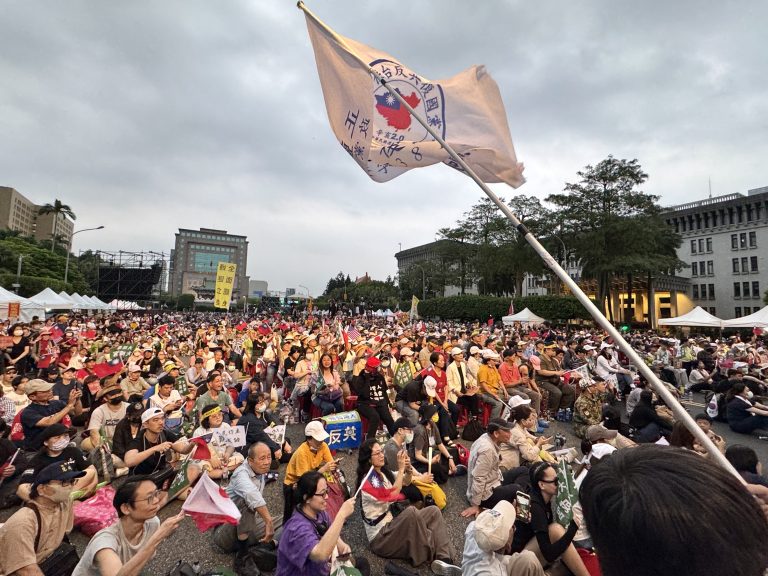
As of preliminary estimates taken on May 9, around 1.3 million Taiwanese have given their signatures in an ongoing effort to arrange recall elections of legislators alleged to be aligned with Communist China.
Taiwan’s current president is Lai Ching-te of the Democratic Progressive Party (DPP), which advocates tougher policies to safeguard Taiwan against Beijing’s ambitions for taking over the island of 23 million.
Meanwhile, the opposition Kuomintang (KMT and Taiwan People’s Party (TPP), forming the “blue-white coalition,” enjoy a majority in Taiwan’s parliament, the Legislative Yuan, and have been using their influence to freeze defense spending, block bills aims at curbing mainland Chinese subversion, and reduce the authority of the executive branch.
- Taiwan Expels Mainland Chinese Influencer Wives for Advocating Communist Invasion
- War Over Taiwan Would Cause 500,000 Deaths, Economic Devastation, US Admiral Paparo Says
These developments have led to major protests from the Taiwanese public since May 2024, culminating in a mass recall effort to remove dozens of opposition legislators beginning this January.
At the time of writing, recall efforts for 28 of the 35 legislators targeted among the “blue-white” coalition have passed the second round of signature collection, and have been submitted to the Taiwanese election commission.
Success
You are now signed up for our newsletter
Success
Check your email to complete sign up
Meanwhile, groups supporting the KMT and DPP have begun their own recall drives, targeting 15 in the “pan-Green” camp, referring to the DPP and its allies. However, none of these petitions has gained the required proportion of signatures (25 percent of constituent voters) to be sent to the election authorities.
The KMT, or Nationalist Party, originally governed the Republic of China (ROC), fighting and losing a decades-long civil war with the Chinese communist movement. In 1949, the KMT was driven off mainland China, and relocated the ROC government to Taiwan, which lies about 100 miles off the coastal province of Fujian.
- Fragile Calm Settles Over India-Pakistan Border After Intense Clashes
- Exposed CCP Espionage Ring at Stanford Unveils Deep Infiltration of US Academia
In modern times, the KMT has shifted to adopt a Beijing-friendly stance, with many legislators going so far as to visit mainland China and meet with top Chinese Communist Party (CCP) officials.
This has led many Taiwanese activists, such as businessman Robert Tsao Hsing-cheng, to deride the targetted legislators as being directly in league with the CCP.
Speaking at a May 3 rally in northern Taiwan where Tsao was also present, DPP legislator Puma Shen stressed that the mass recall effort was not directed at the Kuomintang in particular, but pushing back against the “pro-communist” lawmakers threatening Taiwan’s democratic system.