Recently unearthed excerpts from “Yang Shangkun’s Diary” shed new light on private conversations between former Chinese Communist Party (CCP) General Secretary Hu Yaobang and state leader Yang Shangkun in 1988. Over several meetings, Hu reportedly spoke with rare candor about his regrets, his disillusionment with Deng Xiaoping, and the hidden truths behind key political events of the 1970s and 1980s.
Between July 13 and Aug. 24, 1988, Yang Shangkun visited Hu Yaobang six times, each meeting lasting about five hours. The following are excerpts from “Yang Shangkun’s Diary” recounting those conversations, in which Hu reportedly spoke candidly about his regrets and revealed explosive details about major historical events.
July 14, 1988
“Yaobang told me he did not expect Comrade Deng Xiaoping to be so overbearing, intolerant of any dissenting opinions. He even conducted a ‘curtain-rule’ of sorts. He deeply regretted using underhanded tactics to overthrow Hua Guofeng and support Deng Xiaoping. Yaobang said the ‘Democracy Wall’ at Xidan was set up under Deng Xiaoping’s instigation, with the goal of discrediting Hua Guofeng and putting Deng in power. But unexpectedly, after Deng came to power, he shut down the Democracy Wall and imprisoned Wei Jingsheng.”
July 19, 1988
“Yaobang told me that the April Fifth (1976) incident was also instigated by Deng Xiaoping. He had already discussed the details of the April Fifth incident twice, in March and April 1988, with the writer Shi Dongbing in secret meetings at home, hidden even from family and secretaries.
Yaobang recounted —
Success
You are now signed up for our newsletter
Success
Check your email to complete sign up
On Jan. 15, 1976, after Deng Xiaoping delivered his eulogy at Premier Zhou Enlai’s memorial, he approached me and said: ‘Today I delivered the eulogy for the Premier. Perhaps after our deaths, no one will deliver eulogies for us. We cannot just sit by; we need to take action.’ In mid-March, Deng approached me again, saying his child had heard that during the Qingming Festival on April 5, someone planned to lay a wreath for the Premier at Tiananmen.
‘This is a good opportunity,’ he said, ‘we must find a way to escalate the situation, to give the Chairman a shock, and show that not everyone obeys him.’ Yaobang added that Deng asked him to recruit some children of cadres to go among workers to stir them up, aiming the criticism at Jiang Qing and Zhang Chunqiao. But unexpectedly, some people turned the criticism toward the Chairman himself.
Yaobang further recalled that the protesters engaged in smashing, looting, and assaults, injuring many PLA soldiers. Deng was later very angry, believing it directly triggered his removal from office. This is also why the April Fifth incident was not later officially rehabilitated in a high-profile way. If those few individuals had not targeted the Chairman or engaged in violence, the Chairman would not have removed Deng from office, and Deng could have countered Jiang Qing and Zhang Chunqiao during the Politburo meeting.”
April 5, 1976
“Deng Xiaoping specifically took a car to Tiananmen Square to observe the situation there. When he returned, he told me through his family that there were many people in the square and that it was ‘well done!’ However, he falsely claimed that he had gone to the Beijing Hotel for a haircut. In reality, Deng Xiaoping always had the hotel’s barber come to his home.”
August 5, 1988
“I met with Yaobang again. Yaobang said that Deng is the type of person who ‘crosses the river and then destroys the bridge’ — you must be careful. At the same time, Yaobang revealed a major matter to me, saying it was the most shameful event he had witnessed, and that failing to disclose it would betray his conscience.”
April 1980
“At that time, under the pretext of purging the ‘three kinds of people,’ we lured 24 officials from the Beijing Public Security Bureau, ranging from section-level to division-level, to Dali in Yunnan and secretly executed them. Wang Zhen was even sent to the site to observe. I asked, ‘Why secretly execute them? What crimes did they commit?’ Yaobang said they had evidence proving that Deng Xiaoping and I were the masterminds behind the April Fifth Incident of 1976.
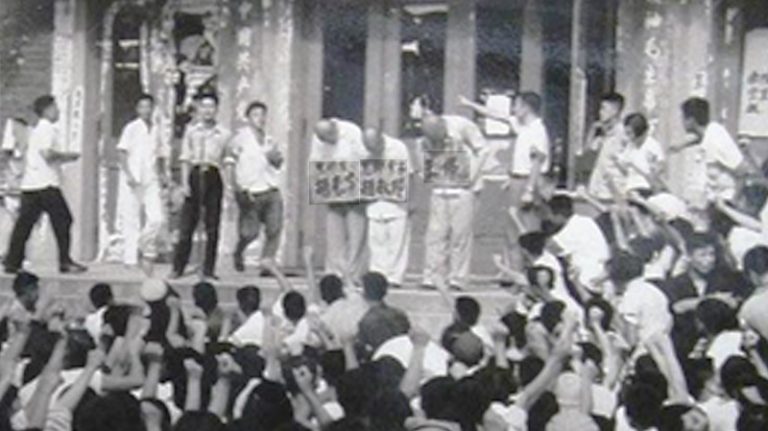
He went on to say that some people also had evidence linking Deng Rong and other high-level cadres to the killing of Bian Zhongyun, the vice principal of Beijing Normal University Affiliated Girls’ High School, on August 5, 1966. Others possessed evidence that members of the same network had killed large numbers of so-called ‘black five categories’ in Daxing County, Beijing, in August 1966. I said, ‘I know about this case — weren’t the main perpetrators, Gao Fuxing and Hu Defu, already sentenced?’ Yaobang replied, ‘Yes, but in September 1975, Gao Fuxing and Hu Defu suddenly recanted, claiming that it had been the network members’ doing. They were innocent. But by that time, Deng Xiaoping was already a Politburo Standing Committee member and suppressed the matter.’
In 1983, Deng instructed me to rehabilitate Gao Fuxing and Hu Defu, which I did. However, several officials in the Beijing Public Security Bureau secretly informed the families of the ‘black five categories’ about this, leading the families to protest and oppose the rehabilitation. Deng was furious and instructed me to secretly execute these Beijing Public Security officials as part of the ‘three kinds of people.’ I was shocked and said, ‘We are now talking about rule of law — how can we arbitrarily kill people like this? Even the Gang of Four didn’t do this.’ Yaobang said, ‘That’s why I feel guilty in my heart.’ Nevertheless, he had already instructed that the 24 officials be treated as having died in the line of duty and provided compensation to their families. Five of the officials were also posthumously honored as martyrs.”
August 6, 1988
“Yaobang said there was another matter he deeply regretted: whenever the public wrote letters criticizing Deng Xiaoping, he would hand them over to the Public Security Bureau for strict investigation and require that the investigation results be reported to him. As a result, over 300 people were sentenced, and more than 60 committed suicide.”