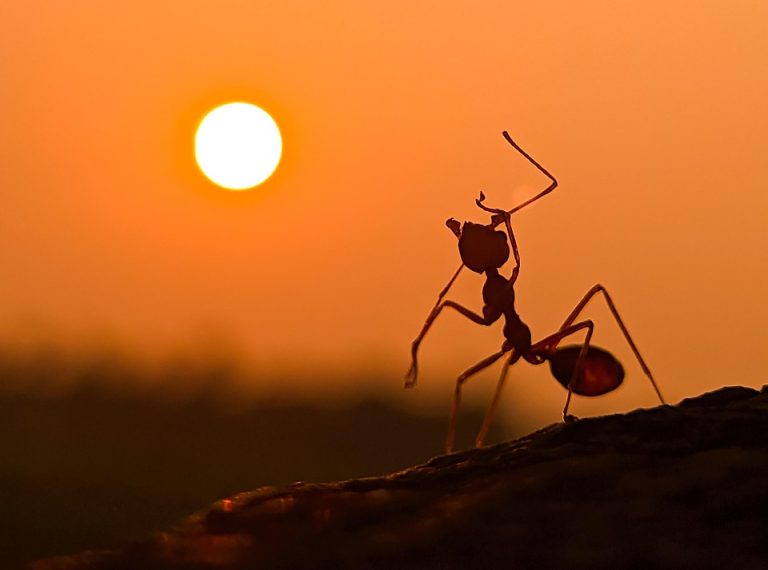
It is well-known that ants, in colonies ranging from a few dozen individuals up to hundreds of millions, work together to carry food they’ve hunted or gathered from long distances; but did you know they were also advanced in agriculture? For millions of years, ants have not only been growing their own produce, but also tending livestock!
Early ingenuity – how ants mastered agriculture
In 2016, Ted Schultz, curator of ants at Smithsonian’s National Museum of National History, co-authored a study on attine ants, revealing they have been practicing agriculture far longer than previously thought.
Attine ants, renowned for farming on a scale comparable to humans, cultivate intricate fungus gardens through specialized labor. With 210 species of attine ants, including 47 species of leafcutters in Central and South America, these ants tear up and carry leaves and vegetation back to their colonies. But they don’t eat them right away. Instead, they use them as a “growth medium” for edible fungi.
These cultivated fungi have adapted to growing in the dry, underground environment of the colony. Like many human crops, they are now entirely dependent on the ants for survival and growth.
“That’s like a lot of our crops,” Schultz said. “We cultivate things that are so highly modified that they exist in forms no longer found in the wild.”
Success
You are now signed up for our newsletter
Success
Check your email to complete sign up
By analyzing genetic data from 276 ant species and 475 fungal species, Schultz and his colleagues built evolutionary trees for both. This led to not only the discovery of the relationship between the organisms, but also when it began.

They deduced that ant farming began around 65 million years ago, precisely when the asteroid that is believed to have wiped out the dinosaurs struck. Schultz called this timing “beyond coincidental.”
The theory suggests the rise in fungi — feeding on decomposing materials post-impact — allowed ancestral ants to survive the extinction event. The ants secured their food source by feeding the fungi poisonous leaves, overcoming the fungi’s natural chemical defenses.
This early partnership deepened; the ants cultivated, spread, and protected the fungi. This, over time, caused the ants to lose the ability to produce the amino acid called arginine. While they could get arginine from hunting or gathering other foods, attine ants are now entirely dependent on their fungal crops for it.
Fungi farming ensures ant colonies have a consistent food surplus, eliminating the risk associated with fluctuating prey from hunting. However, this absolute dependency is also a huge risk. If the fungal crop is suddenly lost, the ants would starve, since such specialized strains no longer exist in the wild, and the ants are not adapted to other strains.
For now, however, the ants are doing great. Millions of years of thriving success speaks for itself: their farming methods are exceptionally effective.

Animal husbandry
Aside from fungus farmers, there are other species of ants that practice animal husbandry, on a miniature scale.
Aphids are small, weak insects that reproduce rapidly and feed on various plants, often ruining crops and spreading disease; they can be a serious agricultural pest — for man. Yet some ants have found a use for them, and established a mutual relationship whereby they get food for protecting the meek creatures.
Aphids consume nutrient-poor plant sap to extract proteins from the sugary lipids. The excess sugar and water are excreted as a sweet, sticky liquid called honeydew; a substance ants find irresistible. Ants manage aphid colonies like livestock for a steady source of this lovely treat.
And the aphids? They receive reliable protection from natural predators like ladybugs and lacewings. Ant farmers also maintain colony health by removing sick and dead aphids.
We have long known that ants produce pheromone trails through their feet, allowing them to communicate important information about resources; but a study by the Royal College of London showed that some of these chemicals are specifically used to control aphids.
Certain pheromones calm the aphids, making them more docile for ants to subdue them. In order to cement their captivity, ants bite the wings off mature aphids. Thus, when they need to relocate, ants may be seen carrying their aphids to another plant.
Another study published in the BMC Evolutionary Biology Journal reads that the yellow meadow ant actually practices animal husbandry, rounding up healthy root aphids for production and selective breeding. While most aphids excrete honeydew as waste, these aphids have a uniquely modified “trophobiotic organ” which stores the honeydew until it is removed by a worker ant — much like milking a cow! When yields go down, the aphid is eaten for protein.
We humans have struggled with farming for 10,000 years, often fighting nature with new technologies, genetic modification and chemicals. Maybe it’s time we take a leaf out of the ant’s Farmers Almanac and simplify agriculture, embracing more symbiotic relationships with what the Creator has provided.