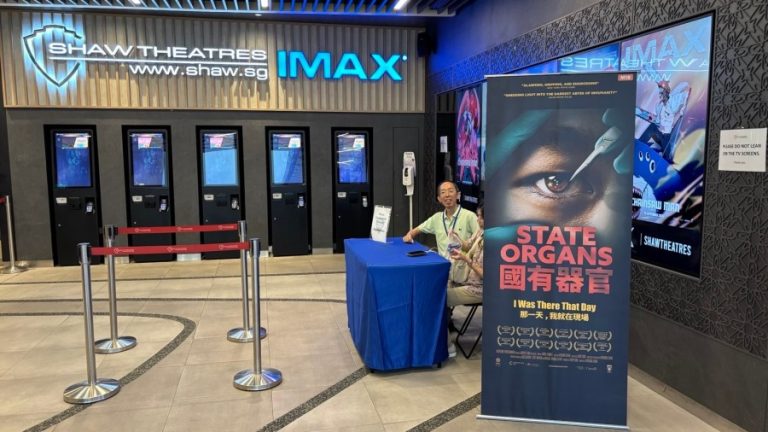
The award-winning documentary “State Organs,” which took several years to produce, had a special screening in Singapore on Thursday, Sept. 25, at Shaw Theatres. The film explores the unconventional nature of the donor sources in mainland China’s organ transplant industry and the industry of profiteering from the forced organ harvesting of living people.
After the screening, a female audience member, who did not want to be named, said, “It’s cruel.” The middle-aged woman, who had stayed in mainland China for a period of time and had heard of live organ harvesting, said she had no idea the organs were being harvested from Falun Gong practitioners. Another interviewee, Ms. Zhang, said, “It’s very sad. I already knew about the atrocities of live organ harvesting, but it was still shocking to see.”
Solid evidence of the crime
The film features testimony from witnesses of live organ harvesting in March 2006, as well as testimony from armed police officers who stood guard during the organ harvesting operations. It also features interviews with international human rights lawyers David Matas, Clive Ansley, and Zhu Wanqi, the World Organization to Investigate the Persecution of Falun Gong, the International Transplant Care Association, and Falun Gong practitioners who were nearly subjected to live organ harvesting. The film also presents several intriguing statistics:
- Hospitals in mainland China capable of performing liver transplants increased from 19 cases before 1999 to over 500 cases in 2006
- Number of liver transplants in China increased by more than 180x, from 10 cases each year between 1991 and 1998 to 1,760 cases per year from 1999 to 2006
- Average wait time for liver and kidney transplants was 2-3 years in the United States, and 1-2 weeks in mainland China after 1999
- Organ donation: The U.S. Department of Health and Human Services reported that in 2007, there were 120 million donors in the United States. In China, as of December 2015, the Chinese Red Cross Shanghai had only five organ donations throughout the entire year, and its Beijing organ donation system was not yet operational
One interviewee, Catherine said, “This movie will inspire people to think.” She said she might search online when she has time to learn more.
Regarding the reliability of the evidence presented in the film, a representative of the organizer Mr. Lim said, “The evidence presented in the film has actually been reviewed by the UK-based independent tribunal, the China Tribunal. You can learn more about it on the China Tribunal website.” The China Tribunal is an independent private tribunal established by the International Coalition on Transplant Abuse in China (ETAC) and headquartered in London. The website is: https://chinatribunal.com/
Success
You are now signed up for our newsletter
Success
Check your email to complete sign up
Another audience member, Sibagamy, had no doubts about the film’s content. She was familiar with films about illegal organ transplants, but “State Organs” was different. She said gravely, “‘State Organs’ depicts murder for organs. That’s murder, and it’s wrong!” Sibagamy said she was aware of illegal organ transplants in India and China, but she had no idea it was happening to Falun Gong practitioners in China. Sibagamy said she believed in karma and retribution. She lamented, “With so much happening in China right now, they still haven’t woken up.”
Truth protects good people, multiple award-winning films
Although the screening was packed, Mr. Lim revealed that the screening of the film was not for profit: “Our intention is simply to bring truth and facts to Singaporeans. Singaporeans need to know this information to avoid unknowingly receiving organs of unknown origin and becoming accomplices to murder or genocide.”
Since the short film “Organ Supermarket” released in 2005, there have been several films exploring state sanctioned organ harvesting practices, including “Hard to Believe” (2014), “Human Harvest” (2014), “Finding Courage” (2020), and “State Organs” (2024). In the face of such enormous evil, people of integrity have devoted countless efforts to revealing the truth.
Mr. Lim said, “We believe truth can protect good people.”
By Ngoh Seng Kiong