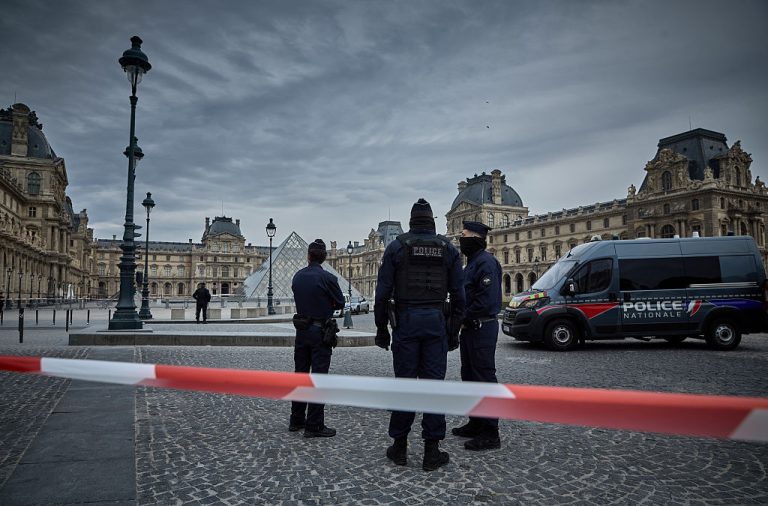
After several jewels were stolen from the Louvre on Oct. 19, authorities have made multiple arrests in connection with the theft, but the jewels remain missing.
Since the city-wide manhunt began, seven people have been arrested for allegedly stealing the jewels worth an estimated $102 million.
The first two — men from Aubervillers, located north of Paris — were caught a week after the heist, and were charged with theft and criminal conspiracy. One of them, an Algerian national, was stopped at the Charles De Gaulle airport outside the city, possessing a one-way ticket to Algeria.
Previously convicted together in a 2015 theft case, both men have “partially admitted” to their roles in the Louvre theft, the Guardian wrote. The prosecutor believes that these two men had entered through the museum’s Galerie d’Apollon (Gallery of Apollo) on the first floor.
The following week, a couple was charged. Traces of their DNA were reportedly found at the crime scene. Denying their involvement, the woman was reported to have broken down in court.
Success
You are now signed up for our newsletter
Success
Check your email to complete sign up
“I am afraid for my children, and for myself,” she cried.
Her partner has 11 prior convictions, mostly for theft.
On Nov. 2, Paris prosecutor Laure Beccuau revealed that these first four suspects are “clearly local people” from the low-income Seine-Saint-Denis area. However, she later said that they do not match any “upper echelons of organized crime.”
“This is not quite everyday delinquency… But it is a type of delinquency that we do not generally associate with the upper echelons of organized crime,” she said.
Three more people were arrested shortly after, but have been released without charge.
The heist
On Oct. 19, four men arrived at 9:30 a.m. local time at the Louvre with a truck-mounted lift, allowing them to ascend up to the Apollo gallery through a balcony near the Seine river. Using angle grinders, in four minutes, the crew broke through glass display cases. The thieves also threatened the guards before cutting into the display cases.
At 9:38 a.m. local time, when the police and museum security arrived, the thieves had already fled the scene using scooters as getaway vehicles.
It was on one of these scooters where DNA traces of one of the thieves was found.
According to the Associated Press (AP), the lift truck had been stolen from a mover who was lured by a fake “moving job” posted on the classifieds site Leboncoin, Beccuau said on Oct. 29. When the mover arrived in the town of Louvres on Oct. 10, he was ambushed by two men.
The stolen jewels altogether are worth an estimated $102 million. These include:
- A tiara and brooch that once belonged to Empress Eugenie, wife of Napoleon III
- An emerald necklace and a pair of emerald earrings from Empress Marie Louise
- A tiara, necklace and one earring from Queen Marie-Amelie and Queen Hortense
- A brooch known as the “reliquary brooch”
All of these jewels are still not located except for Empress Eugenie’s crown, which was found damaged along the thieves’ escape route.
READ MORE:
- How the CCP’s 80-Year Drug Empire Shaped China’s ‘Black Economy’
- US and UK Sanction Cambodian Tycoon; Former Chinese Agent Alleges CCP Ties to Scam Networks
- North Korean Interpreter Defects in Mongolia, Striking Blow to Kim Jong-un’s Regime
Breach of security
While investigations are still being carried out to find more suspects and to recover the stolen jewels, the heist at the Louvre has exposed a major flaw in the Louvre’s security.
Paris police chief Patrice Faure told senators that the first alert came not from the Louvre, but from a cyclist who called the emergency line. Faure also admitted that the museum still had old cameras, with newer CCTV equipment scheduled to be installed by 2029-30.
The Louvre’s director, Laurence des Cars, also acknowledged that the only external security camera set up near the Apollo gallery was pointing in the wrong direction, away from the window.
Politicians have called the heist “a national humiliation,” while others called it the “heist of the century,” Reuters wrote.
“What is certain is that we failed,” Justice Minister Gérald Darmanin confessed to France Inter radio.
“Someone was capable of putting a crane truck in the open in the streets of Paris, to have people walk up for a couple of minutes and take priceless jewels and give France a deplorable image,” he added
Former bank robber David Desclos told AP News that the heist was “textbook” and that he had previously warned the Louvre of its “glaring vulnerabilities” in the Apollo gallery’s layout.
It is feared that the jewels have already been smuggled out of the country, though there is still hope they could be found. Experts have also warned that the jewels could be re-cut and melted into newer stones.