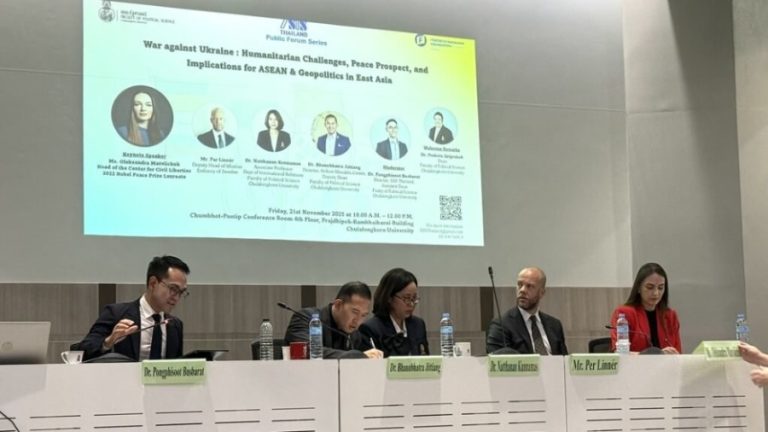
A recent forum in Bangkok examining the Russia–Ukraine war and East Asian geopolitics drew renewed attention to rising Japan–China tensions and escalating risks in the Taiwan Strait. Thai scholars warned that the conflict in Europe has given Beijing a valuable playbook and could shape its future decisions toward Taiwan. At the same time, they emphasized that Taiwan’s resilience and civil defense capacity remain critical deterrents to any potential Chinese military action.
The Institute of Security and International Studies (ISIS) at Chulalongkorn University hosted the event, titled “The War in Ukraine: Humanitarian Challenges, Peace Prospects, and Its Implications for ASEAN and East Asian Geopolitics.” Discussions ranged from the war in Europe to the Thai–Cambodian border disputes and the ongoing crisis in Myanmar, alongside assessments of the shifting dynamics between Japan and China.
Bhanubhatra Jittiang, an assistant professor in the university’s international relations department, said the Russia–Ukraine conflict has exposed the fragility of international law. If similar conditions take root in East Asia, he warned, it would become increasingly difficult to restrain major powers from acting unilaterally.
He argued that once a major power is allowed to violate another country’s sovereignty under various justifications, others will treat it as precedent. “A single wrong example,” he said, can become a license for other states to legitimize their own actions.
He urged small and medium-sized countries to reinforce international norms collectively, noting that weakened legal standards could undermine stability in regions such as the South China Sea and the Taiwan Strait.
RELATED: US, Japan, and Taiwan Form an Emerging Alliance Against Beijing
Success
You are now signed up for our newsletter
Success
Check your email to complete sign up
Ukraine will influence China’s Taiwan strategy
Natthanan Kunnamas, an associate professor in the same department, told CNA that the Russia–Ukraine war offers China a significant reference point that will influence its Taiwan strategy. Beijing, she said, is calculating the risks of international sanctions, economic fallout, and nuclear escalation before deciding whether to use force.
She pointed out that China has been closely following global responses to Russia and preparing accordingly—developing a financial system intended to bypass SWIFT and expanding semiconductor capabilities to reduce reliance on Taiwanese chip manufacturing. SWIFT, headquartered in Belgium, is used by thousands of financial institutions in more than 200 countries for secure cross-border transactions.
But beyond great-power considerations, Natthanan stressed that Taiwan’s internal strength—its resilience, civil defense posture, and capacity for societal mobilization—is one of the most important factors deterring Beijing from taking military action.
Oleksandra Matviichuk, the 2022 Nobel Peace Prize laureate and chair of Ukraine’s Center for Civil Liberties, also addressed the forum and later spoke to the media. She called for stronger international measures against Russia, including using frozen Russian assets to support Ukraine’s defense and reconstruction. If Moscow faces no consequences, she warned, it will embolden authoritarian leaders elsewhere and threaten regional stability, including in Taiwan.
Matviichuk echoed Natthanan’s view, noting that “China is watching developments closely, and the international community’s measures against Russia will influence Beijing’s decisions.”
She said she hopes people in Taiwan do not take peace and security for granted. Preserving them, she emphasized, requires continuous effort and cannot be left solely to political leaders.
She urged Taiwan—and societies everywhere—to build layered defense systems and prepare for a range of contingencies, calling such readiness a shared civic responsibility.