On Nov. 18, East Asia’s security landscape shifted in a single day. As China celebrated the Fujian aircraft carrier’s first open-sea training mission, Japan and the U.S. moved in lockstep by issuing a coordinated warning that immediately recalibrated strategic thinking in Tokyo, Washington, and Beijing.
In a moment that signaled a new geopolitical reality, the U.S., Japan, and Taiwan are now forming what analysts are calling a strategic alignment to counter Beijing’s ambitions.
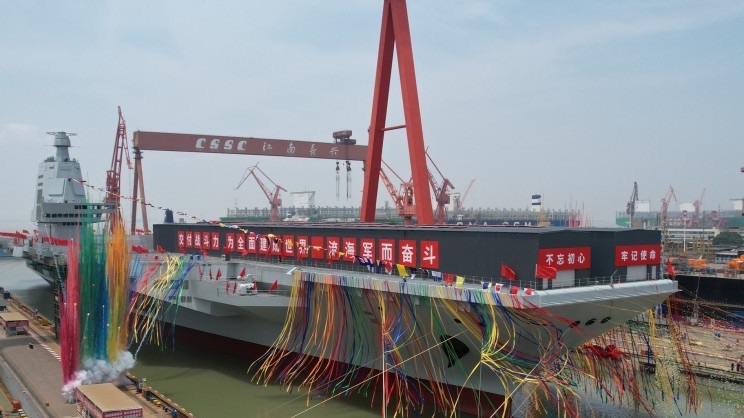
Hours after Beijing confirmed the Fujian’s commissioning, state broadcaster CCTV aired sweeping footage of the carrier strike group conducting its inaugural live-sea drills. J-35 fighters launched via electromagnetic catapult, KJ-600 early-warning aircraft touched down on deck, and the formation practiced long-range coordinated operations before returning to Sanya.
RELATED: Xi’s Waning Power: Generals Absent at Scaled-Down Fujian Carrier Ceremony
Fervent backlash
The propaganda campaign was immediate and intense — a choreography meant to reinforce the message that China’s newest, most technologically advanced carrier was now at sea and combat-ready. But Beijing’s display was overshadowed within hours by a political shockwave from Tokyo.
Success
You are now signed up for our newsletter
Success
Check your email to complete sign up
Japan’s Sankei Shimbun, citing senior government sources, reported that Tokyo has reached an internal strategic understanding: If conflict erupts in the Taiwan Strait and the Fujian attempts to block U.S. intervention, Japan would coordinate with the U.S. navy to sink the carrier. This was the first time Japanese media have openly identified a Chinese carrier as a wartime target — and the first time Japan signaled it would “strike preemptively,” if Beijing were to attack Taiwan.
RELATED: US Backs Japan After Takaichi’s Taiwan Warning as Beijing Steps Up Pressure
Newly-elected Japanese Prime Minister Sanae Takaichi had already stated that a major Taiwan conflict would constitute “a survival-threatening crisis” for Japan. The Sankei report took that position one step further: Japan would not simply support U.S. forces — it would act decisively. China sees Taiwan as a “breakaway province” and has vowed to reclaim the self-ruling island by any means necessary.
For Beijing, the message was unmistakable: Japan is prepared to attack a Chinese warship if necessary.
- A Taiwan conflict directly threatens Japan’s survival
A blockade of Taiwan would sever Japan’s crucial energy and food import routes. If Taiwan falls under PLA control, China’s strike radius immediately encompasses Kyushu and the Nansei Islands.
This is why Japan’s warning is framed not as altruism toward Taiwan, but self-preservation.
- Japan names the Fujian as a specific target
Gone is the cautious language of previous decades. Tokyo is now openly discussing operational objectives — including sinking China’s newest carrier.
- Japan accepts it must act in the opening hours of a conflict
Within weeks of taking office, Takaichi accelerated Japan’s security transformation:
- Formalizing the “survival crisis” doctrine
- Boosting defense spending
- Accelerating deployments across the Nansei island chain
- Deepening operational integration with U.S. forces
Japan is no longer positioning itself as a secondary or reactive actor. It is preparing to fight.
US Navy chief: ‘Not surprised at all’
On the same day the Sankei report was published, U.S. Chief of Naval Operations Adm. Darryl Caudle was asked in Tokyo about Japan’s stance. His response was blunt: “I am not surprised at all. This is exactly what I expected.” He added that Japan’s new defense budget (2 percent of GDP) “is not a ceiling,” signaling Washington’s support for an even more assertive Japanese military posture.
RELATED: Beijing Urges Citizens to Avoid Traveling to Japan, But Flights Remain Full
Caudle’s remarks effectively confirmed that the United States views Japan’s position as aligned with its own. Since Taiwan is the anchor of the “First Island Chain,” control of the island could theoretically determine control of the Western Pacific.
If Taiwan falls, analysts note that Japan’s maritime security could collapse, unraveling America’s Indo-Pacific strategy and enabling Beijing to forge ahead with its second island chain. Analysts also note that both Tokyo and Washington now treat Taiwan as a “strategic keystone,” not an optional commitment.
Meanwhile, public sentiment in Japan has also hardened. Polls show a majority support dispatching the Self-Defense Forces to aid Taiwan in a conflict — a dramatic shift from past decades.
The Fujian’s limitations
Though China hails the Fujian as a breakthrough, its combat readiness is uncertain, including:
- The carrier has just entered service
- Catapult and landing systems remain unproven
- Pilot training hours lag far behind U.S. and Japanese standards
- The KJ-600 early-warning platform is not yet mature
- China’s anti-submarine warfare remains a persistent weakness
In comparison, U.S.–Japan forces field a full suite of carrier-killer systems:
- F-35B and F-35C stealth strike packages
- E-2D early-warning networks
- Advanced submarines and long-range anti-ship missiles
- Japan’s upgraded Type 12 standoff missile
Japan’s warning, therefore, is not bluster — it reflects the military reality that the Fujian may not survive a high-intensity conflict.
An emerging alliance
The events of Nov. 18 marked a turning point. While Beijing amplified its show of force, Tokyo issued a challenge, and Washington endorsed it — all in the same news cycle. But experts also note that the deeper significance lies not in the headlines themselves, but in what they reveal: Japan is no longer hesitant, the United States is no longer ambiguous, Taiwan is no longer isolated, and China can no longer rely on intimidation to shape the region’s strategic choices.
A new three-way alignment — U.S., Japan, Taiwan — has quietly taken shape, one with the potential to redefine Asia’s strategic balance for decades.
In this new environment, when democratic states act in unison, authoritarian powers can do little more than react with outrage; not with leverage.