By Li Muzi, Vision Times
Mainland China is grappling against an aggressive wave of respiratory viruses, with this year’s influenza season described as unusually “ferocious” due to the rise of a so-called “K-type” strain of H3N2. State media and public health data suggest the 2025 flu season is the worst in four years.
Online, many Beijing residents say “the whole family got it,” while some question whether the outbreak signals a covert resurgence of COVID-19.
According to state media outlet CNR, surveillance from the Chinese Center for Disease Control and Prevention (China CDC) shows influenza spreading simultaneously across all regions — “from south to north, from east to west — no one is spared.” Current flu-season statistics have already surpassed previous years and, by the present trajectory, are still “climbing.” As the report notes, “This year is unquestionably the most severe influenza season in recent years.”
RELATED: Beijing Steps Up Crackdown of COVID-19 Vaccine Victims as Influenza Cases Spike
Most severe flu season in years
Success
You are now signed up for our newsletter
Success
Check your email to complete sign up
Beijing residents have reported office environments where “half the people are coughing nonstop,” and classrooms where attendance continues to drop. Children who appeared healthy one day were reportedly developing sudden dizziness, headaches, and fevers spiking to 38°C (100.4°F) the next.
Reports indicate that this influenza wave has already resulted in fatalities. In Henan’s Puyang City, a three-year-old boy reportedly died less than 24 hours after contracting the flu. In Hong Kong, a two-year-old girl died on Nov. 27 due to complications from H3N2 — the city’s third pediatric flu death this year.
RELATED: ‘Zero-COVID’ Lockdown in Shanghai Compounds Xi’s Political Dilemma
State media attributes the intensity of the outbreak largely to the emergence of the “K-type” strain of H3N2, described as a variant more likely to adhere to and invade the respiratory tract, leading to faster transmission. In addition to influenza, respiratory syncytial virus (RSV), adenovirus, and other respiratory pathogens are also circulating widely. Many people report recovering from one infection only to be “hit again” by another; some patients are testing positive for both influenza A and B simultaneously.
On Dec. 10, the Shanghai CDC clarified that “K-type” flu is not a new virus but a subtype of the H3N2 strain currently dominating the city’s outbreaks, accounting for more than 95 percent of detected cases. Shanghai expects peak transmission from mid-December through early January.
Parents report entire families taken out
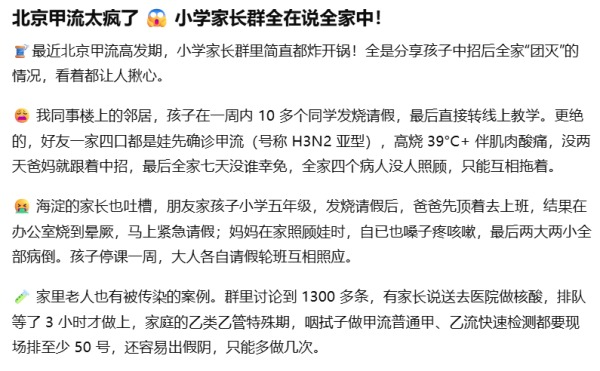
One widely circulated online post describes Beijing’s influenza situation as “out of control.” In elementary school parent chat groups, users say the infection rate is so high that discussions have “exploded,” with many reporting that their children fell ill first — and within days the entire household was sick.
RELATED: Zhejiang Girl Develops ‘White Lung’ After One Day of Fever as China Warns of Influenza Peak
The post recounts a case in which more than 10 students in a single class developed fevers within one week, forcing the school to switch to online instruction. Another Beijing resident described how a friend’s family of four was infected in succession: “The kids tested positive for H3N2 first, with fevers over 39°C (102°F) and muscle aches. Within two days, both parents were down. All four of them were sick for seven days, and there was no one left to take care of anyone — they had to drag themselves around.”
A parent in Beijing’s Haidian District shared a similar account: After a fifth-grader fell ill, the father tried to continue going to work, only to faint from high fever in the office. The mother, caring for the child at home, soon developed a sore throat and cough. Ultimately, “all four — the two adults and two children — were sick at the same time,” forcing everyone to take time off in shifts.
Hospitals at capacity
According to the post, parent-chat discussions reached more than 1,300 messages. One parent said they waited three hours at the hospital just for a nucleic acid test, while rapid flu A/B tests required queue numbers “at least 50 deep” and were prone to false negatives, requiring repeated testing. Another reported a child’s fever “soaring to 40°C (104°F)” and not responding to medication.
Hong Kong’s Ming Pao reported that influenza outbreaks in Beijing kindergartens have been severe, with some institutions nearly “wiped out.” One parent, Beibei, said her child’s entire kindergarten class eventually had to suspend lessons for a full week due to widespread infection.
On Dec. 11, the Chinese CDC released its latest national sentinel surveillance update, confirming that China has entered a high-incidence period for acute respiratory infectious diseases. The agency noted rising overall infection trends, high flu activity, and continued circulation of RSV and rhinovirus.
Mainland Chinese netizens have also posted comments alleging multiple unreported deaths linked to the current outbreak. As these claims circulate, many observers suspect that the Chinese government may once again be concealing the true scale of the epidemic, echoing patterns of cover-ups and misinformation seen during earlier phases of COVID-19.