The twenty-four solar terms are a cultural legacy unique to the East. Although this system plays a significant role in China past and present, it has only recently become more broadly known, and the general understanding of the twenty-four solar terms remains largely superficial.
While many are familiar with the more prominent solar terms, like “Beginning of Spring” (立春, Lichun), the Autumn Equinox ( 秋分, Qiufen), or Winter Solstice (冬至, Dongzhi), few understand the deeper meanings behind them.
The twenty-four solar terms were created based on careful observation of the solar year — one revolution by the Earth around the Sun. The year was divided into twenty-four equal parts (or terms) of approximately fifteen days, and each term was named after a natural or agricultural phenomenon that typically occurred around that time. For instance, 惊蛰 Jingzhe (Awakening of Insects) happens in early March, when the ground begins to thaw, and 芒种 Mangzhong (Grain in Ear) occurs in early June, when the wheat becomes ripe.
Aside from seasonal transitions, the twenty-four solar terms comprise interwoven layers of traditional Chinese culture and wisdom, touching every aspect of life even today. Thus, the twenty-four solar terms not only reflect the ancient Chinese understanding of the cyclical rhythm of nature and time; the system has influenced Chinese politics, philosophy, religion, and agriculture since its emergence in the Han dynasty (202 BC – 220 AD).
An agricultural planner
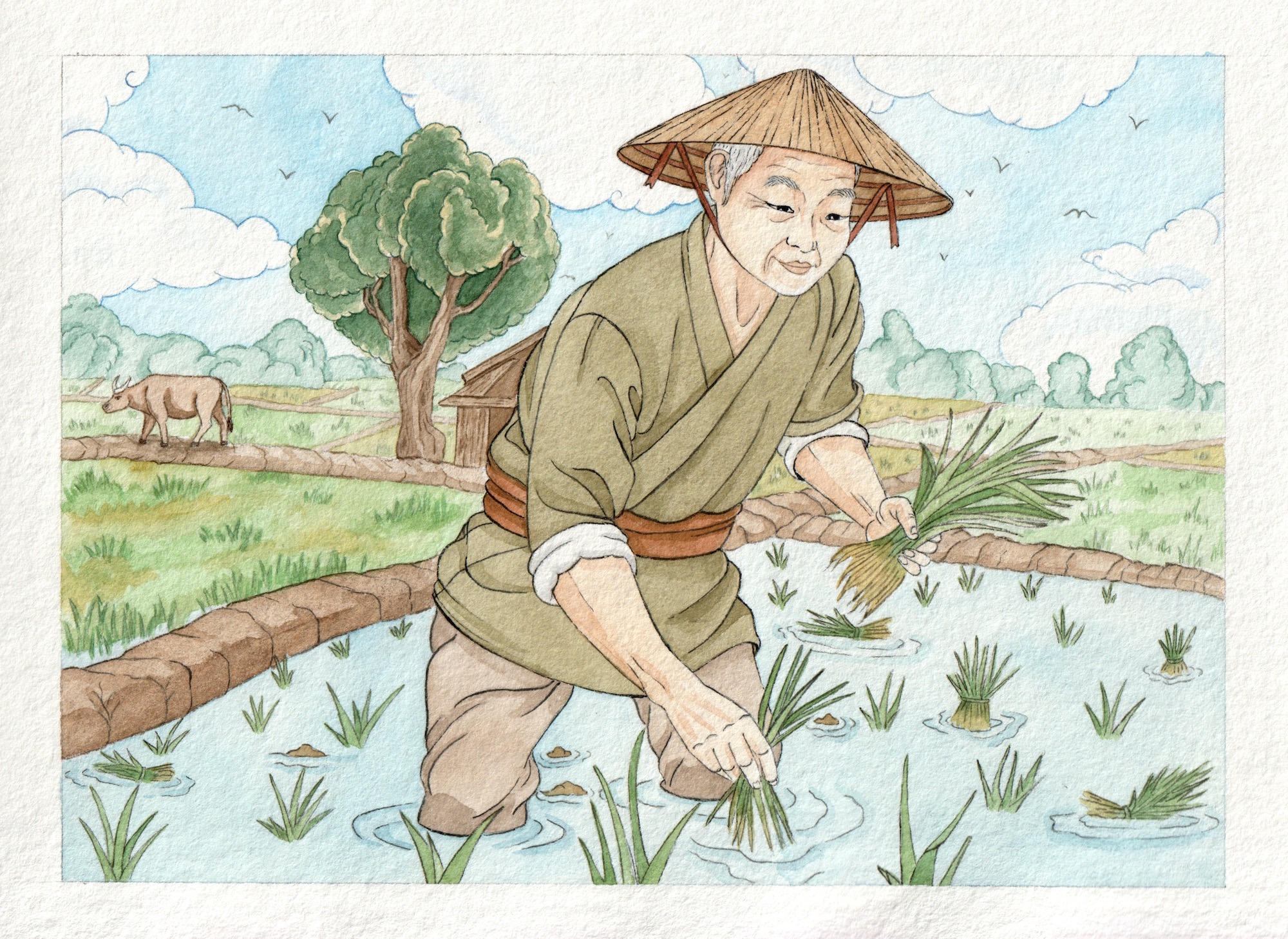
The most well-known function of the twenty-four solar terms is their role in agricultural planning. They act as a planting calendar, providing farmers with annual guidance on when to sow and harvest different crops.
Success
You are now signed up for our newsletter
Success
Check your email to complete sign up
One old adage advises, “Plant melons and beans around 清明 Qingming,” a solar period when the soil temperature can support germination and growth. Another proverb says, “Harvest early at 白露 Bailu (White Dew), and finish before 霜降 Shuangjiang (Frost’s Descent),” warning farmers to get their harvest in before it is damaged by frost.
From sowing seeds to cultivation and harvest, each term offers agricultural guidance, enabling farmers to plan with confidence, and act in accordance with the natural cycle.
An expression of ancient Chinese concepts: “yin,” “yang,” and “qi”
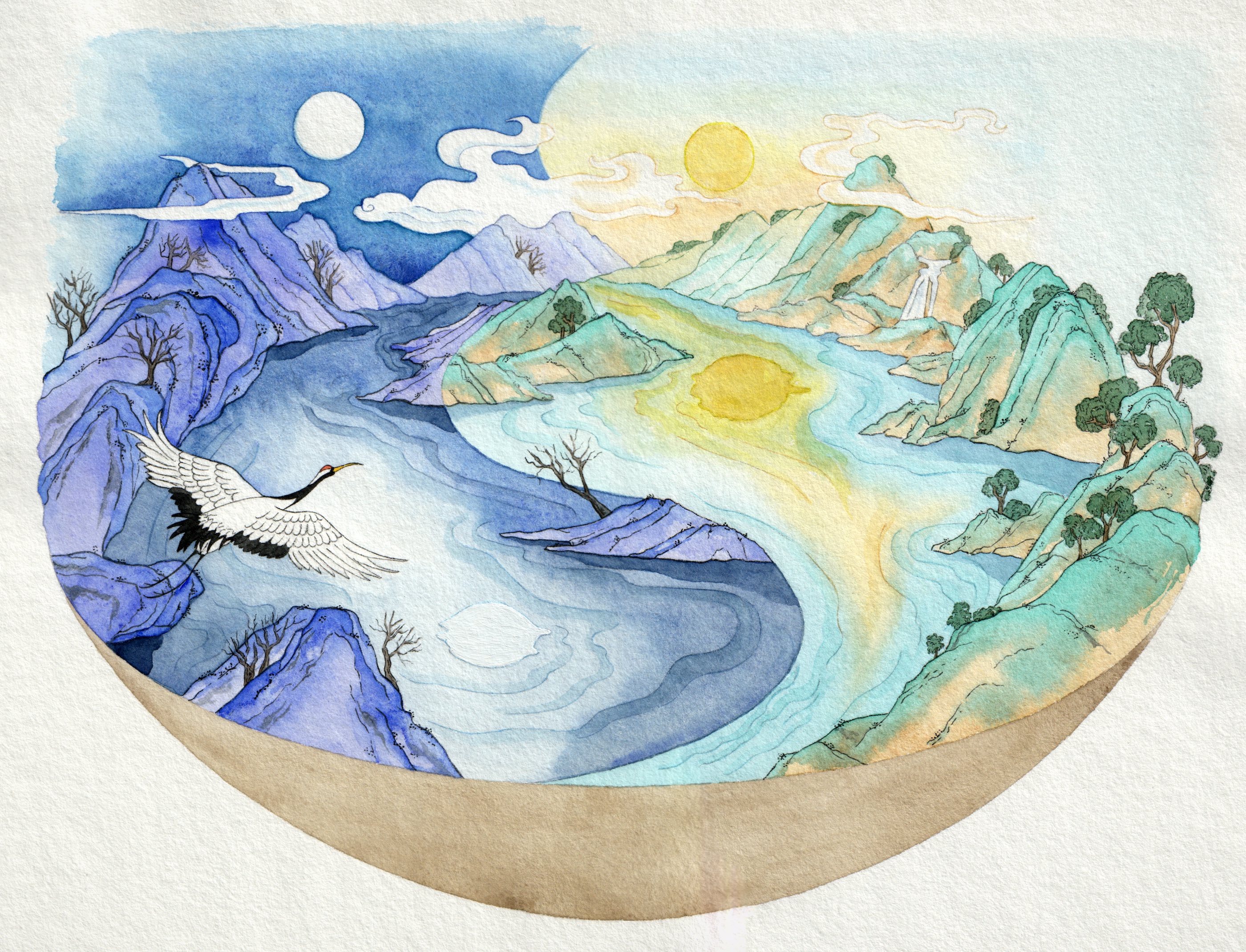
In traditional Chinese thought, qi (vital energy) is a fundamental concept. It is an invisible, yet omnipresent force manifesting via a dual nature that, through interaction, gives rise to all things. Because the twenty-four solar terms are tied to this ancient wisdom, they are sometimes referred to as 節氣 jiéqì (seasons of qi).
Generated from the “lunisolar” method, the twenty-four solar terms exhibit the spiritual insight garnered from the observation of both the lunar cycle (the phases of the Moon as it goes around the Earth), as well as the Earth’s orbit around the Sun. From this dualistic viewpoint emerged the idea of contrasting, yet complimentary forces of qi. The heavenly qi is light and pure, while the earthly qi is dark and turbid.
Together, they formed the mutually interdependent yin-yang principle, which manifests as a balancing act in nature.
In spring, the cold, dark “yin” qi gradually gives way to light and expansive “yang” qi, as the Earth wakes up from its winter sleep. As we progress through the solar terms, spring’s gentle warmth gradually turns intensely bright and hot (increasingly yang) with summer. The shift to autumn’s cool and austere qi is a manifestation of yin, which becomes even more dominant through the frozen winter.
Thus, through the twenty-four solar terms, time itself was imbued with the dynamic essence of qi. By following the philosophy of yin–yang, the system touches multiple layers of meaning within Chinese culture.
A system of moral and spiritual guidance
Perhaps the most important, yet seldom recognized role of the twenty-four solar terms is to provide moral and spiritual guidance.
Cultivating virtue
Each solar term is associated with seasonal customs, ranging from rituals and festivals to consuming specific foods and drinks. These cultural traditions imbue important values from one generation to the next, inspiring virtuous, ethical, and wholesome behavior.
During Qingming, for example, people visit the graves of their ancestors to keep them tidy and offer sacrifices. This ritual serves as a valuable lesson in filial piety and remembrance. Children learn to honor their elders and feel gratitude toward their parents.
Similarly, 端午節 Duanwu jie (Dragon Boat Festival) is an annual event that honors 屈原 Qu Yuan, an historical figure who possessed loyalty and integrity of legendary quality. Named for the fifth day of the fifth month, when Qu Yuan drowned himself in the river after being falsely accused of treason, Duanwu jie is a day for eating zongzi and racing down the river. This recalls how mourners dropped zongzi (sticky rice dumplings) into the river to prevent the fish from eating Qu Yuan’s body, strengthening feelings of community, respect and patriotism during 夏至 xia zhi (summer solstice).
Following nature
Since ancient times, the great sages have advocated following nature and living in harmony with our surroundings. Careful observation of and alignment with natural cycles not only allows us to plan, but also to predict.
Each solar term is divided into three 候 hòu (five-day micro-seasons), for a total of seventy-two throughout the year. Each hòu is associated with specific natural signs involving animals (such as fish, otters, and different birds), plants (like various fruits, herbs, and even duckweed), or weather phenomena (such as heavy humidity, cooling winds, and other seasonal changes dependent on yin/yang dynamics).
Each observation was tied to specific dates, and ancient scholars used them to forecast auspicious or inauspicious events. For example, The Lost History of the Zhou Dynasty (逸周书·时训解 Yi Zhou Shu – Shixun Jie) records: “If duckweed does not sprout at Qingming, yin energy prevails excessively; if the cuckoo does not flutter its wings, the state will not prepare for war; if the hoopoe does not descend upon the mulberry, governance will go astray.”
Another classic, the Annotatted Text Regarding I Ching (易纬·通卦验 Yi Wei – Tonggua Yan), notes that “on the day of the Winter Solstice, if the shadow cast by an eight-foot gnomon matches its measure precisely, the year will be prosperous and the people harmonious.”
Behind these predictive practices lay a spirit of reverent observation — a belief in learning from nature’s order rather than defying it. As the Dao De Jing says, “Man follows the earth, earth follows heaven, heaven follows the Dao, and the Dao follows what is natural.” This ancient ethos of humility and obedience stands in stark contrast to the present Communist ideals about “struggling against heaven and earth” and pursuing ambition without limits.
Faith and reverence
At the deepest level, the twenty-four solar terms embody a profound reverence for the divine. Many myths and legends are intertwined with them. During Lichun (Beginning of Spring), the heavenly dragon is said to rise from its winter slumber to observe changes on earth; every Qiufen (Autumn Equinox), the legend of Chang’e flying to the Moon is told anew.
More importantly, studies suggest that the culture of the solar terms is rooted in ancient faith in divine order. Although there are twenty-four named terms, their foundation rests on four distinct astronomical events: the Spring and Autumn Equinoxes, and the Summer and Winter Solstices — collectively known as the “Four Seasons.”
In ancient times, these four points were not merely calendar markers; they represented divine beings — the Four Spirits of the two solstices and two equinoxes. Oracle-bone inscriptions from the Shang dynasty record their names: Xi, the deity of the Spring Equinox; Yi, the deity of the Autumn Equinox; Yin, the deity of the Summer Solstice; and Wan, the deity of the Winter Solstice.
The Book of Documents (Shang Shu – Canon of Yao, 尧典) preserves these names, describing them as celestial officials under the deities Xi and He — hence the later titles Xi Zhong, Xi Shu, He Zhong, and He Shu. A silk manuscript unearthed from the Warring States period (475 – 221 BC) further portrays these four deities as the children of Fuxi and Nüwa, listed by birth order — consistent with the Yao Canon record.
The ancients believed that these four gods presided over the creation and regulation of the world — forming one of the earliest cosmological systems of divine governance. This faith shaped ancient Chinese civilization and is one reason why China came to be known as the Divine Land (神州 Shenzhou).
Since UNESCO’s inscription of the twenty-four solar terms on the Intangible Cultural Heritage list in 2013, they have inspired posters, books, and films in modern China. While such publicity is welcome, it remains superficial. To truly revive this heritage, we must go beyond mere appearances and rediscover the deep cultural meanings within: reverence for heaven and the divine, governance through virtue, the unity of heaven and humanity, and the balance of yin and yang.
Only when these ancient ideas once again inform daily life and public consciousness can this jewel of Chinese civilization shine with renewed brilliance.