By Guiyu
In medieval Europe, few stories were as widely told—or as enduring—as the legend of Saint George slaying the dragon.
On the surface, it is a tale of knightly valor and religious devotion. Yet beneath that narrative lies a deeper meaning. Across centuries, the story has served as a moral allegory for something far larger: the persistent struggle between good and evil, light and darkness, that runs through human history and across civilizations.
Faith confronting evil
Saint George was a Roman soldier who lived during the period of the Roman Empire’s Tetrarchy. A committed Christian, he was later executed for refusing to renounce his faith and was subsequently canonized as a saint.
His most famous legend centers on a confrontation with a dragon.
Success
You are now signed up for our newsletter
Success
Check your email to complete sign up
According to The Golden Legend, one of the most influential medieval collections of saints’ lives, the episode took place in the town of Silene, variously identified with regions in present-day Libya or Lebanon. A fearsome dragon, said to carry plague and death, terrorized the town and poisoned its surroundings.
To appease the beast, residents first sacrificed livestock. When that failed, they resorted to drawing lots to offer children. Eventually, the king’s own daughter was selected.
As she awaited her fate, a passing knight—George—arrived.
Armed with his lance, named Ascalon, George wounded the dragon. He instructed the princess to lead the subdued creature back to the town as if it were a tamed animal. Addressing the townspeople, George declared that if they accepted baptism, he would kill the dragon.
According to the legend, fifteen thousand people converted. George then beheaded the dragon. A church was later built on the site, and a spring believed to have healing powers flowed from its altar.
Within Western tradition, the symbolism of the story is unmistakable.
The dragon represents evil forces, often understood as Satan.
The princess symbolizes innocence and vulnerable humanity.
Saint George embodies courage, righteousness, and unwavering faith.
Art, memory, and a lasting legacy
Because of these associations, Saint George became the patron saint of many regions, including England, Georgia, Ethiopia, Lithuania, Portugal, and Catalonia.
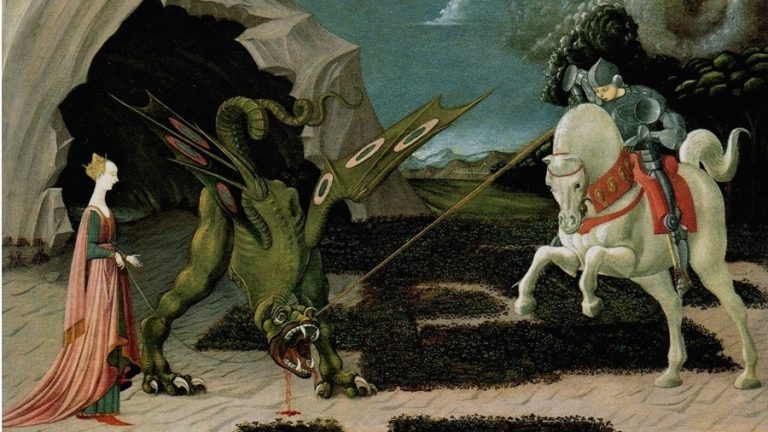
Among the most famous artistic depictions of the legend is “Saint George and the Dragon,” painted around 1470 by Paolo Uccello, an early Italian Renaissance artist. Versions of the work are held by major institutions such as the National Gallery in London and the British Museum.
The painting is notable for its stylized dragon, its pioneering use of perspective, and the dramatic composition in which George’s lance pierces the dragon’s head. The princess, holding the defeated dragon, visually reinforces the triumph of good over evil.
In England, St. George’s Day, observed on April 23, remains a national occasion. Saint George also occupies a prominent place in English literature. In Henry V, William Shakespeare famously invokes him in the rallying cry: “God for Harry, England, and Saint George!”
A cosmic battle beyond the human world
If Saint George’s battle represents the struggle between good and evil on earth, the Book of Revelation presents the same conflict on a cosmic scale.
According to Revelation 12:7–12, Archangel Michael, commander of the heavenly host, leads the angels in battle against the red dragon, identified as the ancient serpent, the devil, or Satan. The dragon is defeated, cast out of heaven, and hurled down to the earth.
This image has shaped centuries of Western art. One prominent example is the statue at the Fontaine Saint-Michel in Paris, completed in 1860, depicting Archangel Michael standing triumphantly over Satan. Such imagery symbolizes the restoration of divine order and moral law.
Once cast down, the red dragon does not abandon its opposition to God. Instead, it turns its hostility toward humanity, rejecting faith, tradition, and moral order, while seeking influence through earthly agents, to destroy humanity.
Communism as the Red Dragon’s earthly proxy: A civilizational interpretation
In certain religious and philosophical traditions, the “Red Dragon” symbolizes a force hostile to the divine, opposed to tradition, and destructive to humanity’s moral order. Within this interpretive framework, communism is viewed not merely as a political ideology, but as an earthly proxy for a deeper spiritual confrontation—one that challenges faith, culture, and ethical foundations.
From secret societies to revolutionary ideology
In 1776, the Bavarian Illuminati was founded in Germany by Adam Weishaupt. Historical records show that the organization promoted secrecy, deception, and ideological discipline. While historians debate the scope of its influence, some commentators view such secretive movements as early expressions of an intellectual current that rejected traditional religion and moral authority.
By the mid-19th century, this current took a more explicit political form. In 1848, Karl Marx and Friedrich Engels—members of the Communist League, which evolved from earlier radical associations—published The Communist Manifesto. Its opening line famously declared: “A specter is haunting Europe—the specter of communism.” To many contemporaries, this “specter” represented not progress, but a fundamental challenge to religion, tradition, and inherited moral norms.
Power through revolution, culture through destruction
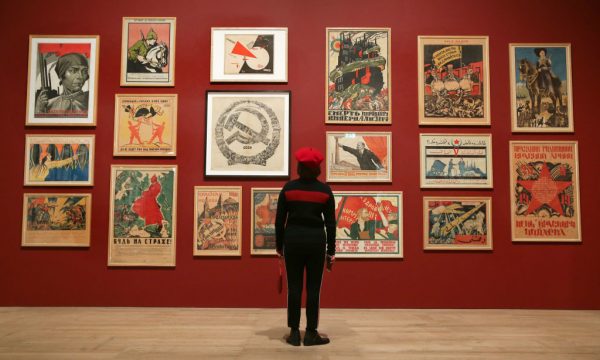
Communist movements sought power through class struggle and revolutionary violence. From the Paris Commune of 1871—which saw widespread destruction of cultural landmarks—to the Bolshevik Revolution of 1917, and later the establishment of communist rule in China in 1949, critics argue that each stage was accompanied by systematic attacks on traditional culture, belief systems, and ethical standards.
The Communist Manifesto itself openly states that communism aims to “abolish eternal truths” and to abolish religion and morality rather than reform them. For many observers, this declaration is central to understanding why communist regimes have repeatedly clashed with faith communities and traditional civilizations.
A broader civilizational conflict
From this perspective, the conflict is not merely political but civilizational. Communism’s hostility toward religion and moral tradition is seen as inseparable from its governing logic. Whether framed in theological terms or secular philosophical critique, the question remains the same: Can a society endure when it systematically dismantles the moral foundations on which it was built?
For Vision Times commentators, this question is not about theology alone, but about history, human dignity, and the long-term consequences of ideology when power is placed above conscience.
A modern spiritual battleground
This struggle has not ended. It has simply shifted form.
Notably, the Chinese Consulate General in Toronto is also located on St. George Street. For more than two decades, practitioners of Falun Gong—a spiritual discipline rooted in the principles of truthfulness, compassion, and tolerance—have held peaceful protests outside Chinese embassies and consulates worldwide following the Chinese Communist Party’s campaign against the group launched on July 20, 1999.

Similar protests have taken place in London, where the Chinese Embassy is located less than a mile from St. George Street. The article frames these sustained, nonviolent actions as a modern form of “dragon slaying”—a resistance grounded in moral persistence rather than force.
The Only Way to Escape This Calamity
Amid the current crisis, as the Red Dragon bares its fangs and ravages the world, the only path to survival lies in recognizing the Communist Party’s dark, destructive nature and severing all spiritual and moral ties with it. Only by withdrawing from the Party, the Youth League, and the Young Pioneers—organizations one may have once joined—and by refusing to lend it legitimacy or support, can individuals escape disaster, much like the townspeople in legend who were saved by Saint George.
The lesson of Saint George endures: justice and courage are the sword that defeats evil. Throughout history’s struggles between good and evil, every individual is ultimately compelled to make a choice of their own.
Editor’s Note:
For readers in China, the moral choice discussed in this article is often expressed through the Quit the CCP (Tuidang) Movement, a voluntary and symbolic declaration renouncing membership in the Chinese Communist Party, the Communist Youth League, and the Young Pioneers.For readers outside China, who do not face the same political constraints, support is commonly expressed through civil society initiatives. One such effort is End CCP (ENDCCP), a global petition documenting opposition to human rights abuses and ideological repression by the Chinese Communist Party.