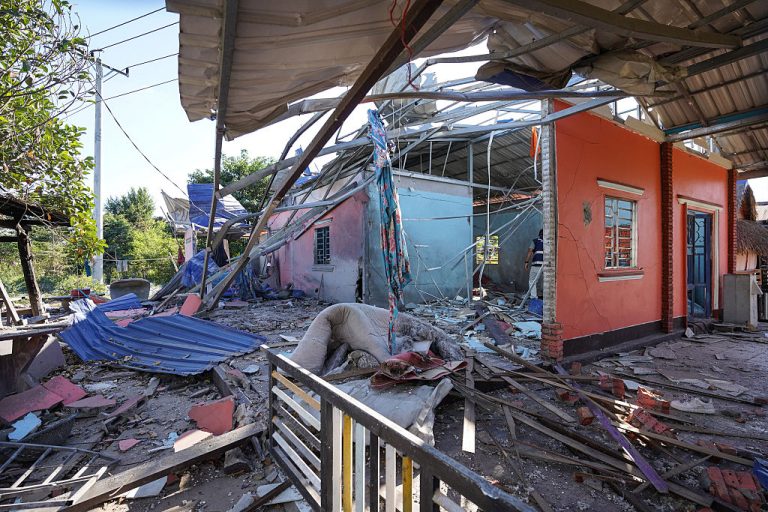
Armed clashes between Thailand and Cambodia have intensified in recent weeks, revealing unexpected military capabilities on the Cambodian side and prompting closer scrutiny of possible external involvement—most notably from China. What began as a familiar border dispute has evolved into a more complex confrontation involving advanced weaponry, drone warfare, and unprecedented Thai airstrikes on suspected scam centers along the frontier.
According to Thai media reports and widely circulated online videos, Cambodian forces—long regarded as militarily inferior to their Thai counterparts—were found to be operating advanced Chinese-made weapons systems. In response, Thailand deployed F-16 fighter jets to strike multiple casino-linked compounds near the border, facilities Thai authorities describe as hubs for telecommunications fraud. The strikes drew particular attention among Chinese netizens, many of whom openly welcomed the attacks on what they consider notorious scam operations, including a site referred to online as the Cambodia Life Science Institute.
Renewed border clashes and unexpected weapons
On Dec. 7, 2025, Thai and Cambodian forces exchanged fire at multiple points along their more than 800-kilometer disputed border. Social media footage appearing to show Cambodian troops firing 122-mm rocket artillery at Thai positions quickly circulated online.
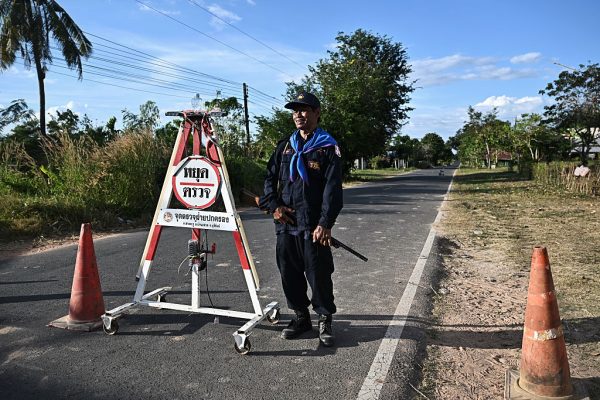
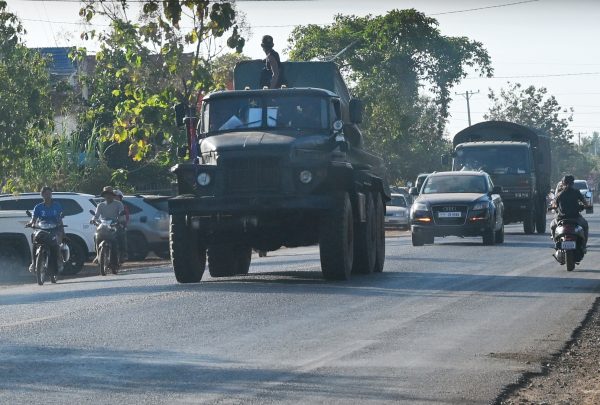
Thailand responded with a significant show of force, deploying regular army units, heavy armor, artillery, and air support, including F-16 fighter jets. Images posted by Thai sources showed armored vehicles and artillery batteries massing near the conflict zones.
According to Thai military reporting, the fighting exposed Cambodian use of BM-21 multiple rocket launch systems and other advanced weapons. Thai ground forces later claimed to have seized a number of long-range anti-tank guided missiles, identified as the “GAM-102 LR,” from Cambodian positions.
Success
You are now signed up for our newsletter
Success
Check your email to complete sign up
Thai military commentators described the GAM-102 LR as a fifth-generation anti-tank missile system designed to defeat modern armored vehicles, with an estimated engagement range of 6 to 10 kilometers and advanced guidance and precision features.
Chinese origin of seized weapons and battlefield evidence
Thai officials stated that the seized missiles were manufactured in China and did not appear to be outdated surplus equipment. According to Thai media, the system was introduced into service by the Chinese military as recently as 2025, with Poly Defense identified as the manufacturer.
In commentary widely shared online, Thai analysts said the military had launched an investigation into how such weapons reached Cambodian units and how they were financed. On Dec.15, Thai security authorities confirmed the seizure of GAM-102 LR missiles at Hill 500 near Chong An Ma, describing them as among the most advanced anti-tank weapons currently in active service.
Defense analysts noted that each missile reportedly costs millions of Thai baht—equivalent to hundreds of thousands of U.S. dollars. Such prices are typically associated with well-funded, technologically advanced armed forces, a category Cambodia is not generally considered to belong to. By comparison, publicly disclosed U.S. arms sales list the Javelin anti-tank missile at approximately $200,000 to $250,000 per unit.
For Thai officials, the presence of these weapons raised immediate and unresolved questions about their transfer, funding mechanisms, and the broader geopolitical implications.
Evidence shared by bloggers and the Thai military
Images released by the Thai army and shared by an X-platform blogger known as “Simplified Chinese Circle – Hot Topics” showed a range of Chinese-made weapons captured after Thai forces overran Cambodian positions on December 15. The equipment reportedly included PF-89 portable anti-tank rocket launchers, components of 82-mm grenade launchers, and various types of Chinese-manufactured ammunition.
Thai forces also reported finding Cambodian logistical supplies, including compressed rations bearing markings inconsistent with domestic Cambodian production.
Some Chinese netizens speculated online—without independent verification—that Chinese celebrities had registered arms-related companies. No public evidence has emerged to support these claims.
Drone warfare and claims of third-party involvement
Despite Thailand’s clear superiority in conventional forces, Thai military statements acknowledged that Cambodian drone attacks inflicted unexpected losses. Thai authorities said the conflict exhibited signs of third-party involvement, a claim underscored by an unusual decision to release official military statements in simplified Chinese—a move widely interpreted as a deliberate signal to a specific external audience.
Thai media later published images of Cambodian drones, suggesting that the equipment originated from outside the country. Bloggers citing Thai military intelligence said Cambodian drone tactics had evolved markedly compared with clashes four months earlier.
According to these accounts, Cambodian forces began deploying 82-mm mortar rounds from drones rather than light munitions, coordinating reconnaissance drones with attack drones to improve targeting accuracy. Thai reports also noted the first appearance of loitering “suicide drones” and suggested the use of encrypted, military-grade communications systems with strong anti-jamming capabilities.
Several Thai military analysts quoted by local media questioned whether Cambodia possessed the technical capacity to develop or field such systems independently.
F-16 strikes on scam compounds
The episode that drew the strongest reaction from Chinese netizens was Thailand’s decision, beginning Dec. 8, to deploy F-16s against casino complexes and suspected scam compounds along the Cambodian border. These sites have long been accused of hosting large-scale telecommunications fraud operations targeting Chinese citizens.
Thai military officials stated that Cambodian forces had used the casino compounds as operational bases, storing weapons and launching drone attacks from within their perimeters. Video footage circulating online appears to show Thai F-16s destroying a casino complex in the Temodda area, reportedly the Eternal Diamond Casino. Thai sources claimed that as many as 39 scam-related compounds had been destroyed.
Online videos showed scam operators fleeing under bombardment, scrambling for transportation amid ongoing artillery fire. Some were reported to have abandoned large sums of cash during their escape.
The strikes prompted widespread celebration on Chinese social media, with users describing the attacks as overdue justice and praising Thailand for taking decisive action against fraud networks.

Speculation over deeper links
Unverified online claims have linked Cambodia’s scam compounds and casinos to powerful interests, including Chinese elites and projects associated with the Belt and Road Initiative. Bloggers alleged that facilities such as the Cambodia Life Science Institute were embedded within scam parks operated by the Prince Group, a major Cambodian conglomerate.
Some posts further claimed that Chinese research institutions, including universities and hospitals, had cooperative agreements with entities operating in these zones. These allegations have not been independently verified.
An anti-fraud blogger described Cambodia’s scam industry as a pillar of the national economy, claiming—without official confirmation—that fraud revenues accounted for as much as 40 percent of Cambodia’s GDP. The blogger cited U.S. Justice Department indictments issued in October 2025 that characterized the Prince Group as one of Asia’s largest transnational criminal organizations.
Public anger and regional fallout
Online commentary reflects growing anger among Chinese citizens toward telecommunications fraud and the authorities they believe enable or protect it. Many have expressed open support for Thailand’s military actions, arguing that any force willing to confront fraud networks deserves public backing.
According to Agence France-Presse, the current conflict is rooted in long-standing disputes over colonial-era borders, with roughly 800,000 people displaced by the fighting.
As clashes continue, the appearance of advanced Chinese-made weapons on the battlefield and Thailand’s unprecedented airstrikes on scam compounds have transformed a familiar border dispute into a broader regional controversy—one increasingly entangled with questions of transnational crime, covert arms transfers, and Beijing’s expanding footprint in Southeast Asia.