By Wang He
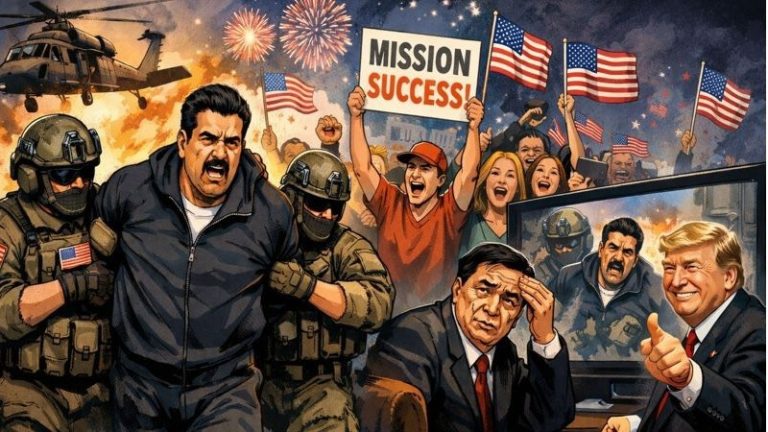
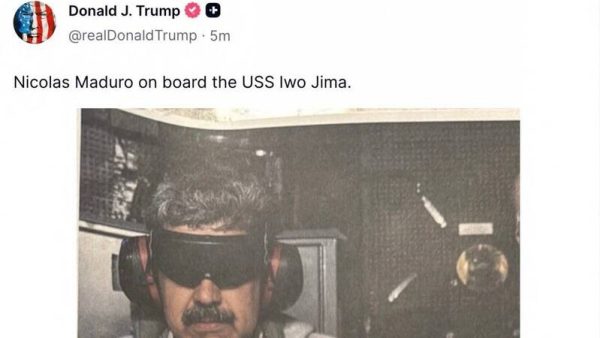
At 10:46 p.m. Eastern Time on Jan. 2, President Trump issued the final order. At 1:01 a.m. on Jan. 3, a joint team of U.S. intelligence operatives and special operations forces arrived at the residence of Venezuelan president Nicolás Maduro. By 3:29 a.m., Maduro and his wife were placed aboard an aircraft and flown out of the country.
What was described as “almost unbelievable” was that the operation resulted in no U.S. casualties and no loss of equipment. Maduro and his wife are to stand trial in New York.
A stunning demonstration of American military power
At a press conference beginning around 11:40 a.m. on Jan. 3, President Trump stated that capturing Maduro within five hours constituted “one of the most astonishing, effective, and shocking demonstrations of military power and capability in American history.”
He emphasized that the operation involved joint forces from the Army, Navy, and Air Force, describing it as an attack “on a scale never before seen—something people have not witnessed since World War II.”
Success
You are now signed up for our newsletter
Success
Check your email to complete sign up
Trump acknowledged that hostile forces were present and that intense firefights occurred. However, U.S. forces, he said, “quickly crushed all resistance,” plunging much of Caracas into darkness during the operation and rendering “all Venezuelan military forces combat ineffective.”
Trump also asserted that U.S. forces could have killed Maduro during the night operation if they had chosen to do so.

‘We may be tasked to do this again’
Following Trump’s remarks, Secretary of Defense Pete Hegseth stated that the operation demonstrated the United States’ ability to act “at any time, in any place, according to our will—coordinated, concealed, lethal, and precise—backed by the full power of the American justice system.”
Chairman of the Joint Chiefs of Staff General Dan Caine described the mission—code named “Operation Absolute Resolve”—as “stealthy and precise,” executed “at the darkest hour of Jan. 2,” and representing the culmination of months of planning and rehearsal.
“Frankly,” Caine said, “only the U.S. military is capable of carrying out an operation like this.” He added, “We may be tasked to do this again.”
Compared with Panama in 1990, US capabilities have leapt forward
By coincidence, exactly 36 years earlier, U.S. forces captured Panamanian leader Manuel Noriega. After seizing power in 1983, Noriega manipulated Panama’s political system and profited heavily from drug trafficking.
On Dec. 20, 1989, citing the need to protect American citizens, the United States launched a large-scale invasion involving 24,000 troops. Panamanian defense forces were defeated the same day, and Noriega fled to the Vatican embassy before surrendering on Jan. 3, 1990. He was subsequently taken to the United States for trial.
The Pentagon estimated that the operation resulted in 516 Panamanian deaths, including 314 soldiers and 202 civilians, while U.S. losses included 23 soldiers and 3 civilians.
By comparison, the intelligence, coordination, and execution demonstrated in the Maduro operation represent a dramatic leap forward in U.S. military capability.
Capturing Maduro as the first concrete result of ‘Trump’s Monroe Doctrine’
On Dec. 4, 2025, the White House released the National Security Strategy 2025, which for the first time formally articulated what it termed “Trump’s interpretation of the Monroe Doctrine.”
In December 1823, President James Monroe declared that the Western Hemisphere should no longer be subject to European colonization. More than two centuries later, Trump stated: “President Monroe’s defense of sovereignty protected the Americas from communism, fascism, and foreign aggression. As the 47th president, I am proud to reassert this long-standing policy.”
According to the National Security Strategy 2025, this updated doctrine seeks to:
- Maintain stability and governance in the Western Hemisphere to deter mass migration to the United States
- Ensure regional cooperation against narcoterrorists, criminal syndicates, and transnational crime
- Prevent hostile foreign powers from controlling key assets or supply chains
- Preserve U.S. access to critical strategic locations
In essence, it aims to exclude malign “non–Western Hemisphere forces” from the region.
The capture of Maduro is presented as the first concrete execution of this doctrine. Prior to the Jan. 3 operation, the Trump administration had already waged months of diplomatic pressure and military containment against the Maduro regime. The decisive action, therefore, represented both a political and military assertion of U.S. resolve.
Within hours, U.S. forces removed Maduro from power without the world even witnessing sustained combat between Venezuelan and American troops. The psychological impact on Latin America—and on the wider world—has been profound, particularly for the CCP.

Three layers of deterrence directed at the CCP
First, Maduro maintained exceptionally close ties with the CCP. During his 2023 visit to China, bilateral relations were elevated to an “all-weather strategic partnership.” Most embarrassing for Beijing was the fact that just hours before his capture, Maduro met with Qiu Xiaoqi, China’s special representative for Latin American affairs, during which Maduro reportedly thanked China’s leaders for their “brotherly friendship.”
The two sides have signed more than 600 agreements. With the United States now assuming control over Venezuela, that relationship is certain to undergo a dramatic transformation.
Second, the Maduro episode may force Latin America as a whole to reassess its relationship with the CCP. Years of Chinese political and economic cultivation across the region now face a severe shock.
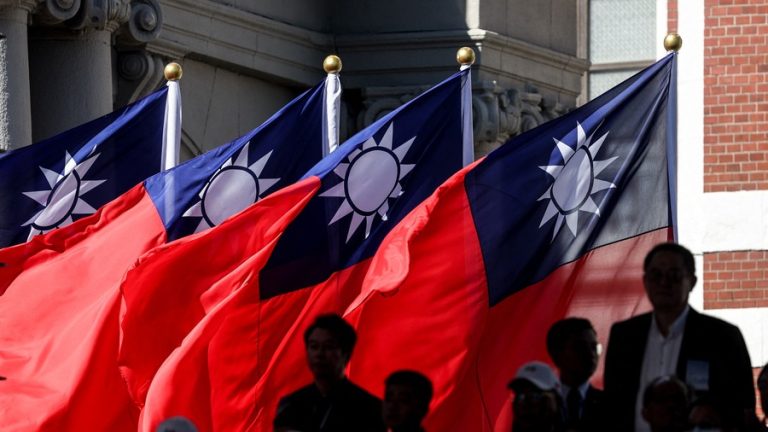
Third, the operation serves as a warning to Beijing not to act rashly in the Taiwan Strait. Trump’s current term runs until January 20, 2029, and the central strategic challenge he faces is preventing China from following Russia’s path in Ukraine.
During the 2024 campaign, Trump made headlines by stating that if China invaded Taiwan during his presidency, he would respond by bombing Beijing. After returning to the White House in 2025, he surprised many by ordering airstrikes on Iranian nuclear facilities.
The capture of Maduro once again demonstrates American power, resolve, and credibility. Secretary of State Marco Rubio told the media that “when Trump says he is serious about something, he truly means it.”
Beijing could not have missed another signal. Just days before Maduro’s capture, on Dec. 28, 2025, veteran national security journalist Bill Gertz wrote on social media that if China were to launch a military attack on Taiwan, a drone-based decapitation strike—similar to the operation that killed Iranian General Qassem Soleimani—could be replicated in Beijing, potentially targeting members of the Politburo Standing Committee, including Xi Jinping.
Rubio stated that Maduro had “many opportunities to avoid this outcome” and that the United States had extended “very, very generous offers.”
There is little doubt, the article concludes, that the Trump administration has likewise extended “very, very generous offers” to Beijing regarding Taiwan. If the CCP chooses to take reckless risks, it will have to face the consequences.