By Jin Yan, Vision Times
As Canadian Prime Minister Mark Carney prepares to travel to China on Jan. 13 for talks with Chinese leader Xi Jinping, human rights groups have intensified calls for Ottawa to place human rights at the center of its China policy. Almost simultaneously, Hong Kong’s High Court moved into the final pre-sentencing stage of the national security case against media tycoon Jimmy Lai, further thrusting human rights issues in Sino-Canadian relations into the international spotlight.
On Jan. 9, the Canada China Human Rights Alliance released an open letter urging the Canadian government to make human rights a core pillar of its engagement with Beijing.
RELATED: Human Rights Day Event Calls for CCP Accountability and Defense of Religious Freedom
All eyes on Carney
The coalition comprises ten Canadian civil society organizations, including Amnesty International Canada (Francophone), the Canada Tibet Committee, Hong Kong Watch Canada, the Falun Dafa Association of Canada, the Federation for a Democratic China (Canada), the Raoul Wallenberg Centre for Human Rights, the Toronto Alliance for Chinese Democracy, the Uyghur Rights Advocacy Project, and the Vancouver Society in Support of Democratic Movement.
Success
You are now signed up for our newsletter
Success
Check your email to complete sign up
RELATED: Border Clashes Between Thailand and Cambodia Expose China’s ‘Human Industry’ Network
The letter notes that Canada–China relations encompass trade, security, and geopolitics, but stresses that China’s human rights conditions continue to deteriorate, with repression of domestic and overseas democracy advocates intensifying. The alliance called on the prime minister to clearly place human rights at the center of bilateral relations before and during his visit, and to adopt a comprehensive and consistent human rights strategy rather than continuing what it described as past approaches that were “piecemeal, restrained, or trade-first.”
The coalition warned that decades of sidelining human rights have produced “profound consequences” and must not be repeated.
Specific demands
The open letter outlines a wide range of concrete demands covering Hong Kong, Xinjiang, Tibet, religious freedom, and transnational repression.
The alliance urged Canada to clearly oppose the arbitrary detention of Jimmy Lai and other Hong Kong democrats, including Chow Hang-tung, and raised concerns over Hong Kong authorities issuing bounties for the arrest of Canadian citizen Joe Tay and other individuals residing in Canada.
RELATED: Lai Ching-te Condemns CCP Conviction of Jimmy Lai, Warns of Global Impact
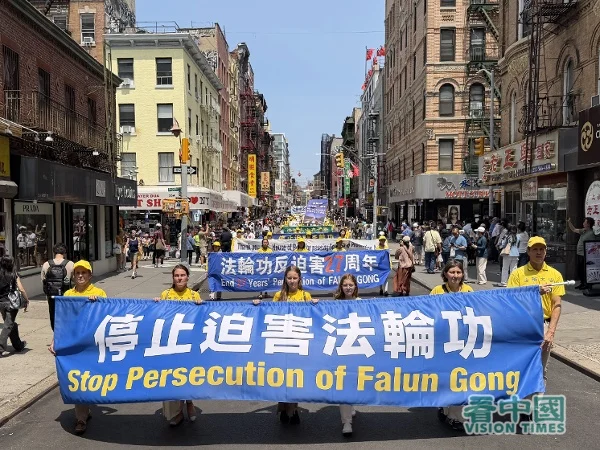
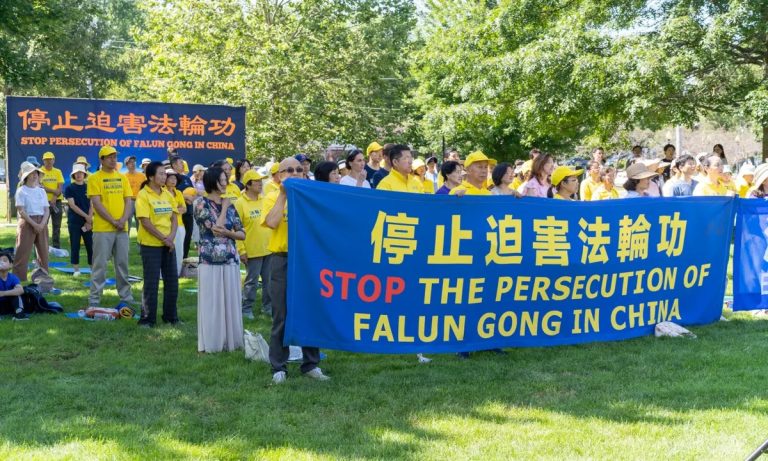
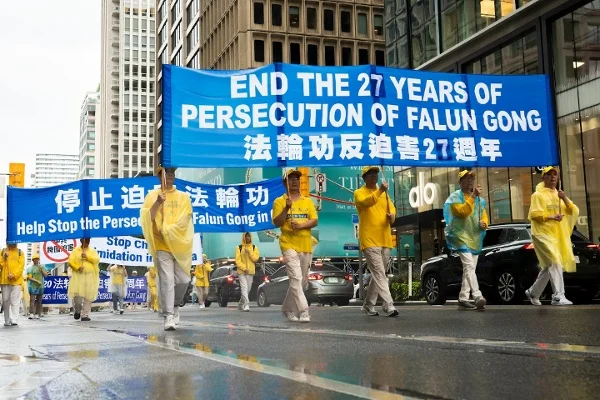
The letter also referenced the case of Wang Bingzhang, noting that several of his immediate family members are Canadian citizens. Citing that at least ten Canadian citizens have relatives imprisoned and tortured for practicing Falun Gong, the coalition demanded the release of all Falun Gong practitioners who are unjustly detained. It further urged the Chinese Communist Party (CCP) to release the long-disappeared Panchen Lama and Chinese Christian pastors who have recently been forcibly removed from their families and churches.
On Xinjiang, the alliance emphasized that Canada cannot accept the detention of Uyghur-Canadian Huseyin Celil on fabricated charges, calling for his unconditional release and the immediate restoration of unhindered consular access. The letter reiterated that Canada’s Parliament has already designated China’s mass detention of millions of Uyghurs as “genocide” under the Convention on the Prevention and Punishment of the Crime of Genocide.
The coalition also expressed grave concern over the CCP’s systemic use of torture, calling for implementation of recommendations from UN human rights experts and international organizations. Regarding interference, harassment, and transnational repression carried out by the CCP inside Canada, the letter demanded an immediate halt and stressed that any Chinese diplomats engaged in illegal activities should be expelled.
The open letter was signed on behalf of the coalition by Kwan Cheuk-chung, co-chair of the Toronto Alliance for Chinese Democracy, with a copy sent to Foreign Minister Anita Anand. The alliance stated that Carney’s visit represents a critical opportunity to recalibrate Canada’s human rights strategy toward China, arguing that placing human rights first is the most pragmatic and forward-looking path.
Jimmy Lai case enters final stage
On Jan. 12, one day before Carney’s departure for China, Hong Kong’s High Court began hearing mitigation submissions from Jimmy Lai and eight co-defendants in their national security law case. The proceedings are widely seen as the final stage before sentencing, with the court to issue its judgment at a later date. Lai, now 78, faces a potential life sentence.
RELATED: Why Jimmy Lai Was Convicted: Key Findings From the 855-Page National Security Verdict
Lai is the founder of the now-defunct pro-democracy newspaper Apple Daily. On Dec. 15, 2025, a panel of three designated judges convicted him on two counts of “conspiracy to collude with foreign forces” and one count of “conspiracy to publish seditious publications.” The trial spanned 156 court days. Lai denied all charges and was denied both a jury trial and the right to choose his own lawyer. Observers widely regard the case as politically motivated, centered on his use of media to advocate freedom, democracy, and international attention to Hong Kong.
The co-defendants include six former senior executives of Apple Daily and its parent company, as well as two representatives of the “Stand with Hong Kong” organization. Although they pleaded guilty earlier, none have yet been sentenced and have been detained for nearly five years.
The mitigation hearing is scheduled to last four days. Defense lawyers argued for reduced sentences based on defendants’ health, remorse, and cooperation. Under the national security law, sentences range from a minimum of 10 years to life imprisonment.
On the first day, some defendants sought a 50 percent sentence reduction, citing cooperation and witness roles. Lai’s lawyers focused on his advanced age, health conditions, including hypertension, diabetes, and cataracts, and the severe physical and psychological impact of more than 1,800 days in solitary confinement. Prosecutors responded by stating that his health condition was “stable.”
Sustained international pressure
Jimmy Lai’s case has drawn sustained international attention. Foreign ministers from Canada, France, Germany, Italy, Japan, the United Kingdom, the United States, and the European Union have publicly called for his immediate release.
RELATED: US Strike Sends Shockwaves Through Beijing as the CCP Faces a Multi-Front Crisis
Committee for Freedom in Hong Kong (CFHK) chairman Mark Clifford, a former director of Next Digital, described the trial as “a tragic stage drama,” stating that the 855-page verdict shows the court “serves the CCP rather than justice.” He said Lai paid a heavy price for loving Hong Kong, adhering to non-violence, and defending freedom, adding that “advocating freedom and opposing the CCP became his crime in Beijing’s eyes.”
Former Canadian diplomat Michael Kovrig, who was detained by China for three years as what many described as a “diplomatic hostage,” said the key issue in Lai’s case is not judicial procedure alone but how the international community applies pressure. He stressed that advocacy must be “intensive, repeated, and sustained,” aimed at changing Beijing’s and Hong Kong authorities’ cost-benefit calculations.
Kovrig argued that governments should continually raise the reputational and economic costs of continued detention, making clear that it damages international standing, business confidence, and diplomatic relations. At the same time, he said authorities should be offered “face-saving off-ramps,” such as humanitarian release on health grounds, deportation, or at minimum conversion to more humane forms of custody such as house arrest.
He recommended that world leaders make Lai’s release a standing agenda item in meetings with Chinese officials, clearly signaling that freeing Lai would bring positive, constructive international responses, while continued detention would chill diplomatic and commercial ties. Sustained international coordination and pressure, he said, remain the most realistic path toward securing Lai’s freedom.