By Li Jingyao, Vision Times
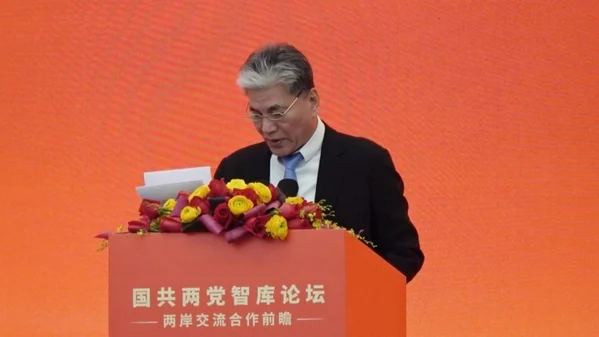
On Feb. 3, a “Kuomintang (KMT)-CCP Think Tank Forum” opened in Beijing, with organizers claiming it would promote exchanges in the five major industries of tourism, precision machinery, healthcare, energy, and disaster prevention. But the meeting has sparked controversy in Taiwan, as many of the sectors involved are tightly regulated strategic industries. Critics warn the forum could pose national security risks and undermine Taiwan’s efforts to strengthen a “non-red supply chain” while reducing economic dependence on the Chinese Communist Party (CCP).
Some analysts warn the forum reflects a broader political agenda that could “lock Taiwan back into China,” running counter to global economic trends.
RELATED: Taiwan Lawmaker-Elect Li Zhenxiu Risks Seat After Missing Citizenship Deadline
The event was co-hosted by the Kuomintang’s (KMT) National Policy Foundation and the Taiwan Affairs Office-affiliated Cross-Strait Relations Research Center. According to Taiwan’s Central News Agency (CNA), National Policy Foundation Deputy Chairman Lee Hong-yuan said that people on both sides of the strait “must work together to uphold the ‘1992 Consensus’ and oppose Taiwan independence.”
Success
You are now signed up for our newsletter
Success
Check your email to complete sign up
Participants reportedly reached five broad areas of agreement, producing 15 joint recommendations. Because the forum touches on highly sensitive sectors, critics argue it represents a deeply politicized operation rather than a normal civil exchange. Analysts have identified four major areas of concern.
1. National security risks
Wu Jun-zhi, director of the Democratic Progressive Party (DPP) China Affairs Department, warned on Feb. 3 during a DPP livestream program Wu Qing LIVE that the forum, though framed as “people-to-people exchanges,” involves national security and critical supply chains.
He also noted that precision machinery, medical technology, energy, and disaster prevention are all strategic industries subject to strict controls worldwide.
RELATED: Japan’s Takaichi Signals Tough Stance on Taiwan, Vows Alliance Support
Precision machinery, in particular, is a key link in Taiwan’s “non-red supply chain,” directly affecting Taiwan–U.S. industrial cooperation. Wu also stressed that the medical sector involves highly sensitive technologies, while China’s record of ethical controversies has drawn international concern.
Amid intensifying U.S.–China competition, Wu argued these exchanges cannot be viewed as purely civilian. Wu also noted the forum is fundamentally “a highly politicized operation” and serves as groundwork for a potential “Zheng-Xi meeting.” He warned its deeper aim is to allow the CCP’s social surveillance and political influence to penetrate Taiwan society.
DPP legislator Wang Ding-yu likewise emphasized that the forum is “a political arena, not an economic arena.” Taiwan’s precision instruments, healthcare, and energy industries, he noted, are tied to military equipment, advanced calibration, and satellite-related technologies. Bringing such sectors into this environment could create uncontrollable security risks.
2. Undermining the ‘non-red’ supply chain
Wu Jun-zhi argued that economically, the forum could weaken the trust foundation of Taiwan–U.S. trade cooperation and damage efforts to build a “non-red supply chain.”
DPP spokesperson Han Ying stressed that Taiwan must deepen global connections through such supply chains in order to engage the international community. She warned that if opposition parties remove the concept or cooperate with offshore island development regulations enabling origin-washing, it would effectively “lock Taiwan back into China.”
Wang Ding-yu pointed out that democratic nations worldwide, especially Taiwan’s key European and American markets, are actively building “non-red supply chains.” The KMT, he said, is moving against the global economic current by attempting to bind Taiwan’s supply chains back into China.
Recent trends show Taiwan’s dependence on China for trade and investment has declined, while overall economic performance has improved. Wang argued that the KMT’s “economic push against the tide” harms Taiwan’s future in democratic global markets.
3. Risks for Taiwan
Wu Jun-zhi said another purpose of the forum is to align with the CCP’s “155 Taiwan economic absorption” strategy—re-binding Taiwan’s industries and “locking Taiwan back into China.” Taiwan President Lai Ching-te addressed the issue at a press conference on Feb. 3, reporting on the results of the Taiwan–U.S. Economic Prosperity Partnership Dialogue (EPPD).
Lai said the forum offers Taiwanese society a clear comparison: “Should Taiwan continue working with the United States, Japan, Europe, and allied partners to move toward the world? Or should it once again be locked into China, pushing a second westward expansion?” He also emphasized that Taiwan’s trade strategy in recent years has been “based in Taiwan, deployed globally, and marketed worldwide.”
From former President Tsai Ing-wen to the present, Taiwan has signed the 21st Century Trade Initiative with the U.S., completed talks on reciprocal tariffs, and signed investment agreements. Lai added that Taiwan has signed new agreements with Japan, the United Kingdom, and Southeast Asian partners, including the Taiwan–Japan Digital Trade Agreement and the Taiwan–UK Enhanced Trade Partnership Initiative.
Taiwan has also updated and negotiated agreements with India, Thailand, Vietnam, and the Philippines. Over the past decade, Lai said, Taiwan’s steady economic strategy has ensured its businesses can thrive globally: “No matter when or where the sun rises, it can shine on Taiwan’s enterprises.”
4. Creating openings for CCP manipulation
Wang Ding-yu warned that the KMT’s participation creates “a breach” that benefits Beijing and harms Taiwan. Historically, he argued, forums led by KMT figures such as Cheng Li-wen have brought political costs to the Republic of China. Wang criticized Cheng’s “anti-U.S., pro-China” orientation as damaging Taiwan’s national interests, warning the consequences would ultimately be borne by the Taiwanese people.
According to “Liberty Times,” Cheng Kung University political science professor Hung Jing-fu said the forum’s real purpose is to pave the way for a “Zheng-Xi meeting.” He noted the CCP could use the Taiwan Affairs Office-linked research center to convey hidden strategic planning, fueling suspicion that the KMT is traveling to Beijing to “receive instructions.”
Taiwan’s Mainland Affairs Council condemned the forum, noting that Beijing has intensified pressure through “forced unification.” Amid worsening cross-strait tensions and turmoil in China’s military leadership, the Council said it is deeply regrettable that the KMT continues to align with the CCP through the “1992 Consensus” framework.
Editorial note: Views expressed in this article are the opinions of the author and do not necessarily reflect the views of Vision Times.