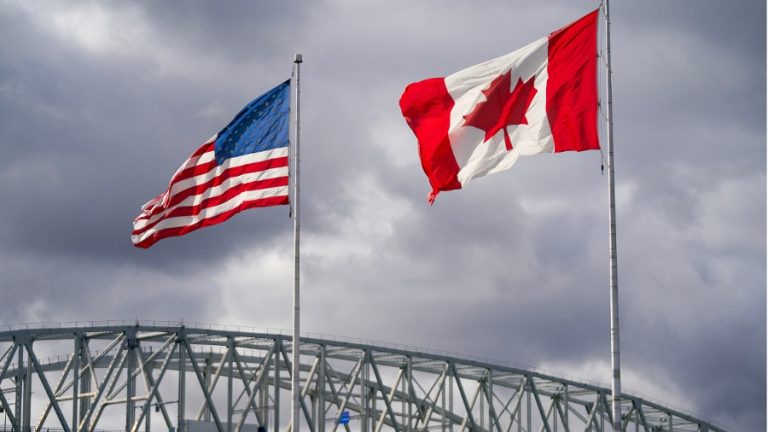
The U.S. Supreme Court has struck down one of President Donald Trump’s key tariff tools, ruling that he exceeded his authority in using emergency economic powers to impose sweeping duties — a decision that modestly lowers tariffs on Chinese goods but leaves the broader trajectory of U.S.-China competition largely unchanged.
In a 6-3 ruling on Feb. 20, the court held that the International Emergency Economic Powers Act (IEEPA) does not grant the president authority to impose tariffs. “Our task today is to decide only whether the power to ‘regulate … importation,’ as granted to the president in IEEPA, embraces the power to impose tariffs. It does not,” Chief Justice John Roberts wrote. He added that the president must “point to clear congressional authorization” to justify such an assertion of power.
The ruling did not address how the government should handle refunds of tariffs already collected.
Immediate impacts
According to Capital Economics, the decision reduces the effective U.S. tariff rate on Chinese goods from 32 percent to 23 percent. The change is significant but far from decisive, especially given the sharp escalation in tariffs over the past year.
Trump had raised tariffs on Chinese imports to as high as 145 percent in April 2025 under his so-called “Liberation Day” measures. Beijing retaliated with duties of 125 percent on U.S. goods. A subsequent truce brought rates down to 30 percent on Chinese exports to the U.S. and 10 percent on U.S. exports to China.
- Supreme Court Ruling Shakes Trump’s Tariff Strategy Ahead of Xi Summit
- Former US F-35 Instructor Charged With Providing Defense Training to China’s Military
Success
You are now signed up for our newsletter
Success
Check your email to complete sign up
The Supreme Court’s ruling trims the U.S. side of that equation but does not dismantle the broader trade regimes established by the Trump administration over the course of 2025.
President Trump called the ruling “deeply disappointing” and criticized the justices who ruled against him. Within hours, the White House pivoted.
White House shifts strategy
On the same day as the decision, the Trump administration invoked Section 122 of the Trade Act of 1974, declaring that the United States faces fundamental international payments problems. Under Section 122, the president can impose tariffs of up to 15 percent for 150 days without congressional approval.
The administration initially set a 10 percent tariff effective Feb. 24, 2026. On Feb. 21, Trump announced he would raise the rate to the statutory maximum of 15 percent, though no executive order had yet formalized the increase at the time of writing.
In parallel, Trump directed the launch of investigations under Sections 301 and 232 of U.S. trade law. Section 301 allows action against unfair foreign trade practices, while Section 232 permits tariffs or quotas on national security grounds, without a statutory ceiling on tariff levels.
According to The Wall Street Journal, the administration is considering Section 232 tariffs targeting industries including large-scale batteries, cast iron and fittings, plastic piping, industrial chemicals, and power grid and telecommunications equipment. Such measures would be separate from the Section 122 tariffs.
Other tools remain available as well, including Section 338 of the Tariff Act of 1930, which authorizes tariffs of up to 50 percent following findings of discriminatory treatment against U.S. commerce, though it has never been used to impose restrictions.
The shift underscores that while the court curtailed one pathway, the executive branch retains several others.
Beijing’s response
China’s commerce ministry said on Feb. 23 that it was conducting a “comprehensive assessment” of the ruling and urged Washington to cancel the tariffs. The ministry stated that U.S. measures, including reciprocal and fentanyl-related tariffs, “violate both international trade rules and U.S. domestic law and do not serve the interests of any party.” It reiterated that “trade wars produce no winners and protectionism offers no way forward.”
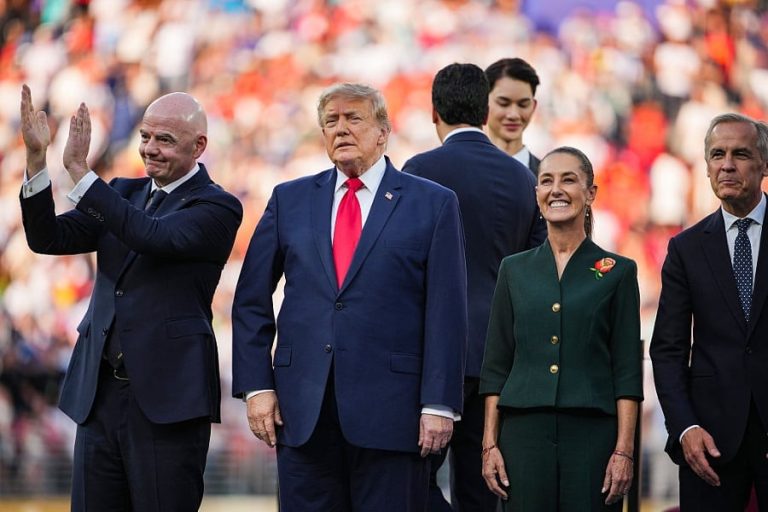
The ruling comes ahead of Trump’s planned visit to Beijing from March 31 to April 2, where he is expected to meet Chinese leader Xi Jinping. The two last reached a détente in Busan in 2025 that helped pause a cycle of retaliatory tariff hikes and led to a temporary relaxation of Chinese export controls on rare earths imposed in April and October 2025.
The trade relationship, however, remains entangled with disputes over technology restrictions, security concerns, and geopolitical flashpoints such as Taiwan.
Competition continues under new constraints
Analysts at SinoInsider, a New York-based risk consultancy specializing in elite Chinese politics, argue that the court’s decision is unlikely to alter the overall direction of U.S.-China rivalry. While Beijing may gain a short-term tactical advantage, Washington retains multiple legal avenues to sustain pressure on trade, technology, and security issues.
At the same time, SinoInsider notes that the ruling could reduce some unpredictability in U.S. trade policy. By requiring clearer statutory grounding, the decision may limit abrupt or sweeping tariff moves that lack congressional authorization. Future escalations are more likely to proceed through established investigative channels such as Sections 301 and 232, which require administrative processes and interagency coordination.
That procedural shift could make trade actions slower and more structured, though not necessarily less intense.
For Beijing, the ruling offers potential rhetorical leverage. SinoInsider suggests Chinese officials may characterize future U.S. tariff measures as “double unlawful,” arguing they violate both World Trade Organization rules and U.S. domestic law. Such framing could feature in bilateral talks or in potential WTO litigation, possibly alongside other countries affected by U.S. trade measures.
How aggressively China presses the issue may depend on broader strategic calculations. A confident Beijing might use the ruling to demand tariff refunds or seek expanded concessions during Trump’s upcoming visit. Alternatively, if Chinese leaders judge that stability is preferable amid domestic economic pressures, they may avoid steps that would derail the fragile détente.
So far, China’s response suggests caution rather than confrontation, given the various structural weaknesses in the Chinese economy, which is highly reliant on manufacturing for export.