Israel’s The Jerusalem Post reported on March 4 that the Israel Defense Forces (IDF) announced at 10:30 a.m. that an F-35I “Adir” fighter jet shot down an Iranian YAK-130 aircraft over Tehran. This marks the first fighter-to-fighter aerial combat since the outbreak of the current war.
The IDF stated that this was the Israeli Air Force’s first air-to-air kill in nearly 40 years. The last similar incident occurred on Nov. 24, 1985, when an Israeli F-15 “Baz” shot down two Syrian MiG-23s over Lebanon.
According to the IDF, the “Adir” successfully intercepted and destroyed the Iranian YAK-130. Iran has not yet confirmed the reported loss.
The F-35I achieved operational capability in the Israeli Air Force in 2017. Israel has ordered 75 of the aircraft from Lockheed Martin, with 36 delivered as of November 2022. The model is a modified version of the F-35A; the “I” stands for Israel, and “Adir” means “Mighty One” in Hebrew.

YAK-130 outperforms Iran’s older jets
The Daily Mail reported that the YAK-130 was designed and manufactured in Russia. Production began in the 1990s, and it entered service in 2010. It is typically used as an advanced trainer but can also carry out light attack and reconnaissance missions, with a maximum weapons payload of approximately 6,600 pounds.
Success
You are now signed up for our newsletter
Success
Check your email to complete sign up
Compared with Iran’s aging F-4 and F-5 aircraft currently in service, the YAK-130 represents a more advanced platform. On Sunday, Israeli forces reportedly destroyed F-4 and F-5 jets on the runway as they were preparing for takeoff.
However, in terms of overall air combat systems, the Iranian Air Force remains at a clear disadvantage. Within the first two days of the conflict, Israel and the United States established overall air superiority over the Tehran region, enabling sustained close-range strikes and prolonged loitering over targets with minimal interference.
Conflict expands; Energy and regional security under pressure
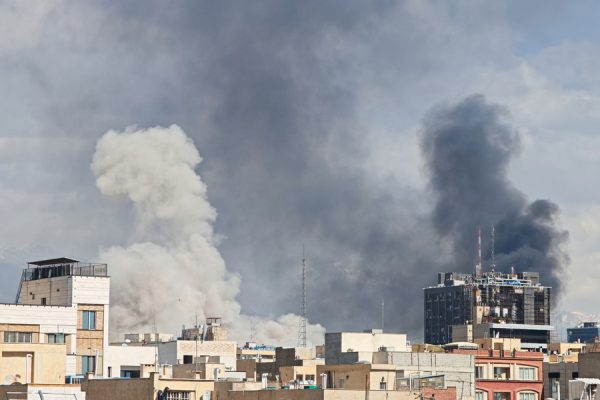
As the war entered its fifth day, U.S. and Israeli forces continued airstrikes on Tehran and other cities. Multiple buildings in central Tehran were damaged, and the Shiite holy city of Qom was also struck.
Iranian authorities claim that 1,045 people have been killed in U.S. and Israeli airstrikes so far, though this figure cannot be independently verified. Officials also announced that a memorial event originally scheduled for Supreme Leader Ali Khamenei has been postponed.
Regional security tensions have risen simultaneously. Turkey’s Ministry of Defense stated that NATO air defense systems intercepted a ballistic missile launched from Iran that was originally headed toward Turkish airspace. Off the coast of Sri Lanka, the Iranian frigate “IRIS Dena” encountered an emergency situation, and 32 people were rescued locally.
As shipping risks in the Strait of Hormuz increase, Brent crude oil prices rose to $84 per barrel, up more than 15 percent since the conflict began, marking the highest level since July 2024. Global stock markets have also come under pressure amid soaring energy prices.