News analysis
During the 2026 “Two Sessions” meeting of the Chinese national legislature and its overshadowing Communist Party organization, many delegates from the People’s Liberation Army (PLA) were conspiciously absent in a demonstration of the tectonic purges that have ripped through the senior leadership of the Party’s armed forces.
Footage broadcast on the state-run evening program Xinwen Lianbo from a March 7 meeting between Chinese leader Xi Jinping and military delegates showed only four active-duty full generals present: Central Military Commission (CMC) vice chairman Zhang Shengmin, Defense Minister Dong Jun, Eastern Theater Command commander Yang Zhibin, and Central Theater Command commander Han Shengyan.
Two retired generals, including Fan Xiaojun, former political commissar of the Northern Theater Command, and Yi Xiaoguang, a former Central Theater Command commander, also attended in their capacities as officials in the National People’s Congress (NPC).
- Gen. Zhang Youxia Reportedly Detained, Signaling Deeper Xi-Led PLA Purge (Jan. 22, 2026)
- Confirmed: Xi Jinping Purges Top PLA Commanders as Military Turmoil and Taiwan War Fears Mount (Jan. 25, 2026)
- China Boosts Defense Spending at 2026 ‘Two Sessions’ as Military Priorities Grow
Top commanders removed or under investigation
Their presence contrasted sharply with the absence of many other prominent commanders, among them some of the most powerful officers in the Chinese military establishment. They include former CMC vice chairmen Zhang Youxia, placed under investigation late this January, and He Weidong, who came under scrutiny in October 2025.
Success
You are now signed up for our newsletter
Success
Check your email to complete sign up
Four former members of the Central Military Commission — the body that commands China’s armed forces — have already been publicly linked to investigations or removals.
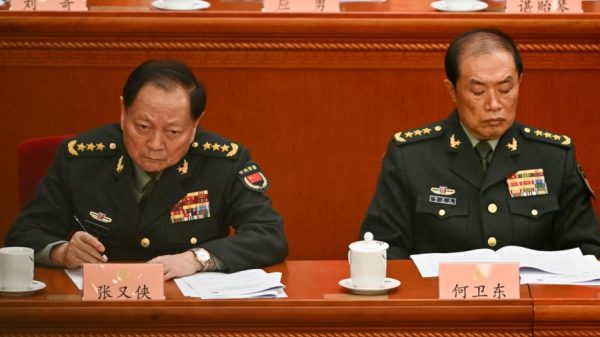
Zhang Youxia, along with several other purged top commanders, were regarded as close allies of Xi Jinping, eliciting much speculation and rumors about whether Xi had perhaps lost power over the military, while other observers regarded the purges as part of the CCP head’s determination to root out corruption and disloyalty throughout the ranks.
Also absent from the Two Serssions were generals Liu Zhenli, former chief of the PLA Joint Staff Department, and Miao Hua, former head of the military’s Political Work Department.
According to official reports, 243 delegates from the PLA and the People’s Armed Police attended the 2026 Two Sessions. That represents a 13.5 percent drop from the 281 military delegates who were present at the beginning of the current NPC term in 2023.
The decline is even more dramatic among the military’s top ranks. The number of full generals among the delegation fell from 26 in 2023 to just six in 2026, suggesting sweeping upheaval in the PLA’s senior leadership.
Other prominent commanders who have lost positions or had their NPC delegate status terminated include Li Qiaoming, former commander of the PLA Ground Force; Shen Jinlong, former commander of the PLA Navy; Qin Shengxiang, the Navy’s former political commissar; Yu Zhongfu, former political commissar of the PLA Air Force; and Li Wei, former political commissar of the Strategic Support Force.
Several frontline commanders still technically listed as NPC delegates were also absent from the March 7 plenary meeting. These include former Air Force commander Chang Dingqiu, former Navy commander Hu Zhongming, and former Western Theater Command chief Wang Haijiang.
Meanwhile, in March 2026 three more senior officers — Han Weiguo, Gao Jin, and Liu Lei — had their membership in the Chinese People’s Political Consultative Conference revoked, another sign of political trouble.
Xi signals hardline stance on loyalty

Xi Jinping’s March 7 speech to the military delegation offered clues about the political logic behind the upheaval.
In his remarks, Xi stressed that the PLA must remain absolutely loyal to the Chinese Communist Party and warned that there could be no place in the armed forces for those who are disloyal.
“The military is the force that holds the gun,” Xi said, emphasizing that there “must never be individuals who harbor divided loyalties” towards the CCP and himself. He also called for tighter oversight of military finances, power structures, and major defense projects, while urging improvements in supervision of military-civil integration and weapons development.
The speech underscored Xi’s long-running effort to ensure the Party’s “absolute leadership” over the armed forces — a central principle of the CCP political system. Mao Zedong, the founder of Communist China, famously said that “political power grows out of the barrel of a gun.”
Political purge or modernization push?
Analysts say the unusually high number of absent generals suggests the PLA is undergoing one of the most sweeping leadership purges in decades.
According to New York-based political risk consultancy SinoInsider, the sharp drop in military delegates — particularly the absence of roughly 85 percent of the full generals who once represented the PLA at the NPC — cannot be explained by routine retirement or ordinary personnel changes.
Instead, the pattern suggests a far-reaching campaign to remove officials whose political loyalty or performance is in question. In particular, Xi’s speech singled out political reliability as the most pressing concern.
By warning against “divided loyalty,” Xi was signaling that the threat inside the military is not merely corruption but also potential factionalism, SinoInsider said.
At the same time, the Party leadership appears concerned about the effectiveness of the PLA’s military modernization programs. Xi emphasized the need to monitor funding flows and ensure that “every yuan” of defense spending is used effectively — an apparent reference to corruption scandals and mismanagement in recent years, including problems reportedly uncovered within the PLA Rocket Force.
Security overseers
Another unusual moment during the meeting was the presence of Wang Xiaohong, China’s minister of public security and a member of the Communist Party Secretariat. Wang is also reagrded as being a close ally of Xi.
Although Wang is not part of the PLA command structure, state television showed him in a close-up shot during the military delegation meeting. SinoInsider noted that Wang’s appearance may indicate that civilian security organs are playing a larger role in investigating corruption inside the military. His involvement could also reflect Xi’s lack of confidence in the PLA’s internal disciplinary system, which would normally handle such cases.
While the purge may strengthen Xi’s political control over the armed forces, it could also create practical challenges for the PLA, especially if Beijing decides to wage war or is pushed into a military conflict.
SinoInsider argues that the leadership reshuffle echoes historical campaigns such as Mao Zedong’s purge of military leaders following the 1971 Lin Biao incident, when large numbers of officers were removed or sidelined following the defection, death, and official denunciation of the top general who had once helped Mao seize control over China and was even annointed his successor as CCP chairman.
Even as Xi reinforces his political authority and pours more resources into the PLA, the frequent personnel turnover could disrupt the military’s chain of command and weaken morale in the short term. It may also encourage officers to further prioritize political loyalty over professional expertise, which could affect battlefield decision-making and innovation.