In the distant universe, an almost unimaginably massive object continues to release enormous amounts of energy. “TON 618,” short for “Tonantzintla 618,” is currently one of the most massive known celestial objects, located in the constellation Canes Venatici. Based on redshift calculations, its light has traveled approximately 10.8 billion years to reach us, meaning we are seeing it as it appeared in the early universe.
This object was first recorded in 1957 during observations at the Tonantzintla Observatory in Mexico, and at that time it was merely classified as a faint, unusually bright star. In the 1960s, astronomers began to study the object more carefully, gradually realizing its true nature. In 1970, radio observations at Bologna in Italy detected strong radio emissions, confirming that it was not an ordinary star but an active galactic nucleus.
Further spectral analysis showed that TON 618 exhibits a significant redshift, indicating its extreme distance while also revealing its immense luminosity. Its absolute magnitude is approximately −30.7, and its total radiative power is about 4 × 10⁴⁰ watts, equivalent to tens of trillions of Suns, making it one of the most luminous objects currently known. The energy output is believed to originate from a central supermassive black hole. According to 2019 research, this black hole has a mass of roughly 40.7 billion solar masses, far exceeding that of Sagittarius A in the Milky Way. Earlier estimates suggested a mass of 66 billion solar masses, indicating a scale that surpasses the total stellar mass of many galaxies.
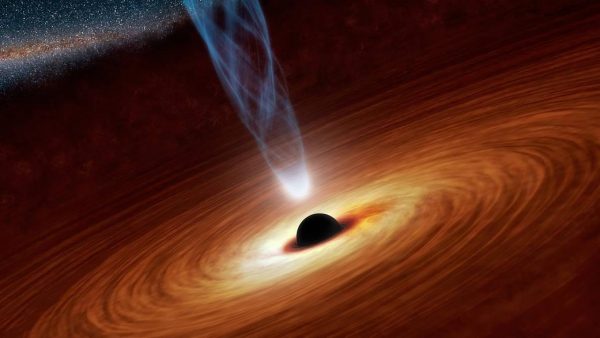
Surrounding this black hole is an accretion disk of violently infalling gas and matter, with measured gas velocities reaching up to 10,500 km/s, reflecting the black hole’s immense gravitational pull. The motion of this gas broadens the spectral emission lines, forming the so-called “broad lines,” a key signature used to identify quasars.
Moreover, TON 618 is surrounded by an enormous gas nebula. In 2021, observations using the Atacama Large Millimeter/submillimeter Array (ALMA) confirmed the presence of this vast gaseous structure, identified as a “Lyman-alpha blob.” This nebula spans 330,000 light-years, over twice the size of the Milky Way, making it one of the largest known star-forming structures. The massive cloud is composed of neutral hydrogen, which, under the radiation from the quasar, emits prominent Lyman-alpha spectral lines, causing the nebula to glow in ultraviolet light. Within the nebula, there is also ionized gas with a mass of tens of billions of solar masses, aligned with the quasar’s powerful jets.
Success
You are now signed up for our newsletter
Success
Check your email to complete sign up
Because Earth’s atmosphere absorbs much of this radiation, studying such objects is challenging and primarily relies on infrared observations. As such, TON 618 has become a crucial target for studying the formation of early massive galaxies.
This quasar, one of the largest known, is considered a progenitor of modern massive galaxies, and its activity provides important insights into how early matter structures grew. Once mistaken for a normal star, TON 618 has now become an iconic example of a quasar. Its study reflects humanity’s ongoing expansion of cosmic understanding. This distant, luminous object is not just an observational target but also a message from the far reaches of the universe, demonstrating unimaginable cosmic forces silently at work.