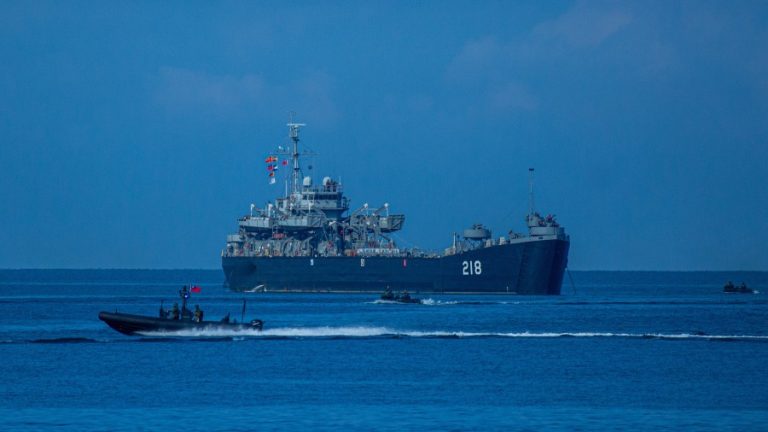
Amid ongoing tensions in the Middle East, a British defense analyst says Taiwan has a narrow window to study real-world conflict dynamics in the Strait of Hormuz.
Philip Shetler-Jones, a senior research fellow for Indo-Pacific security at the Royal United Services Institute, or RUSI, said Taiwan should track developments in the strategic waterway closely. The situation offers practical insight into how to prepare for scenarios such as blockades, quarantines, and embargoes. The opportunity, he said, is immediate.
If Taiwan has experimental systems ready for testing, including mine countermeasures, threat detection technologies, or unmanned platforms, the United States would likely welcome their deployment in the region. There may be no better operational environment right now.
Defensive advantages in strait warfare
Despite the gap in military strength between Taiwan and China, geography could still favor the defender.
Shetler-Jones pointed to Iran’s position in the Strait of Hormuz and Ukraine’s operations in the Black Sea. Both show how weaker actors can shape access to contested waters. Iran’s naval forces have taken heavy losses, yet it continues to exert practical control over the Strait of Hormuz and the connected waters of the Persian Gulf and Gulf of Oman. U.S. naval operations remain constrained.
Success
You are now signed up for our newsletter
Success
Check your email to complete sign up
In a Taiwan Strait scenario, he said, even if naval or coast guard forces were degraded, land-based defenses, situational awareness, and command systems could still deny full control of surrounding waters.
That outcome depends on speed. Adversaries adapt quickly. Taiwan, he said, must move faster.
He also pointed to another trend. Recent U.S. strikes on Iran have not stopped at launch platforms or warships. They have extended to military production facilities and supply chains. Pressure is now aimed at the source. For Taiwan, that shift carries clear implications.

Testing systems in real-world conditions
Some have suggested Taiwan could support the United States more directly in the Middle East. Shetler-Jones takes a narrower view.
Rather than deploying ships or troops, Taiwan could test specific capabilities, especially mine-clearing and threat detection systems. Many are already moving toward unmanned operation. All are essential in breaking a blockade.
If deployed, such efforts would likely be seen in Washington as a signal of support. But even without that political effect, the operational value stands on its own. Testing systems under real conditions serves Taiwan’s interests directly. The Strait of Hormuz offers that environment.
In a recent article on the RUSI website, Shetler-Jones warned that a conflict in the Taiwan Strait would have consequences for global shipping and supply chains that could exceed those seen in the Middle East today. There is still time to act, he said, but not indefinitely.
US resource strain and public opinion risks
Since late February, as fighting intensified in the Middle East, the United States has shifted resources from the Indo-Pacific. Missile defense systems, thousands of Marines, and amphibious assault ships have been redeployed from South Korea and Japan.
At the same time, key munitions stockpiles are being drawn down. These include Joint Air-to-Surface Standoff Missiles, Tomahawk cruise missiles, and Patriot air defense systems. All are central to U.S. and allied deterrence in the Indo-Pacific.
Production is not keeping pace. That imbalance has raised concerns about the durability of U.S. deterrence against China.
Shetler-Jones said allies are right to be concerned. Further reallocations to the Middle East remain possible.
But the longer-term issue may lie elsewhere. Public opinion.
How the current conflict ends will shape how Americans view future overseas engagements. If the outcome is seen as a failure, with high costs and limited results, support for foreign intervention could weaken. That includes potential involvement in Asia.
Debate in Washington is already shifting. While the long-standing view has been to maintain Taiwan’s current status, more voices are now questioning Taiwan’s relevance to U.S. national interests.
That shift raises the threshold. Those arguing for U.S. intervention in a Taiwan contingency will have to make their case more forcefully.
At the same time, the Strait of Hormuz crisis has underscored a broader reality. Disruptions to shipping lanes can trigger cascading economic, social, and political effects across borders. A Taiwan Strait conflict would likely follow a similar pattern. It would not remain a localized issue.
UK role and limits of naval capacity
If conflict were to break out in the Taiwan Strait, Shetler-Jones said the United Kingdom could provide meaningful support, including intelligence. The constraint is not capability, but political choice.
Despite resource pressures, the UK continues to deploy assets such as nuclear-powered submarines to the Indo-Pacific.
At the same time, he acknowledged a structural problem. As an island nation, the UK has underinvested in naval power for years. That gap is now visible in the Middle East, where naval resources are stretched.
The lesson is straightforward. If Britain wants to sustain global commitments, it will need to prioritize maritime and air capabilities. Doing so would expand its options in future crises.