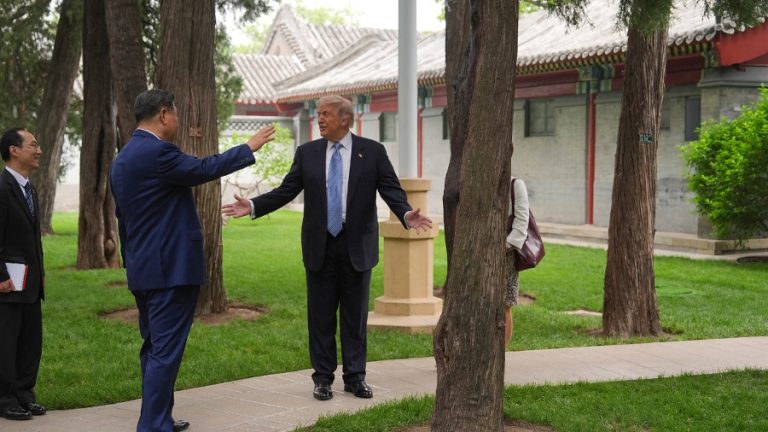
Cheng Li-wun, chairwoman of Taiwan’s largest opposition party, the Kuomintang, is set to visit mainland China this month after being invited by Chinese leader Xi Jinping ahead of a separate planned trip to Beijing by U.S. President Donald Trump.
Taiwan-based experts told Vision Times that the summit, which Cheng has “gladly” accepted, is part of the Chinese Communist Party’s effort to shape the narrative on Taiwan ahead of talks between Xi and Trump.
The People’s Republic of China (PRC) sees democratic Taiwan as part of its own territory, while the island of 23 million hosts the government of the Republic of China (ROC), which retreated there following its military defeat on the mainland in 1949.
Since the introduction of democratic elections in the 1990s, the Kuomintang — whose name translates to “Chinese Nationalist Party” and used to govern all of China — has adopted friendlier ties with Beijing, contrasting with the ruling Democratic Progressive Party (DPP) which is more explicitly for a Taiwanese identity separate from China.
- Hackers Claim Breach of China’s Supercomputing Hub, Stealing 10PB of Sensitive Military Data
- Taiwan Hosts Multiple High-Profile International Delegations Amid Rising Global Attention
- Lai Ching-te: US Now Taiwan’s Top Investment Destination and Export Market
- KMT Chair Cheng Li-wen Faces Backlash for Honoring CCP Spy in ‘White Terror’ Remembrance Tribute
Cheng’s visit to Beijing is likely to happen in early April following the Qingming festival, while Trump’s trip, delayed by the ongoing U.S. war on Iran, is expected to come in May.
Success
You are now signed up for our newsletter
Success
Check your email to complete sign up
“After meeting with the opposition, Xi Jinping can use this opportunity to emphasize the resumption of cross-strait interaction and exchanges, advocating that cross-strait affairs be resolved by China itself and that the United States should not interfere in China’s internal affairs,” Shen Ming-Shih, director of national security research at Taipei’s Institute for National Defense and Security Research, told Vision Times in emailed statements.
The invitation has come at a time when Taiwan President Lai Ching-te’s administration is trying to get the Legislative Yuan — the ROC’s parliament — to accept an extra $40 billion in defense spending. Taiwan’s divided legislature with an opposition-majority has tremendously raised KMT’s stakes in national decision making.
The Kuomintang said that it wants to strengthen Taiwan’s defenses, but it refuses to sign “blank cheques” and has sought more details from Lai’s administration.
In this context, Shen believes that Xi can use his meeting with Cheng to demand that the US stop arms sales to Taiwan.
Cheng has told reporters that her April visit will usher in a “new spring” between Beijing and Taipei and work towards extending “kindness” and building “mutual trust.”
“We will work hard for cross-strait peace and stability, making positive efforts, and let the whole world feel at ease,” she said, as reported by Reuters.
Courteney Donovan Smith, Taipei Times columnist, noted in a text message to Vision Times that the invite was sent by Xi and the CCP’s Central Committee. This implies that they enjoy comfort with Cheng and that Xi is “personally invested” in it.
“However no official meeting between Cheng and Xi has been announced, so likely there are still some concerns or issues on the Chinese side that still remain to be negotiated,” Smith said.
United Front tactics
Experts said the timing of the invitation showcases Communist China’s maneuvering tactics — called United Front work in CCP parlance — aiming at influencing Taiwan’s policy makers and the island’s broader politics to serve Beijing’s interests.
“For Taiwan, Xi Jinping’s meeting with the chairperson of the opposition party KMT [Kuomintang] is a classic example of united front tactics,” Shen said.
He added that “with the KMT divided into pro-US and pro-China factions, Xi’s meeting with the chairperson Cheng Li-wen, known for her anti-US stance, can bolster her power in the internal party struggle and attempt to reverse the KMT’s policy direction.”
Smith said much will depend upon what Cheng will say during her trip and there are concerns that it’ll res this year’s election within the Kuomintang.
“That the KMT is providing zero assistance to press in joining this trip and is asking them to apply to China’s TAO [Taiwan Affairs Office] directly is not a good sign for those who hope she will uphold Taiwan’s dignity and sovereignty during her trip,” he said.
According to Shen, the situation would also impact the Kuomintang’s junior coalition partner, the Taiwan People’s Party (TPP). With its eight seats in the Legislative Yuan, the TPP is a critical third-party swing vote in Taiwan’s hung parliament.
However, the strength of the coalition could be weakened as its former chair, Ko Wen-je, was recently sentenced to 17 years in prison on corruption charges. The current TPP chief, Huang Kuo-chang, has defended Ko and described his conviction as political targeting.
How will Trump respond?
Smith pointed at the possibility of Xi pressing Trump to modify U.S. language on Taiwan during the summit.
“They likely hope that Cheng will provide language that suggests the Taiwan side is in favour of working with or even unifying with China,” Smith said.
Americans have used a “nuanced and carefully calibrated” language about Taiwan, according to him but in today’s geopolitical context, Beijing may hope that Trump will be willing to shift that language because first, the US may not understand that nuance anymore and secondly Trump may agree to trade that away for something that concerns him immediately.
“However, this is a risky bet, how Trump might react to such an offer is anyone’s best guess,” said Smith.
Shen even sees a shift in the PRC’s future approach to Taiwan after Cheng’s Beijing visit.
According to Shen, Beijing’s persistent policy of coercing Taiwan through military or economic threats will no longer work. Instead, the PRC will in the future prefer to work towards peaceful unification through greater United Front tactics. Rigid policies and constant coercion of Taiwan would prove disastrous for the Kuomintang in the upcoming 2026 local elections.
Conversely, if Xi Jinping “shifts to a more conciliatory approach towards Taiwan or even stops the coercive policies around the Taiwan Strait, the Kuomintang chairperson’s visit to China would help stabilize her domestic political power and would also encourage KMT to stop its arms purchases and security cooperation with the United States,” Shen wrote.