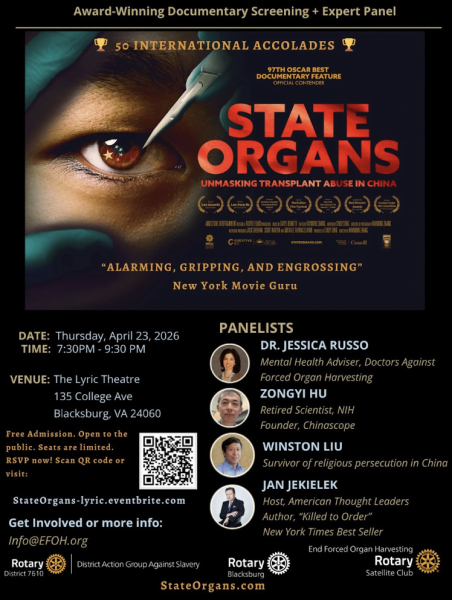
BLACKSBURG, Virginia — On April 23, the Lyric Theatre hosted a screening of “State Organs,” an award-winning documentary that examines one of the world’s least understood forms of human trafficking: Forced organ harvesting and its far-reaching human rights implications.
Hosted by the Rotary Club of Blacksburg and Montgomery County in partnership with the End Forced Organ Harvesting (EFOH) Rotary Satellite Club as well as District Action Group Against Slavery (District 7610), the event brought together film, expert commentary, and firsthand testimony.
What unfolded was not just a viewing experience, but a sobering look into horrifying allegations that have drawn international scrutiny and government legislation calling for greater transparency.
RELATED: Bomb Threat Targets Taiwan University Over ‘State Organs’ Screening
State-sanctioned organ harvesting
According to a 2024 report from the U.S. Department of State, trafficking for the purpose of organ removal remains among the least reported and least understood forms of human exploitation. While such crimes are often associated with unstable regions, organizers and panelists pointed to mounting evidence suggesting that prisoners of conscience in China have been systematically targeted.
Success
You are now signed up for our newsletter
Success
Check your email to complete sign up
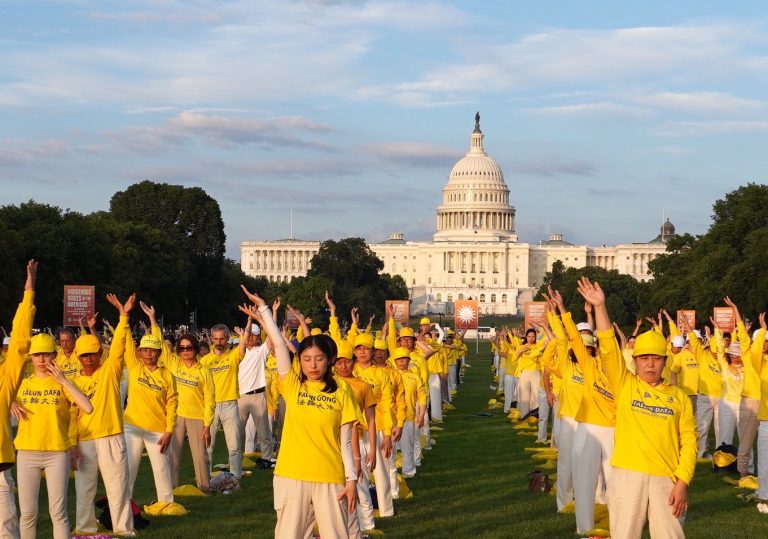
The documentary itself follows the decades-long search of two families whose loved ones disappeared under mysterious circumstances. Their investigation leads to disturbing conclusions: A state-run system harvesting organs from detained individuals, many of whom are practitioners of Falun Gong, an ancient spiritual discipline rooted in the principles of truthfulness, compassion, and tolerance.
Falun Gong, also known as a Falun Dafa, saw explosive growth in China during the 1990s, with tens of millions of adherents before the Chinese Communist Party (CCP) launched a sweeping crackdown in July 1999. Since then, thousands survivors and investigators have reported widespread detention, forced labor, and medical testing consistent with organ matching procedures.
RELATED: Canadian Parliament Hearing Spotlights Beijing’s Transnational Repression Tactics
Human rights’ violations
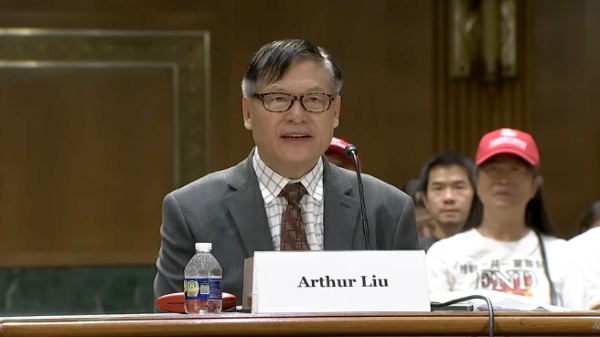
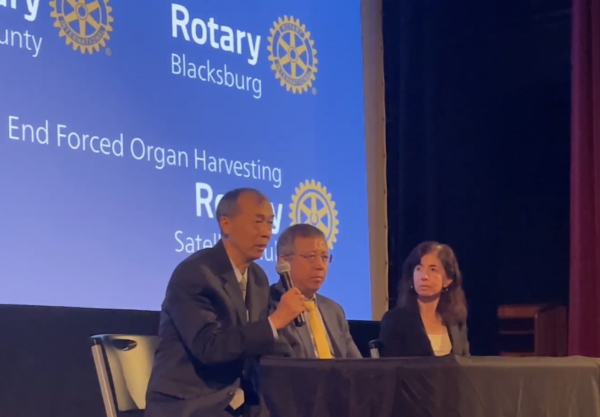
The emotional weight of the film carried into the panel discussion that followed. Winston Liu, a former Ph.D. candidate at Tsinghua University, shared his personal story of being imprisoned four times between 1999 and 2003 due to his beliefs. His testimony underscored the human toll behind the allegations: Years of separation from family, psychological trauma, and the erosion of personal freedom.
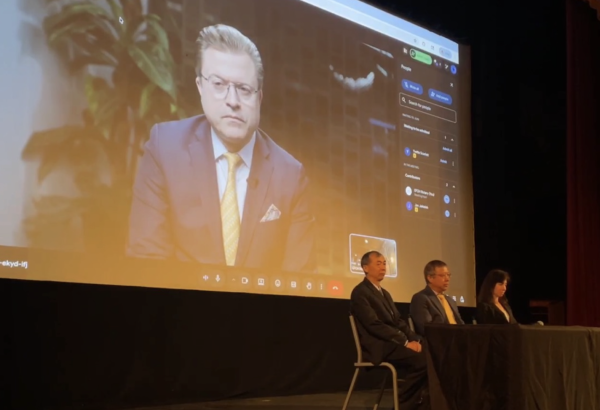
Another member of the panel, Dr. Jessica Russo, a mental health advisor with Doctors Against Forced Organ Harvesting (DAFOH), shifted the focus to the global medical community. She highlighted the ethical challenges surrounding transplant systems that lack transparency, particularly the difficulty of verifying donor consent in countries where information is tightly controlled.
Zongyi Hu, a retired scientist from the National Institutes of Health, offered insight into why Western institutions have been slow to confront these allegations, while journalist Jan Jekielek, author of “Killed to Order,” emphasized the critical role of investigative reporting in bringing such issues to light.
‘Gut-wrenching’
For many in attendance, the experience was deeply unsettling. One attendee, Catherine, described the issue in the film as “stunningly awful,” overwhelmed by what she saw as the scale and brutality of the abuses. Another audience member, Kim, called the documentary “shocking, informative, and gut-wrenching,” adding that it would take time to fully process the scope of the abuse.

For Christy Brown, a Rotary member who helped organize the event, the screening was more than an educational effort; it was a call to responsibility. “At first I didn’t want to attend the screening of this film last year during the Rotary International Convention in Calgary Canada. But then I felt that as a human being, it’s my responsibility to learn the uncomfortable truth,” she said. Brown was deeply disturbed by what she saw in “State Organs.” She then decided to bring the film to her local community in Blacksburg to raise more awareness.
Organizers echoed that sentiment, stressing that awareness alone is not enough. Cindy Liu, chair of the “End Forced Organ Harvesting” initiative, urged attendees to translate knowledge into action, framing the issue as a broader moral challenge.
Legislative efforts
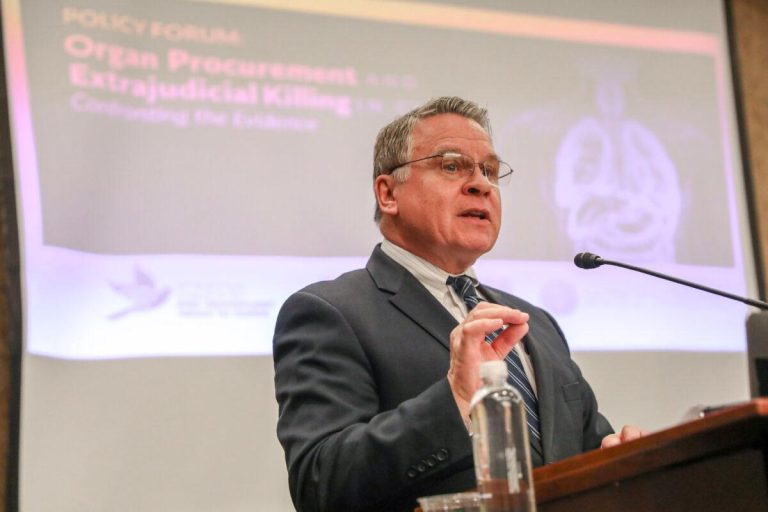
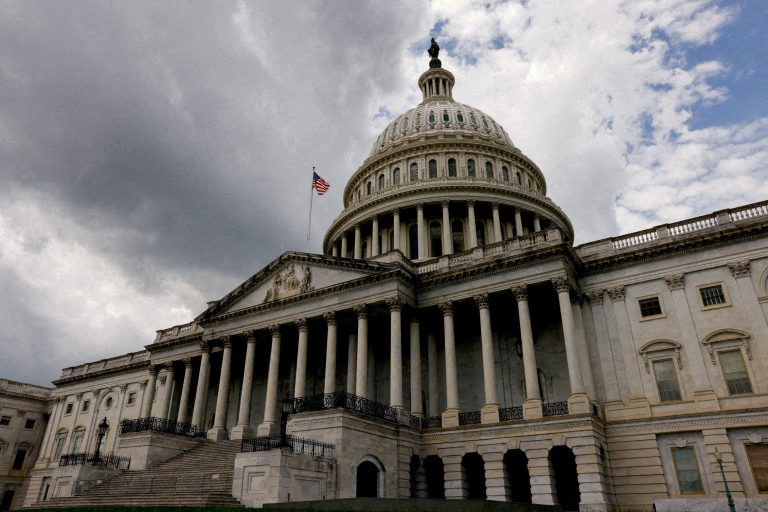
Legislative efforts are beginning to reflect that urgency. On May 5, the U.S. House of Representatives passed H.R. 1540, while the “Falun Gong and Victims of Forced Organ Harvesting Protection Act” (S.4009) is under consideration in the Senate. Advocates say public engagement, through calls, emails, and outreach to lawmakers, could play a decisive role in advancing future measures that call on greater transparency and protection for prisoners of conscience in China.
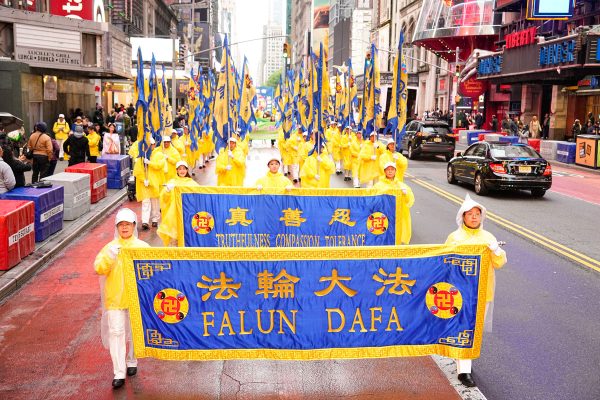
H.R. 1540, which passed without a single objection, authorizes sanctions on individuals involved in or facilitating the involuntary removal of organs from detained Falun Gong practitioners in China. The penalties range from blocking entry into the U.S. and revoking visas, to fines of up to $1 million and prison sentences of up to 20 years.
By the time the theater emptied, some attendees were already talking about next steps, including how to learn more, who to contact, and what could be done beyond the screening to raise more awareness on the issue of forced organ harvesting in China.
About the Film
“State Organs” exposes China’s state-run organ transplant system, which targets Falun Gong practitioners, ethnic minorities, and political prisoners. The documentary has won over 50 international awards and was the 97th Academy Award (Oscar) qualified for Best Documentary Feature.