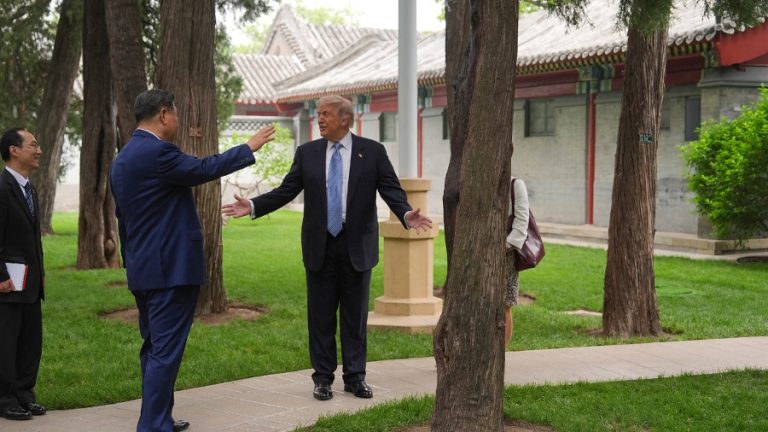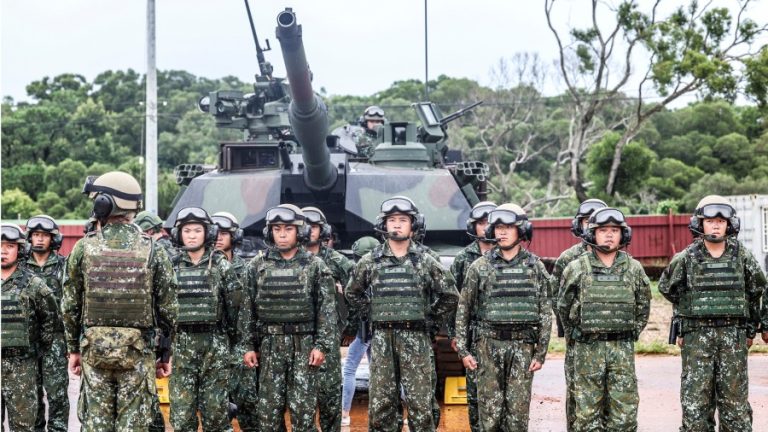
Taiwan’s ruling and opposition parties have failed three times to reach an agreement on the “Special Defense Budget Act” while U.S. President Donald Trump’s upcoming trip to China for a meeting with Xi Jinping is drawing closer.
Lien Hsien-ming, president of the Chung-Hua Institution for Economic Research, said in a message on social media that while scholars from U.S. think tanks have recently been making visits and that while many legislators have also privately expressed support for the special defense budget, in reality progress is very difficult.
“They themselves are not sure where the problem lies,” he said, warning that if the issue is not resolved before the Trump–Xi meeting, Taiwan could run into serious trouble.
If Taiwan does not cooperate, Trump’s reaction is unpredictable
Lien Hsien-ming stated in a Facebook post on May 1 that during previous exchanges with U.S. think tank scholars, the topic of Trump’s decision-making style and Taiwan-related issues came up. He said Trump is “extremely, extremely busy” dealing with domestic politics and international conflicts, and Taiwan is not among his top priorities. Therefore, Taiwan’s best strategy is to keep a low profile and avoid drawing Trump’s attention unless necessary.
Lien added that when Trump does focus on Taiwan—such as during the Trump–Xi meeting in mid-May—he will examine several areas, including the trade deficit, bilateral trade agreements, the semiconductor supply chain, U.S.-Taiwan energy cooperation, and defense spending. If Taiwan gives him the impression of being cooperative and meeting his expectations of an ally, he will shift his attention elsewhere. However, if he perceives Taiwan as uncooperative, his response becomes difficult to predict, as his negotiation style relies on maximum pressure and involves few constraints on tactics.
Success
You are now signed up for our newsletter
Success
Check your email to complete sign up
Lien Hsien-ming further analyzed that a typical president distinguishes between long-term and short-term factors and separates economic, political, and security domains—using trade measures for trade issues and military means for military matters. However, Donald Trump does not think in this way; instead, everything is driven by transactional interests.
U.S. scholars, he said, have offered a well-intentioned reminder that Taiwan should, before the “Trump–Xi meeting,” make Trump feel that it is a cooperative ally.
“It’s like a final exam—if you do well, even if you’ve been slacking off, the teacher won’t bother you. On the other hand, if during the few moments when he pays attention Trump finds Taiwan uncooperative, it’s hard to predict what he might do to express dissatisfaction,” Lien wrote.
Possible actions could include suddenly canceling future arms sales, demanding increased investment in the United States, or even canceling bilateral tariff agreements that are currently under negotiation.
‘Taiwan could run into trouble’
Lien stated that most U.S. think tanks currently still support Taiwan, but there are also some who believe Taiwan should not create strategic risks in the U.S.–China relations because of its tensions with China.
He emphasized that “Taiwan needs to demonstrate its determination and capability for self-defense; otherwise it will be difficult to convince the American public to continue supporting Taiwan. This is also the hardest position for them when speaking up for Taiwan.”
Lien Hsien-ming said that during visits by U.S. think tank scholars, many lawmakers from the Kuomintang (KMT), Democratic Progressive Party (DPP), and Taiwan People’s Party (TPP) privately expressed support for the special defense budget. However, in reality, progress has been very difficult.
He said, “They themselves are not sure where the problem lies, but they assess that if the issue is not resolved before the Trump–Xi meeting, Taiwan could run into trouble.”
Upcoming negotiations
Taiwan’s ruling and opposition parties have failed three times to reach consensus on the special defense budget. According to the Central News Agency, Legislative Speaker Han Kuo-yu announced that another round of negotiations will be held on May 6.
Each side has proposed three different versions of the defense budget. The Executive Yuan’s proposal includes a NT$1.25 trillion eight-year “Strengthening Defense Resilience and Asymmetric Capabilities” special budget, covering U.S. arms purchases, domestically developed drones, and the “Taiwan Shield” system, emphasizing completeness without cuts.
Within the Kuomintang, there are internal disagreements over the budget size, with no consensus reached between the “380 billion + N” and 800 billion proposals. The opposition prefers restricting the funds solely to U.S. arms purchases, while the Executive Yuan version also includes domestically produced systems such as “naval vessel construction in Taiwan” and “domestic aircraft production,” accounting for roughly NT$300 billion.
The delay in passing the special defense budget has drawn attention from the United States, which has sent bipartisan officials to visit Taiwan to understand the situation.
According to Reuters, the American Institute in Taiwan emphasized that a “comprehensive” special budget is crucial for establishing Taiwan’s deterrence capability in the coming years and sending an important signal to the international community. Washington is concerned that delays in the budget could result in Taiwan losing priority in the production and delivery schedule for U.S. weapons.
By Li Jingyao, Vision Times