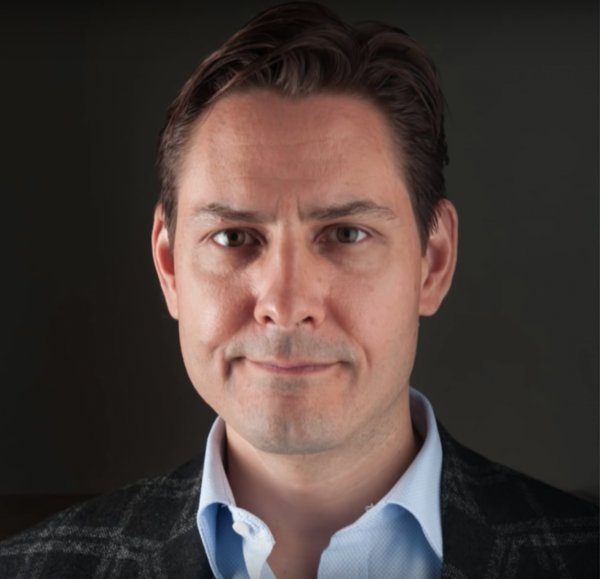
Former Canadian diplomat Michael Kovrig, who was imprisoned by the Chinese Communist Party for 1,028 days, issued a stark warning while testifying before Parliament on May 4: Prime Minister Mark Carney’s push toward expanded trade with China is leading Canada into a trap it may not be able to escape.
Kovrig was detained by China in December 2018 in what is believed to be retaliation for Canada’s arrest of Huawei executive Meng Wanzhou and was released in 2021. During recent testimony before the House of Commons Standing Committee on Industry and Technology, he said that based on his personal experience and deep understanding of how the CCP operates, “importing Chinese EVs means importing predatory monopolistic behavior our companies can’t survive.”
According to The Bureau, this marked the third time in the past ten weeks that Kovrig has testified before a parliamentary committee. He currently serves as executive director of the Global Strategic Impact Network. He had previously delivered similar warnings before committees on international trade, science and research, and industry and technology. Together, the three testimonies form a systematic critique of the Carney government’s China engagement strategy, carrying particular authority because of Kovrig’s dual experience as both a diplomat and a former detainee.
Risks of ‘strategic partnership’ and the costs of appeasement
In testimony before the International Trade Committee in February, Kovrig first laid out the broader strategic framework. He acknowledged that Carney’s January trip to China may have had some justification in terms of restoring diplomatic dialogue, but expressed deep concern over Carney’s revival of Beijing’s preferred “strategic partnership” language, agreement to reduce trade barriers, and openness to further trade and investment ties.
He argued that normalizing relations without demanding accountability from Beijing sends a message to the CCP that democratic nations will eventually yield under pressure.
Success
You are now signed up for our newsletter
Success
Check your email to complete sign up
In April testimony before the Science and Research Committee, Kovrig focused on the narrowing choices facing Canada’s economic foundations. He gave a detailed analysis of the state-backed financing model behind China’s EV industry, which he said has received more than C$300 billion in subsidies, tax breaks, cheap land, and artificially suppressed labor costs.
According to The Bureau, Kovirg said the model follows three stages: “flood, consolidate, weaponize.” In the first stage, Chinese firms overwhelm foreign markets with low-cost products. In the second stage, competitors are driven out and Chinese firms consolidate market dominance. In the third stage, the CCP transforms supply chains, export capacity, and pricing power into geopolitical leverage.
Kovrig warned that Canada is now approaching the threshold of the first stage. He cited Mexico as an example: Chinese battery-electric vehicles reportedly surged from one-quarter of the market to nearly 90 percent within two years, prompting Mexico to impose a 50 percent tariff in January as an emergency measure. “Canada should not repeat that mistake,” he said.
Sovereignty risks and the Taiwan issue
During Monday’s testimony before the Industry and Technology Committee, Kovrig further emphasized the sovereignty dimension. Just last week, China’s ambassador to Canada urged Ottawa to weaken its long-standing Taiwan policy, while the first shipments of Chinese EVs were entering Canada—providing what Kovrig described as a real-time example of Beijing’s tactics, The Bureau reported.
“The PRC weaponizes technology, supply chains and market access to coerce acquiescence to its geopolitical agenda,” Kovrig said. “China’s Ambassador just demonstrated that when he pressed Canada to weaken longstanding policy on Taiwan.”
The issue carries particular personal significance for Kovrig. The Bureau previously reported that a top-secret 2019 assessment by the Canadian Security Intelligence Service (CSIS) concluded Beijing had launched a “calibrated and multi-faceted pressure campaign” over the Meng Wanzhou case. The campaign reportedly combined trade coercion — including restrictions on Canadian canola imports — with the detention of Canadians and covert interference in the 2019 federal election to apply “personalized political pressure” on Canada’s leadership. The assessment was reportedly led by China’s Ministry of State Security, with reports delivered directly to Xi Jinping.
The assessment warned that Beijing was using its primary intelligence apparatus to “apply pressure and encourage dialogue with Canada on Beijing’s terms” and to pressure the Canadian business community, especially individuals with access to senior government officials. CSIS reportedly concluded that China’s restrictions on Canadian canola imports were intended to force Ottawa to back down on Meng’s extradition proceedings.
USMCA renewal deadline approaches
According to his May 4 testimony, Kovrig recommended that Canada treat the current quota of 49,000 Chinese EVs as a temporary ceiling rather than an import target. He called for strict reviews covering vehicle ownership structures, subsidies, forced labor concerns, supply-chain traceability, and connected-vehicle cybersecurity. He also urged Canada to reward only verified domestic industrial capabilities, allocate imports through controlled quarterly batches, align security rules with Washington, and establish automatic “snapback provisions” that would restore restrictions if Beijing resumes coercive actions.
These debates are unfolding as Canada struggles to advance renegotiations with the United States on trade issues. The renewal deadline for the United States-Mexico-Canada Agreement (USMCA) is approaching on July 1, but negotiations remain stalled. Donald Trump has already questioned the agreement’s value to the United States. U.S. trade officials have said Canada is lagging behind Mexico in trade discussions and accused Ottawa of “doubling down on globalization” — precisely the China-oriented shift promoted by Carney, The Bureau reported.
Meanwhile, other U.S. allies have made notable progress. Japan reached a strategic trade and investment agreement with Washington in July 2025 that reduced tariffs to 15 percent. The United States and India reached an interim trade framework in February 2026, while the U.S. and Europe also signed a memorandum of understanding on critical mineral supply chains. Canada, by contrast, continues to face Section 232 tariffs from the United States, with its steel, aluminum, automotive, and lumber industries still under pressure.
Kovrig’s testimony highlights the difficult choices facing Canada: balancing short-term economic interests against long-term strategic security and national sovereignty. Chinese EVs currently account for less than three percent of Canada’s light-vehicle market, but already represent 40 percent of battery-electric vehicle sales in 2025. Without decisive action, Kovrig warned, Canada could follow Mexico’s path of rapid market displacement while becoming increasingly vulnerable to Beijing’s geopolitical coercion.
By Li Xin, Vision Times