Recently, two incidents have shocked the overseas Chinese community, pushing every ethnic Chinese living abroad to a crossroads of choice.
In April this year, an incident that shocked the Chinese international student community took place. More than 20 Chinese scholars holding valid visas and preparing to attend academic conferences in the United States were individually taken aside for questioning by customs officers at Seattle airport, and were ultimately denied entry and sent back on return flights.
The questions asked by customs were highly specific: Are you a member of the Chinese Communist Party? Are you a member of the Communist Youth League? What field do you research? Who funded your trip? Faced with this series of questions, many people were reportedly stunned on the spot. The Chinese Embassy in the United States even issued an urgent reminder advising people to “avoid Seattle airport.”
This was not an isolated incident. In May 2025, U.S. Secretary of State Marco Rubio publicly announced on social media that the United States would “aggressively revoke” visas for Chinese students connected to the Chinese Communist Party or studying in sensitive fields.
There are currently nearly 280,000 Chinese students in the United States. This means that almost every Chinese national hoping to remain in or travel to the U.S. could be affected by the policy.
Success
You are now signed up for our newsletter
Success
Check your email to complete sign up
On the other side, a real case emerged in Canada. A Chinese woman surnamed Li applied for Canadian permanent residency in 2016 and followed the normal process step by step. Unexpectedly, in July 2024, Canada’s immigration authorities sent her a letter stating that there were reasonable grounds to believe her husband — a deputy director who had served for 30 years at a public security bureau in Hebei Province — had been involved in “crimes against humanity.”
The letter stated that China’s criminal justice system systematically engages in torture and human rights abuses, and that a deputy public security bureau director who had worked within that system for three decades was “at minimum complicit.” Two months later, her application was officially rejected.
U.S. customs authorities and Canada’s immigration department, one after another, were essentially doing the same thing: scrutinizing the nature of a person’s ties to the Chinese Communist Party.
‘A law dormant for decades’ has been revived
Many people are unaware that U.S. immigration law has long contained provisions barring entry based on membership in communist or totalitarian organizations. Under INA 212(a)(3)(D), individuals who are or were members of the Communist Party or related totalitarian organizations are, in principle, inadmissible to the United States.
For decades, because U.S.-China relations were primarily cooperative, this law was largely treated as something “written on paper and left at the bottom of a drawer,” rarely enforced seriously. But now, that dormant gate has been fully reopened. Customs officers, immigration authorities, the Department of Homeland Security, and the FBI are all using this law as a basis for questioning people.
When immigration officers conduct reviews, they do not simply ask, “Are you a Party member?” They also follow up with four key questions:
- Did you join the Party voluntarily?
- Do you still identify with or support the Communist Party?
- Have you participated in Party organizational activities?
- Have you ever formally withdrawn from the Party?
The U.S. government ultimately wants to determine just one thing: where do you stand today?
Why are overseas Chinese so easily ‘caught up’ in these investigations?
Currently, about 1 out of every 14 Chinese citizens is a Chinese Communist Party member. Many people may not grasp the scale of that figure: the Chinese Communist Party has more than 99 million members, and when members of the Communist Youth League and Young Pioneers are included, the total reaches over 400 million people. Chinese scholar Wang Zichen once described it this way: “On average, 1 out of every 14 Chinese people is a Party member.”
This means that for people coming from mainland China, almost everyone has, at some stage in life, been “enrolled” in some form of CCP-affiliated organization — the Young Pioneers in elementary school, the Communist Youth League in middle school, or Party organizations at universities or workplaces.
These organizational ties can repeatedly resurface at critical moments in life:
- Applying for a green card: Form I-485 explicitly asks whether you have ever been a member of or affiliated with the Communist Party or any totalitarian party.
- Applying for naturalization: Immigration officers may ask detailed questions and require written explanations.
- Seeking jobs in finance, technology, defense, biomedicine, or government contracting: Background investigation forms such as the SF-86 may thoroughly examine your Chinese educational background, work history, and family connections.
- Entering or leaving the country: Customs officers can question individuals on the spot and immediately decide whether to allow entry.
More seriously, beginning in April this year, even naturalized U.S. citizens reportedly face retrospective scrutiny. Individuals accused of concealing past CCP membership during the naturalization process have been listed among categories of people who could potentially face denaturalization proceedings.
The old assumption that one could simply check “No” on a form and move on no longer works today. If authorities later determine that someone lied, the consequences can be far more severe than honestly disclosing the information in the first place — ranging from visa revocation and loss of permanent residency to permanent inadmissibility, and even possible revocation of already obtained U.S. citizenship.
Employment with the US government and major corporations: Security screening becomes the first hurdle
Immigration status is only the first barrier. For Chinese immigrants who hope to truly establish themselves in the United States and integrate into mainstream society, another equally daunting hurdle lies ahead — employment-related security screening.
At present, applicants seeking positions in U.S. federal government agencies, defense contractors, military-industrial firms, intelligence-related departments, and even many major companies in the technology, finance, and biomedical sectors are subject to strict security background investigations.
For Chinese nationals from mainland China, the review process tends to focus on several core issues:
- Family ties and background in mainland China;
- Any form of connection to the Chinese government, military, or state-owned enterprises;
- Whether the applicant was ever a member of the Chinese Communist Party, Communist Youth League, or other Party-affiliated organizations;
- Whether the applicant received Party or government training or related sponsorship while in China.
The outcome of these investigations can directly determine whether a mainland Chinese applicant is able to secure employment in the United States. Many people encounter difficulties at this stage not because they necessarily engaged in wrongdoing, but because they cannot clearly explain their relationship with the CCP — or simply lack written documentation to clarify it.
This pressure is not emerging in a vacuum, but is rooted in serious real-world concerns.
FBI alarm raised: Chinese espionage networks deeply embedded in the United States
Last year, the number of espionage cases linked to China prosecuted by the Federal Bureau of Investigation reportedly surged by 47 percent, with multiple indictments and arrests occurring almost every month.
The depth of the alleged espionage network’s infiltration has alarmed U.S. authorities. Cases have reportedly involved personnel from multiple branches of the U.S. military, including Navy sailors, and even individuals connected to elite Delta Force special operations units, with accusations that military secrets were continuously transmitted back to mainland China.
Kash Patel openly stated that the Chinese Communist Party’s intelligence networks had already penetrated deep into the United States through strategically arranged “agricultural real estate” acquisitions. According to this view, the core method of infiltration involves purchasing land — particularly ranches, farmland, and properties near U.S. military bases.
Once large tracts of private land are acquired, they can allegedly serve as physical cover for surveillance operations. Equipment can then be imported and positioned to monitor U.S. military fixed-wing aircraft, helicopters, and personnel stationed at nearby bases.
The CCP would never permit Americans to purchase large ranches near Chinese military bases, yet China is accused of carrying out similar activities on American soil.
The administration of Donald Trump responded to what it describes as this infiltration system with a hard-line national security approach, insisting that espionage networks must be eradicated completely. However, the broader investigations have also placed Chinese communities in the United States under heightened scrutiny.
The Federal Bureau of Investigation’s investigative net is cast broadly and does not focus solely on confirmed spies, but also examines individuals with ties or perceived ties to the CCP.
This is a reality every Chinese person in the United States must recognize: one does not necessarily need to have committed wrongdoing; simply being unable to clearly explain one’s relationship with the CCP may be enough to raise concerns among investigators.
Asylum applicants are especially vulnerable on this issue
For individuals applying for asylum on the basis of political, religious, or ideological persecution, Party membership can become a particularly sensitive issue.
The core of an asylum case is that the judge must believe the applicant genuinely suffered persecution because of political views or religious beliefs. However, many applicants claim to oppose the CCP while records indicate they themselves were Party members.
Such contradictions can immediately raise doubts for immigration officials: is the applicant truly opposed to the CCP, or simply fabricating a story to obtain legal status?
Within the U.S. immigration system, “credibility” is often decisive. Once an immigration officer determines that an applicant lacks credibility, the case is likely to collapse, and that assessment may continue affecting future visa, green card, and citizenship applications.
Many asylum cases with otherwise strong factual foundations ultimately fail not because the claims themselves are weak, but because applicants cannot clearly explain their current relationship with the CCP.
The law leaves a ‘back door,’ but applicants must prove it themselves
Section 212(a)(3)(D) of U.S. immigration law also provides three exceptions:
- Involuntary membership exemption: If you were forced to join (for example, if refusing to join the Youth League would have prevented you from attending university), you may apply for an exemption.
- Former membership exemption: If you have ceased participating in Party activities for more than five years and no longer identify with the organization, you may apply for an exemption.
- Close relative exemption: If your purpose is to reunite with immediate family members in the United States, you may apply for an exemption.
However, the key issue is that the burden of proof rests on the applicant, not on the system.
Immigration officers may ask questions such as:
- Did you ever refuse to join at the time?
- Did you ever publicly oppose the organization?
- Did you formally withdraw from it?
- Do you have written evidence?
If someone merely says verbally, “I stopped identifying with the Party long ago,” but cannot provide any written documentation, why would an immigration officer necessarily believe it? This, the article argues, is why a formal third-party-issued certificate stating that a person has withdrawn from the Party can carry far more weight than repeatedly making the claim verbally.
A new Cold War between China and the United States: a path with no turning back
The airport detentions in Seattle, the visa revocation measures announced by Marco Rubio, and Canada’s immigration rejection letters are presented not as isolated incidents, but as signs of a much broader historical shift.
Anew Cold War structure between China and the United States has already taken shape. It argues that the conflict is rooted not only in trade disputes or geopolitics, but in a deeper clash of ideology and social systems. The article portrays the United States as representing democratic and free societies, while accusing the Chinese Communist Party of using the resources of the world’s second-largest economy to challenge the U.S.-led international order through methods including technology theft, political infiltration, and influence operations via social media platforms such as TikTok.
Both major U.S. political parties now regard the CCP as the principal strategic threat, citing the 2025 U.S. national security framework. In its view, stricter scrutiny of mainland Chinese individuals with ties to the CCP has become a bipartisan and long-term policy that will continue regardless of which party controls the White House.
Waiting until an immigration interview to address these issues may already be too late.
‘A need to sever ties with the CCP’
Withdrawing from the CCP and its affiliated organizations is not only a legal matter, but also a moral and ethical issue.
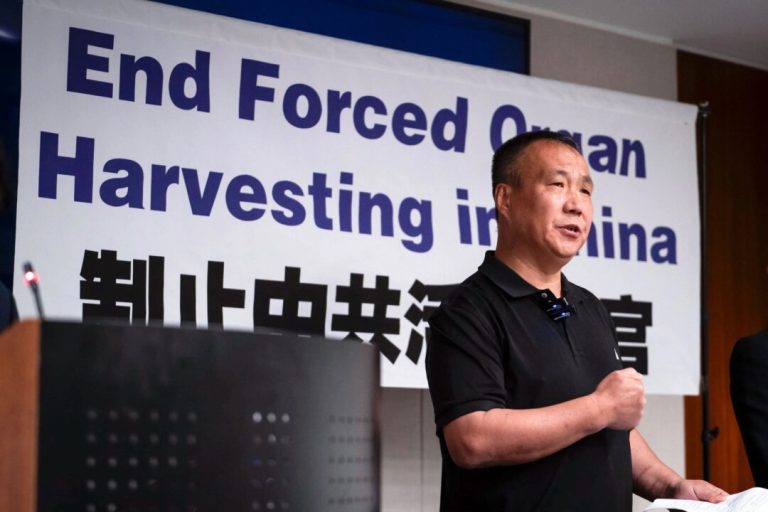
It references traditional Chinese ideas of moral accountability and then makes a series of serious allegations against the CCP, including claims regarding political campaigns after 1949 and accusations of forced organ harvesting from Falun Gong practitioners and prisoners of conscience.
These allegations remain highly disputed and politically sensitive. Various human rights organizations and investigative bodies have published reports and raised concerns regarding organ harvesting allegations, while the Chinese government has repeatedly denied wrongdoing.
The signs of “retribution” against the Chinese Communist Party are already emerging. It describes China’s economic slowdown and deflationary pressures not as ordinary cyclical adjustments, but as evidence that the CCP’s authoritarian political system is fundamentally incompatible with the normal functioning of a market economy.
The CCP has chosen to preserve political control over economic development, while social tensions, violent crimes, and public frustration are portrayed as indicators of a system under severe strain.
Internal political purges within the CCP — including investigations, arrests, dismissals, unexplained deaths, and confiscations of assets involving officials and military figures — reflect deep instability and internal power struggles within the system.
Citing the Chinese saying, “A wise person does not stand beneath a collapsing wall,” the article argues that publicly withdrawing from CCP-affiliated organizations is the safest course before what it predicts will be the Party’s eventual downfall.
More than 460 million Chinese people have declared withdrawal from the Chinese Communist Party, the Communist Youth League, and the Young Pioneers, with records maintained by the Global Service Center for Quitting the Chinese Communist Party.
What is a ‘withdrawal certificate,’ and why is it considered useful?
A“withdrawal certificate” is a formal document issued by the Global Service Center for Quitting the Chinese Communist Party, which is headquartered in New York.
The organization has operated since 2005 and states that more than 460 million Chinese people have used its website to publicly declare their withdrawal from the CCP, Communist Youth League, or Young Pioneers — a process commonly referred to as “Three Withdrawals” (“三退”). The article claims that more than 15 million new declarations were registered in 2025 alone.
Increasing numbers of people are applying through the organization to obtain what it describes as a legally meaningful “withdrawal certificate.”
The certificate serves three functions:
- It documents the individual’s process of recognizing problems associated with the CCP;
- It records the person’s explicit and proactive withdrawal action;
- It demonstrates the individual’s intention and position of completely severing ties with CCP organizations.
With such a document, the article argues, immigration officers have a clearer basis for evaluation: “This person is no longer part of the system and has already separated from the CCP.”
The certificate can serve as written evidence in several contexts, including:
- eligibility reviews under INA §212(a)(3)(D),
- strengthening credibility in asylum cases,
- and supplementing green card or naturalization applications.
Public reports and immigration attorneys’ case experience indicate that U.S. immigration authorities have, in some cases, accepted such certificates as supporting evidence that an individual either:
- joined CCP-affiliated organizations involuntarily, or
- ceased participating in Party-related activities for more than five years and no longer identifies with them.
Application process described as simple and secure
The application channels provided by the Global Service Center for Quitting the Chinese Communist Party are publicly accessible and include:
- Online application: Tuidang Certificate Application Page
- 24-hour hotline: +1 (718) 888-9552
Applicants can receive either a PDF electronic version or a mailed paper copy, and that records are stored permanently for future verification. It also claims personal information is kept confidential and inaccessible to Chinese authorities.
The process takes slightly over an hour in total, including:
- approximately one hour of online video training and certification,
- and about 15 minutes to complete the application form.
This is a way to create a documented record of separation from the CCP and to provide greater security for one’s future and family.
‘The logic of the American system is simple: consistency’
The U.S. immigration system values consistency above perfection. Past affiliations or experiences, it says, can be explained, but applicants must clearly state and demonstrate where they currently stand politically and ideologically.
When the gates close at Seattle airport, when visa revocation policies announced by Marco Rubio take effect, when security background investigation forms are placed before applicants, or when rejection letters arrive from immigration authorities, many overseas Chinese may come to see a “withdrawal certificate” as an important document that could potentially help clarify their status and affiliations.
In the view of its supporters, a real-name “withdrawal certificate” is no longer merely a political statement or a matter of belief, but a practical form of “identity insurance” for overseas Chinese communities.
The process is simple, secure, and convenient, and the time spent obtaining such documentation is worthwhile.
By the Global Service Center for Quitting the CCP