Liu Shaoqi served as China’s head of state throughout the 1950s and early 1960s. Mao Zedong had him imprisoned without trial, denied him medical treatment for diabetes and bronchitis, and left him to die alone in a provincial holding room in November 1969. He was 71. His wife, Wang Guangmei, was held in solitary confinement for twelve years. In 1983, she traveled to Mao’s birthplace to pay her respects, signing the guestbook as his student, in solemn remembrance.
Wang had internalized the CCP’s doctrine of “Party nature” — the demand that collective political loyalty supersede individual feeling, family bonds, and private conscience — so thoroughly across a lifetime inside the system that she could not break with it even after the Party had destroyed everything she had.
Mao’s decision to destroy Liu Shaoqi
The decision to destroy Liu Shaoqi was made in January 1962, at what the Party called the Seven Thousand Cadres Conference, a gathering of some seven thousand senior Party officials convened to assess the catastrophic failure of the Great Leap Forward — Mao’s 1958–1962 mass-mobilization program that forced peasants onto collective farms and redirected agricultural labor into backyard steel production, triggering a famine that killed tens of millions of people.
At that conference, Liu gave a speech that implicitly indicted Mao. The famine, Liu told the assembled officials, was “thirty percent natural disaster and seventy percent man-made calamity.” He added that the “Three Red Banners” — the three political slogans that had driven the Great Leap — would not be formally abandoned yet, but should be revisited in ten years. Mao heard the speech as a direct threat. He concluded that Liu was China’s version of Nikita Khrushchev, the Soviet leader who, after Stalin’s death, had denounced Stalin’s purges and assigned responsibility for mass deaths to him publicly. Mao resolved to eliminate Liu before Liu could do the same to him. He waited four years for the right opening.
It came on June 1, 1966. Mao authorized the national broadcast of a wall poster written by Nie Yuanzi, a philosophy lecturer at Peking University, accusing the university’s Party committee of suppressing revolutionary activity. The broadcast ignited schools across China. Students stopped attending classes to “make revolution,” Party committees at every campus collapsed under assault, and campuses descended into chaos. Mao then withdrew to Shaoshan, his home village, and watched the fire spread from a distance.
Success
You are now signed up for our newsletter
Success
Check your email to complete sign up
Liu and Deng Xiaoping, who jointly managed day-to-day Party operations at the time, responded by dispatching work teams — Party-appointed investigators sent to restore order and identify targets for criticism — to universities across the country. Wang Guangmei personally led the work team sent to Tsinghua University, where she oversaw the disciplining of student agitators, including Kuai Dafu, a student radical who would become one of the most feared Red Guard commanders of the era. (The Red Guards were the Party-mobilized student militias that Mao unleashed to terrorize officials, intellectuals, and their families throughout the Cultural Revolution.)
Mao seized on the work teams as his justification. Upon returning to Beijing, he announced their withdrawal and convened a full meeting of the Party’s Central Committee in August 1966. On Aug. 5, he produced his famous wall poster, titled “Bombard the Headquarters,” which accused Liu of suppressing the mass movement and pursuing a “bourgeois reactionary line” — a political attack label meaning Liu had sided with the class enemy against the revolution. The organizational reshuffling that followed dropped Liu from second place in the Party ranking to eighth. Lin Biao was installed as Mao’s chosen successor.
At the Aug. 18 mass rally on Tiananmen Square — the first of eight gatherings at which Mao reviewed Red Guard formations that summer and autumn — Mao reportedly told Liu that the Party had made mistakes in sending the work teams and that someone would have to take responsibility. Liu, according to his son-in-law Wan Runnan, believed Mao was speaking candidly. He was wrong. Within weeks, Liu was under house arrest.
Imprisoned without charges, denied care, left to die
Liu Shaoqi was a member of the Politburo Standing Committee, the Party’s innermost ruling body, which formally governs both the Party and the country. He was detained for years without a Central Committee vote authorizing it, without charges filed, and without any judicial process. Mao’s will was the only operative authority.
In October 1968, at a full meeting of the Party’s Central Committee, Liu was formally expelled from the Party on charges of being “a traitor, an enemy agent, and a scab.” The accusations were fabricated.
Liu suffered from diabetes and bronchitis. In detention, he received no adequate medical treatment and his conditions worsened steadily. In October 1969, he was secretly transported to Kaifeng, the provincial capital of Henan province. Twenty-six days later, on Nov. 12, 1969, he died in a bare room, attended by no one who knew him. He was 71.
Mao killed him. Had Liu remained a Politburo Standing Committee member with access to appropriate medical care, he would not have died at that age from treatable conditions.
Even emperors in imperial China, when they wished to execute someone, went through some form of legal ritual. The CCP dispensed with that entirely. Its system of rule, in this respect, was more arbitrary than any imperial dynasty.
READ MORE:
- How Mao Zedong’s Four Policies Starved Tens of Millions: A Survivor’s Account
- Mao’s ‘Heaven Won’t Fall’: How the CCP Was Built on Impunity
- Mao Launched the Cultural Revolution to Seize Absolute Power, Not to Pursue an Ideal
Twelve years in solitary confinement
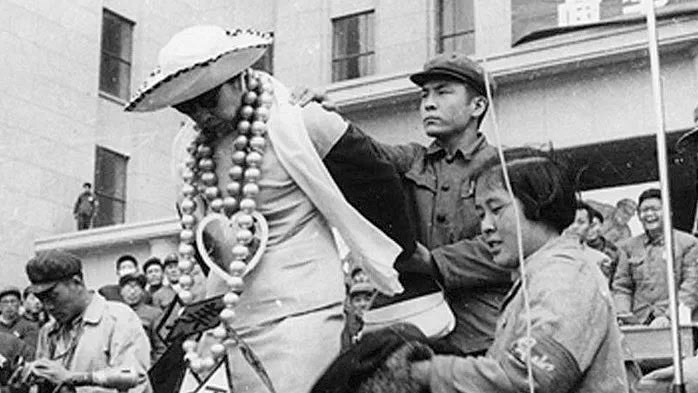
In April 1967, acting on instructions from Jiang Qing — Mao’s wife and the driving force behind the Cultural Revolution’s most vicious political campaigns — the Red Guard commander Kuai Dafu organized a mass struggle session against Wang at Tsinghua University. Thirty thousand people attended.
Wang was forced to wear the qipao, a form-fitting traditional dress associated with bourgeois elegance, that she had worn on a state visit to Southeast Asia, and to put on a necklace made from strung ping-pong balls, a grotesque parody of the pearl necklaces she had worn abroad. She was then bent into the “jet plane” position, a stress posture that forced the arms back and the head down, used as a humiliation and punishment technique throughout the Cultural Revolution. Mao knew this was happening. He said nothing. His silence was authorization.
In September 1967, Wang was imprisoned in Qincheng Prison, the facility on the outskirts of Beijing reserved for high-ranking political prisoners and their families. She was not released until 1978, two years after Mao’s death. She had been held for twelve years in total.
Wang Guangmei’s tribute at Mao’s birthplace
In November 1983, the 62-year-old Wang Guangmei traveled to Shaoshan, Mao’s birthplace in Hunan province, with her children. They toured Mao’s childhood home and the exhibition hall devoted to his memory. According to records held at the Shaoshan memorial, Wang told staff: “I have always deeply admired Chairman Mao. Chairman Mao once said he was not a genius, but certainly not an ordinary man. I understand that more deeply now.” In the guestbook, she wrote a tribute in solemn remembrance of Chairman Mao, signing herself as his student.
In the summer of 2004, Wang went further. She asked her son Liu Yuan, a senior military officer who would later rise to become Political Commissar of the People’s Liberation Army’s General Logistics Department, to arrange a dinner bringing together her family and the families of Mao’s two daughters, Li Min and Li Na. The gathering was warm. Past grievances, apparently, had been set aside.
How Party indoctrination replaced grief
Mao had once elevated Liu Shaoqi — before his patronage, Liu had been a largely obscure figure — but whatever Mao gave, he took back tenfold. Murdering someone cancels any prior debt of gratitude. The more durable explanation for Wang’s behavior is ideological. Decades of CCP indoctrination had restructured her moral hierarchy so thoroughly that Party loyalty took precedence over personal suffering. Publicly condemning Mao would harm the Party. Wang, having absorbed this calculus across a lifetime inside the system, apparently could not bring herself to break with it even after the Party had destroyed everything she had.
Spouses denounced each other to demonstrate loyalty. Children turned in parents. Li Rui, a former secretary to Mao who later became a prominent voice for internal Party reform, had his ex-wife Fan Yuanzhen report his alleged “anti-Party crimes” to the authorities; she also divorced him. In an even starker case, a young man denounced his own mother for defending Liu Shaoqi. She was executed. He later expressed remorse. His mother could not be brought back to life.
Bo Xilai, the Chongqing party secretary who staged a neo-Maoist revival with his “Sing Red, Strike Black” campaign before his dramatic downfall in 2012, serves as a final example. His mother was persecuted to death during the Cultural Revolution. He spent his political career glorifying Mao and celebrating the era that killed her.
The tragedy of Wang Guangmei is not that she forgave Mao. It is that the Party had replaced the part of her that might have refused to.
(The views expressed in this article represent the author’s personal position and perspective.)
By New Century/ Yucun’s Blogger