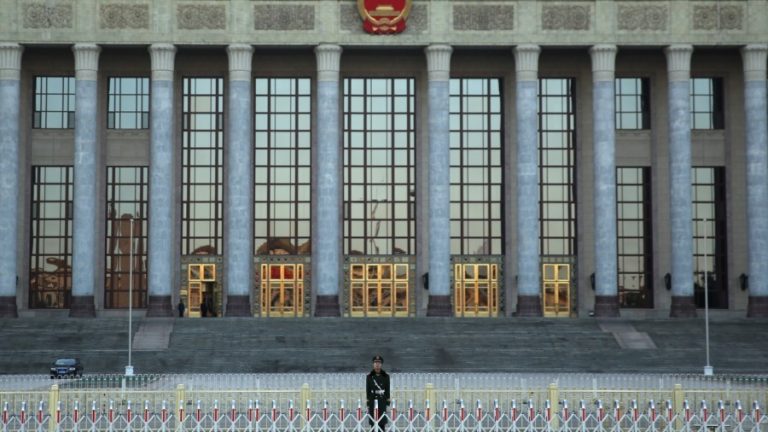
A young Chinese blogger drew widespread attention online this week after standing outside the Shenzhen municipal government building and publicly declaring that he wanted to run for mayor to “speak for ordinary people” struggling to survive in the city.
The video, originally posted on May 26 on the Chinese social media platform Douyin, quickly spread across China’s internet. In the video, the young man says he had gone directly to Shenzhen City Hall to ask officials about the qualifications and procedures required to run for mayor. But according to him, government staff were unable to provide any answers or offer any guidance.
After the video went viral, it was quickly scrubbed from the app by China’s iron-clad internet censors.
‘I want to speak for ordinary people’
“I want to run for mayor of Shenzhen because I’ve seen how hard life is for people at the bottom,” he said in the video. “Elderly people are collecting recyclables. Many people are sleeping on the streets. I want to speak for ordinary people and do something for them.”
RELATED: Nearly 13 Million Graduates Enter China’s Job Market as Employment Crisis Deepens
Success
You are now signed up for our newsletter
Success
Check your email to complete sign up
Standing outside the government complex, the blogger described what he called a sense of responsibility shared by younger generations. “This is the sense of responsibility our era requires,” he said. “Young people should stand up for those at the bottom and do something for ordinary citizens.”
He added that after entering the government office to inquire about the process, staff repeatedly told him they “didn’t know” how someone could run for mayor. “I don’t even know where to ask about running for mayor,” he said. “What qualifications are required? What conditions need to be met? What procedures are involved?”
RELATED: China’s Economic Rise Loses Momentum as Global GDP Share Declines
In recent years, slowing economic growth, a prolonged property downturn, weak consumer confidence, and layoffs across the technology and manufacturing sectors have left many young people struggling to find stable work. Shenzhen, long known as China’s “Silicon Valley,” has also faced mounting pressure as competition for jobs intensifies and living costs continue rising.
A system that works for the few
The apparent inability, or unwillingness, of local officials to explain any formal electoral process quickly became a major talking point online. Though China officially maintains a system of local people’s congresses and indirect elections under the Chinese Communist Party (CCP), top leadership positions such as mayor are generally decided internally through Party appointment mechanisms rather than open competition via public elections.
The incident also revived memories of an earlier high-profile case involving Chinese businessman Cao Tian. According to a 2011 report by Voice of America, the Zhengzhou entrepreneur once announced plans to spend 100 million yuan of his own money to campaign independently for mayor of Zhengzhou, the capital of Henan Province.
However, Cao later said he faced enormous political pressure after making his intentions public and eventually chose to flee. “They say accounts are settled after autumn,” Cao told Voice of America at the time. “But before autumn even arrived, they had already begun settling accounts. What are they afraid of? Are they really that fragile?”
Cao’s proposed platform reportedly included dismantling China’s controversial urban enforcement agencies, lowering housing prices through market reforms, and punishing officials involved in forced demolitions.
Netizens react
The video triggered sharply divided reactions online before disappearing from Chinese platforms. Some social media users praised the young man’s sincerity and willingness to challenge the system. “This young man is amazing,” one commenter wrote. Another user commented: “He may sound naïve, but he has taken an important first step.”
RELATED: Chinese Netizens Slam State Media for Glorifying Elderly Labor: ‘A Toxic Message’
Others argued the video exposed deeper frustrations about political participation in China. “The most ironic part is that ordinary people try to follow legal procedures, only to have the first obstacle be officials saying they ‘don’t know,’” one user wrote.
Critics of the Chinese political system were even more blunt. “One ordinary person trying to run for mayor while the Communist Party remains in power? Pure fantasy,” another commenter wrote. Others claimed that leadership positions in China are effectively determined internally by Party authorities rather than through meaningful public elections.
The swift removal of the video also reignited discussion about censorship and political sensitivity surrounding grassroots activism in China, where even relatively modest calls for political participation can quickly attract official scrutiny. While it remains unclear whether the young blogger faced any direct repercussions after the video was removed, the incident struck a nerve among many Chinese netizens frustrated by economic pressure, rising inequality, and limited avenues for public political expression.
For some observers, the episode reflected a broader disconnect between official narratives about “serving the people” and the realities many ordinary citizens feel they face in modern day China.