By Yi Xin
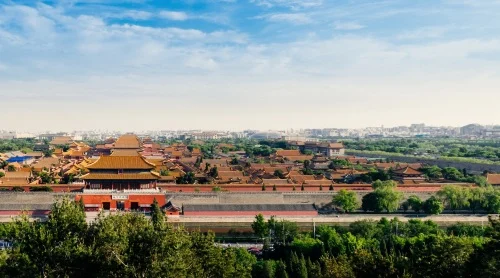
As the imperial palace of 24 emperors across the Ming and Qing dynasties, the Forbidden City has long evoked feelings of solemnity and mystery. When it later became the Palace Museum, housing countless ancient artifacts and ranking among the world’s top five museums, people gradually began to appreciate its true scale and significance. Today, the museum’s collection—centered on court treasures from the Ming and Qing dynasties—attracts countless visitors. Yet, do we really understand it?
Even the most basic question may stump us: Who designed the Forbidden City?
Since its completion, the Forbidden City (Beijing’s Palace Museum) has stood for over 600 years. It remains the largest palace complex in existence, covering 720,000 square meters, with buildings occupying approximately 150,000 square meters. Construction began in the fourth year of the Yongle Emperor Zhu Di’s reign (1406) and was completed in the eighteenth year (1420).
But who, exactly, designed the Forbidden City? Could it be that the architect’s name, unlike that of the craftsmen who carved the statues in the Dunhuang grottoes, left no trace on a single object—vanishing entirely from history? Alas! The truth lies in the social status of Ming dynasty artisans: it was low. Even the few craftsmen whose names were recorded were rare exceptions. Thus, the identity of the person who designed the Forbidden City remains a six-century-old mystery.
Success
You are now signed up for our newsletter
Success
Check your email to complete sign up
However, although it remains a mystery, three main theories have circulated among the public.

Theory 1: Kuai Xiang
The most widely circulated theory is that the Forbidden City was designed by Kuai Xiang, an exceptional craftsman of the Ming dynasty. Kuai Xiang (1398–1481), styled Tingrui and also known as Xiangshan, hailed from Xiangshan in Wu County (present-day Suzhou, Jiangsu) and was considered the progenitor of the Xiangshan guild of artisans. He was reputed not only for his woodworking skills but also for his remarkable artistic talent and aesthetic sensibility.
However, although Kuai Xiang is often credited as the designer of the Forbidden City, even scholars at the Palace Museum have pointed out that he was only in his early twenties when construction began. As such, it is unlikely that such a young and relatively inexperienced craftsman would have been entrusted with the monumental responsibility of designing the imperial palace. His actual contributions likely occurred during reconstruction work in the Zhengtong period.
Nevertheless, a popular story about Kuai Xiang and the construction of the Forbidden City persists in folklore:
It is said that during construction, an artisan accidentally sawed over a foot off a massive timber tribute from Burma, which had been designated by Emperor Zhu Di as the threshold for the main hall. Worried, the artisan reported the mistake to Kuai Xiang. Remarkably, Kuai Xiang instructed him to saw off another foot, allowing for an adjustment. His ingenious solution was to attach dragon heads to both ends of the threshold and embed a pearl at each boundary. This design facilitated easier installation and removal of the threshold. When Zhu Di saw the result, he was delighted, praising Kuai Xiang’s craftsmanship and famously comparing him to the legendary carpenter Lu Ban, calling him “Kuai Lu Ban.”

Theory 2: Cai Xin
The second theory suggests that the designer of the Forbidden City was Cai Xin, a craftsman from Wujin in Southern Zhili (present-day Wujin, Changzhou, Jiangsu Province). While precise biographical details about Cai Xin are no longer verifiable, folklore preserves a story of his involvement in the palace’s design.
According to the tale, Emperor Zhu Di entrusted the construction of the palace to Minister of Works Song Li. Understanding that a detailed design plan was needed before construction could begin, Song Li sought out the skilled designer Cai Xin to draft the imperial city plan. Demonstrating exceptional ability, Cai Xin soon submitted a design that thoroughly impressed Song Li. Its square, orderly, and stable layout symbolized the Ming dynasty’s long-lasting stability, much to Zhu Di’s delight.
Zhu Di was particularly pleased to hear that the new palace would feature nine tiers of courtyards and a total of 9,999 half-rooms. This number, just one short of the legendary 10,000-room heavenly palace, symbolized both imperial majesty and the emperor’s modesty—a design perfectly reflecting the emperor’s authority while subtly nodding to human humility. Consequently, Cai Xin’s plan passed inspection without difficulty.
From then on, the legend that the Forbidden City has 9,999 rooms spread widely. Although this figure is mythical rather than exact, it remains popular. In reality, the Palace Museum contains a total of 8,707 rooms, including palaces, halls, towers, pavilions, and other structures. This figure was confirmed in 1973 when experts conducted a special survey to tally every room in the complex.
Theory 3: Yang Qing
The third theory proposes that the designer of the Forbidden City was Yang Qing.
Very little is known about Yang Qing. Historical records indicate that he began as a tile worker and eventually rose to the rank of Vice Minister of Works. It is said that the name “Yang Qing” was bestowed by Emperor Zhu Di himself, suggesting that his contributions were indeed significant.
But how could the construction of such a monumental palace be attributed to only three craftsmen? Why is Kuai Xiang—the youngest of the three—most often recognized as the designer? Scholars, examining historical sources, believe that by the time construction began, Cai Xin and Yang Qing were already advanced in age, though their contributions were substantial. Kuai Xiang, although young, excelled in painting and design; it is said he could draw identical dragons simultaneously with both hands, merging them perfectly. Moreover, he could calculate and produce palace plans with minimal effort. His exceptional skills naturally drew attention.
After the deaths of Cai Xin and Yang Qing, Kuai Xiang went on to lead numerous imperial construction projects, further cementing his high status. As a result, the general public often mistakenly regards him as the sole designer and builder of the Forbidden City.
Regardless of which individual is credited, it is important to remember that the construction of a grand and solemn royal palace depended on the collective efforts of countless artisans and laborers. Behind the few celebrated names—receiving public acclaim and admiration—lay the silent, nameless craftsmen whose knowledge, skill, and sweat made the palace possible. These unsung builders pooled their intellect and labor to create a lasting cultural masterpiece.
When we gaze upon these traditional structures in awe, we should not forget who built them, why they were built, and the impact they brought to the land and its people.

(All images above sourced from Adobe Stock)
References
- “A 600-Year Mystery: Who Designed the Forbidden City?”
- “The Six-Century Enigma: Who Was Behind the Design of the Forbidden City?”
- “Kuai Xiang or Cai Xin? Reexamining the Designer of the Tiananmen Gate Tower”
- “Did Cai Xin of Changzhou Design the Forbidden City?”