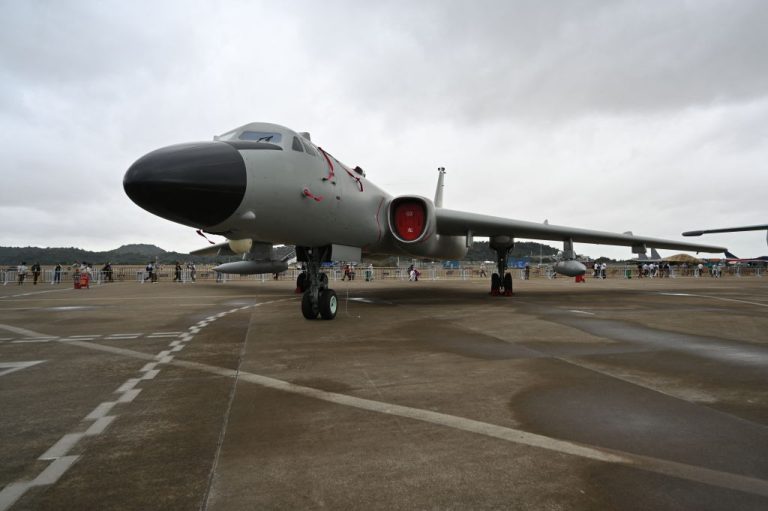
In recent war games launched around Taiwan, China showcased one of its newest weapons in its arsenal; an upgraded version of a Cold War-era bomber.
Broadcast through Chinese state-run media, the war-game drills — designated Joint-Sword 2024B by the communist People’s Liberation Army (PLA) — the modernized H-6 bomber flew maneuvers that served as a “stern warning” to those in Taiwan seeking independence, the military said.
According to Taiwan’s Ministry of National Defense, 153 Chinese military aircraft, 14 warships and 12 other ships were spotted when the drills began on Oct. 14, and that 111 of the aircraft had penetrated Taiwan’s air defense identification zone (ADIZ).
Speaking to Reuters, the ministry reported “three groups of three H-6 aircraft” were also caught entering the air space; and that two of them launched “simulated attack drills.”
Much like the American Boeing B-52 Stratofortress, China’s Xian H-6 bomber was first flown during the Cold War. Hailing from the Soviet Tupolev Tu-16 bomber, Beijing built their bombers “under license in the late 1950s,” experts on the PLA said.
Success
You are now signed up for our newsletter
Success
Check your email to complete sign up
In recent years, Taiwan and Japan have spotted H-6 bombers being deployed near their airspace, while also flying over the South China Sea in disputed areas where Beijing had claimed to own.
However, unlike the B-52 — which ceased production in 1962 — China continues to build the H-6 at a plant in central China, though production had slowed, Thomas Shugart — an expert on the Chinese military — claimed.
Some of the newly retrofitted H-6 bombers are now able to fire ballistic missiles with nuclear warheads, while others can launch long-range anti-ship and land attack missiles, defense analysts and the Pentagon reported. There are variants that can also be refueled mid-flight, making them capable of flying from the mainland to attack U.S. bases in the Western Pacific.
State-run media outlet CCTV broadcasted a bomber escorted by fighters and a WZ-7 recon drone. The drone detects enemy forces for the bomber, allowing its missiles to land on the designated target.
According to testimony to the U.S.-China Economic and Security Review Commission in March, Shugart said China’s H-6 bomber fleet has grown in size and capability, with enhanced airframes, technology, engines, and long-range weaponry.
Regarding the military drills, Taiwan’s defense ministry said it was monitoring “the communist military’s movements around Taiwan,” and sent “air, sea and missile forces to respond as appropriate to ensure national defense and security.”
Should conflict arise, these bombers would be a formidable threat to both land and sea-based targets, striking without warning.
READ MORE:
- China Opens Controversial Deep-water Megaport in Chancay, Peru
- Chinese Markets Cool in Anticipation of Redoubled ‘America First’ Policies
- Taiwan Considering $15 Billion Purchase of US Weapons From 2nd Trump Administration: Sources
America’s preparations
As Donald Trump prepares his return as President of the U.S., China’s military might is once again highlighted.
Shugart believes that H-6 bombers would be used in Chinese military strikes across the Pacific, striking headquarters, military infrastructure, airfields and ports as part of the Chinese military doctrine for its island campaigns.
According to Major Pete Nguyen, spokesperson for the Pentagon, the U.S. would be ready to respond to any threat posed by the PLA, though U.S. Defense Secretary Lloyd Austin denies that conflict with China are “imminent nor inevitable.”
Experts believe that the H-6 bombers should be struck while they are still on the ground.
“Any common sense war plan would target those aircraft before they could take off,” David Deptula, dean of Mitchell Institute for Aerospace Studies, said.
A joint patrol of two Chinese H-6 and two Russian Tu-95 bombers near Alaska prompted American and Canadian fighter jets to scramble on July 24, the North American Aerospace Defense Command (NORAD) reported. While Russia regularly patrols this area, this was the first time Chinese bombers flew near the U.S. mainland, highlighting China’s growing military power and confidence, according to former U.S. Air Force officers.
Taiwan’s defenses tested
In the midst of China’s war games and Trump’s electoral victory, Taiwan plans to spend 70.6 billion New Taiwan dollars ($2.2 billion) on American weapons next year to counter the possible threat of a Chinese invasion.
“Taipei has signed contracts with the U.S. for 21 procurement projects, totalling NT$716.6 billion, with final payments scheduled to be made in 2031,” the Taiwanese defense ministry said on Nov. 18.
“Of this total, approximately NT$373.1 billion has already been paid, while NT$343.5 billion remains unpaid and will be disbursed according to the payment schedule,” it added.
Next year, Taiwan plans to buy more weapons, ranging from air defense missiles to radar system improvements.
During his campaign, Trump called on what the media termed “bluntly transactional diplomacy”, lambasting Taiwan for its “insufficient military spending and its semiconductor dominance.”
In response to this arms deal, Beijing claimed it will take “countermeasures” to protect its supposed sovereignty.
“China will take resolute countermeasures and take all measures necessary to firmly defend national sovereignty, security and territorial integrity,” China’s foreign ministry said.
During the Zhuhai air show, Russia media had reported that Moscow had signed a deal to export its Su-57 fighter jet to other countries. Alexander Mikheyev, CEO of Russian arms seller Rosoboronexport, said that “partners from friendly countries” desired “reliable and proven” weapons from Russia, hoping it would boost the country’s industry in the years to come.