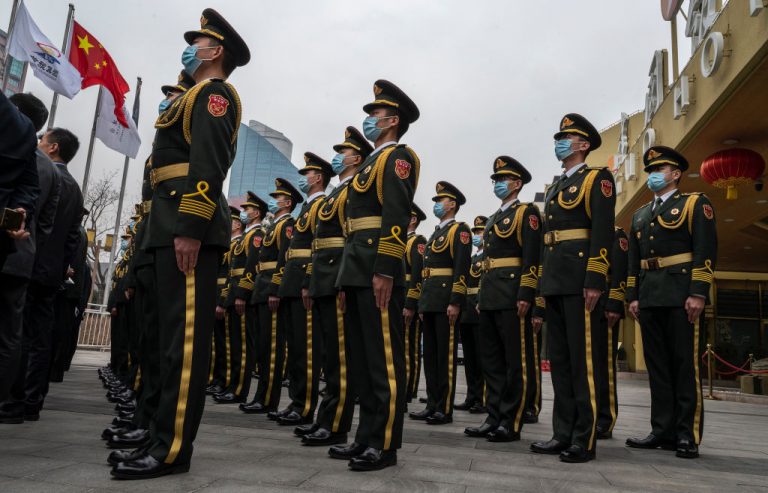
In what appears to be an intensified effort to manage the country’s youth amid rising unemployment and economic downturns, the Chinese Communist Party (CCP) has announced a renewed push for mandatory military draft registration beginning Jan. 1, 2025 for all males aged 18 and older.
For the first time, state media outlets are issuing stern warnings that “failing to register” could jeopardize young men’s ability to enroll in colleges, universities, or even secure jobs. While authorities frame the policy as a “routine measure” to bolster military readiness, many observers see it as a broader strategy to manage rising unemployment and maintain societal control.
According to state-run “The Paper,” the registration process is outlined under China’s Military Service Law and requires all males turning 18 to fulfill this obligation. Those aged 17 who wish to pre-register voluntarily may also participate. This latest campaign marks a significant departure in tone, as media outlets emphasize the severe consequences of skipping the mandatory draft.
Pushback among Chinese youth
The directive has sparked skepticism and concern among Chinese citizens. Beijing resident, Mr. Han, told the Chinese version of Vision Times that while draft registration has been “standard practice” for decades, the recent warnings are unusual. “In the past, no one really paid attention to this; the most you’d get is a phone call from your neighborhood committee reminding you,” said Han, adding that while completing draft registration is “necessary for university admissions,” military service “holds little appeal” for urban youth like himself.
“I grew up in a middle-class family, so I don’t see much incentive to enlist. But in poorer regions, joining the army could be a way out. You can earn tens of thousands of yuan in a couple of years, which is far more than what some families make annually,” he noted.

Success
You are now signed up for our newsletter
Success
Check your email to complete sign up
RELATED: Desperate Times: China’s Youth Take to Social Media to Lament Skyrocketing Unemployment
Analysts are also pointing to China’s current economic challenges and record-high youth unemployment as driving factors behind the intensified push for draft registration. Many suspect that authorities are using military enlistment as a tool to manage social unrest, crush dissent, and keep tabs on potential “troublemakers.”
“With so many young people jobless and not earning wages, the government can funnel them into the military for better control. It gives them structure, and for some, it’s even a career option to make money,” said Han.
Economic challenges and ‘social stability’
China’s military has long struggled to attract recruits amid dwindling incentives and career prospects. Former Chinese naval officer Yao Cheng, who spoke with Vision Times, underscored this trend. “The military hasn’t raised salaries for over two years, and many benefits have been scrapped. Once soldiers finish their two-year service, they’re left to find jobs again,” said Yao, adding, “Today, most officers are university graduates, so the chance of enlisted soldiers rising through the ranks is slim.”

Yao further added that economic uncertainty compounds the problem. “People are smart — if there’s no financial advantage, why would anyone volunteer?” he questioned. “Right now, enlisting is just a way to survive, a fallback job. With the possibility of war rising, parents are also reluctant to send their children to the battlefield.”
RELATED: ‘My blood is on Xi Jinping’s hands’: Chinese Civil Servant’s Note Exposes CCP Failures
Meanwhile, online reactions to the draft registration directive have shown mixed results, with many netizens expressing cynicism and humor about the policy. Some see it as a last-ditch attempt to manage youth unemployment through coercion, while others mock the effort as ineffective or impractical by citing personal reasons like poor health, low education levels, or disinterest in military service altogether.
“It’s not about refusing enlistment; it’s about delaying and controlling enlistment — moving from quantity to quality,” one comment sarcastically read, while some others even joked about loopholes: “I have 400-degree myopia with astigmatism, so I guess I’m out,” and “I’m too old now — dodged a bullet!”
Skepticism and defiance
Another netizen summed up the public’s widespread skepticism by saying, “This is an ultimate measure — linking military registration to education and employment is classic coercion. They know they can’t really force an entire generation of only-children into military service without pushback.”

Some observers pointed out that the heavy-handed messaging suggests long-term military preparedness. “Mandatory registration is a contingency plan for war mobilization,” noted one online commentator, adding, “They’re serious about it, even if we all know it’s unlikely to happen.”
The sudden shift in tone highlights the Chinese government’s delicate balancing act as it contends with economic strain, social discontent, and its geopolitical ambitions. With China’s unemployment rate among young people reportedly surpassing 20 percent, the draft registration policy may serve as a strategy to channel disaffected youth into a controlled environment.
A youth under pressure
The timing is particularly sensitive as concerns about global conflicts grow. Analysts warn that public resistance could escalate if authorities were to move from registration to mandatory service. For now, the government’s strategy appears to involve “soft compulsion,” using education and employment incentives as leverage to ensure compliance.
RELATED: Sen. Cardin Introduces Bill to Revoke Hong Kong’s Special Status
The registration push has also fueled anxieties about China’s long-term military intentions, particularly amid rising tensions in the Taiwan Strait and growing fears of a potential large-scale conflict. Some observers worry that the policy signals preparations for future mobilization, with speculation centering on a possible invasion of Taiwan.
Taiwan, a democratically-governed island known formally as the Republic of China (ROC), has long been a focal point of Beijing’s. Despite preserving its own sovereignty and de-facto governance, the CCP has long considered it a breakaway province and has vowed to use any means necessary to reclaim it.
Ultimately, while China frames the campaign as part of routine military readiness, citizens and experts alike view it as a broader effort to maintain stability amid rising uncertainties. “At the end of the day, it’s about control,” said Han. “The military gives them a way to manage restless young people while buying some time to figure out the economy.”
With reporting by Li Muzi.