Since South Korean President Yoon Suk-yeol’s release from prison on March. 8, the final ruling on his impeachment trial has yet to be determined; the longest deliberation on a presidential impeachment case in the nation’s history.
Yoon had his functions as president suspended due to his short-lived declaration of martial law last December.
The Korea Times wrote that legal experts expected a verdict this week based on past cases, but with no announcement by Wednesday at 6 p.m., the ruling will likely be delayed until next week. The deliberations for former presidents Park Geun-hye and Roh Moo-hyun ended within around two weeks.
Some believe the delay came due to the court seeking a unanimous 8–0 decision to prevent social unrest, while others cite internal disagreements among justices as the cause. To move towards an impeachment, the court needs at least six out of the eight justices to agree.
It is also reported that the court is “still reviewing critical issues” without any results.
Success
You are now signed up for our newsletter
Success
Check your email to complete sign up
“The court should have already completed writing its opinion given the time it takes to do so,” Kim Seon-taek, professor of law at Korea University, told The Korean Herald.
With no verdict announced by Wednesday evening, Yoon’s case will surpass 100 days of deliberation next week, after having been sent to the court in mid-December.
The opposition Democratic Party had urged the Constitutional Court to decide on a verdict soon, saying that the delays were “irresponsible” and causing more social unrest.
Yoon remains suspended and faces insurrection charges over his brief martial law declaration, Reuters wrote. Separately, the Constitutional Court will soon rule on his impeachment, deciding whether to reinstate or remove him.
Police personnel will be sent to Seoul on the day of the verdict, with detectives assigned in the Constitutional Court to apprehend anyone who would disturb the process.
READ MORE:
- South Korean President Yoon Defends Martial Law as Warning Against Communist Infiltration
- Football, Politics, and Historical Wounds: How ‘Tank Man’ Became Gwangju Fans’ Retaliation
- Mass Protests Erupt in London Against Beijing’s ‘Mega-Embassy’
The trial of Yoon Suk-yeol
On Dec. 3, 2024, Yoon declared martial law, calling the opposition-led National Assembly a “den of criminals” and vowing to “eradicate” his rivals. But a day later, he lifted it, leading to moves to impeach him.
Despite initial resistance, he was later suspended from office on Dec. 14 after parliament approved his impeachment.
On Jan. 15, Yoon was arrested on charges of insurrection, after failing to appear for his first hearing on his impeachment trial, becoming the first sitting president of South Korea to be detained.
Power over the nation was handed over to Finance Minister Choi Sang-mok, who stepped in to keep the nation under control.
Since then, Yoon was placed in a detention facility located south of the capital of Seoul. His defence minister, Kim Yong-hyun, national police chief Cho Ji-Ho and other military commanders were also arrested under the same charges.
On Jan. 26, authorities charged Yoon with staging a rebellion, accusing him of unlawfully attempting to dissolve the National Assembly and detain politicians and election officials.
In February, Yoon appeared in court to hear allegations of inciting rebellion. His lawyers claimed his detention was invalid due to procedural flaws in an arrest warrant issued on Jan. 19.
On March 7, the Seoul Central District Court cancelled the arrest warrant, allowing Yoon to be released from jail, though it did not ignore his charges. They also said the case was a separate one from his impeachment, which is still ongoing.
Yoon’s defence and presidential office approved the decision, claiming the case against him was a political move with “no legal justification,” al-Jazeera reported.
“The court’s decision to cancel the arrest showed this country’s rule of law is still alive.”
A day later, Yoon was finally released from jail. Footage was aired showing the former president leaving, waving to his supporters. His lawyers expressed how difficult the detainment was on “both procedural and substantive aspects,” adding that the ruling is the “beginning of a journey to restore rule of law.”
Aftermath of release
The martial law and its aftermath had widened the social divide between conservatives and liberals in the country, who clashed over the fate of Yoon as president of South Korea.
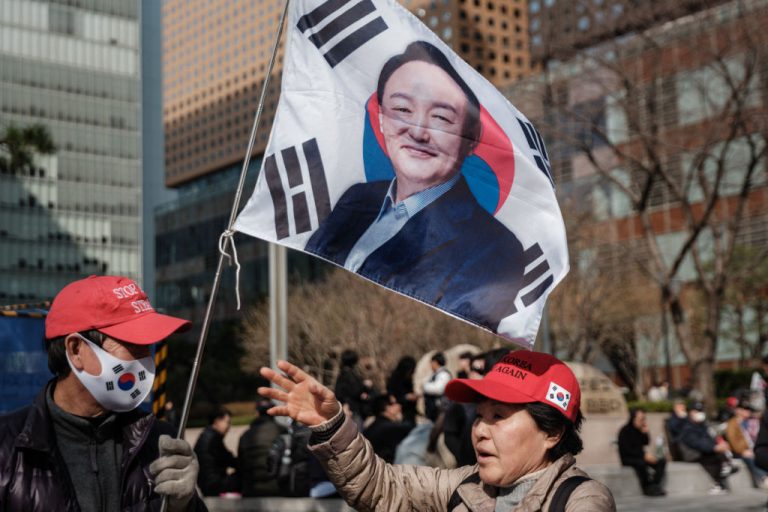
Following his release, South Koreans gathered en masse throughout the capital, divided between support and opposition against him. The city was filled with flags and signs calling for either his official removal from power or his return to office.
On the same day of his release, around 55,000 of his supporters flooded the main districts, with 32,500 citizens shouting their disapproval of him.
Protester Song Young-sun told Reuters that it was “incredibly” frustrating to hear the news of Yoon’s release.
“So this week I came here, hoping that the Constitutional Court will rule on the impeachment case next week,” Song said.
Another protester, Kim Hyung-joon, told Reuters of his hopes that the court would make a “precise judgement and dismiss the case.”
The Constitutional Court will decide if Yoon’s tenure as president will end or continue. Should he be removed, a national election will be held for two months to find a successor.
The ruling People Power Party said it will respect the verdict when the decision is finally made.
“Our party’s official stance is that it will respect the Constitutional Court’s final verdict, in line with the President’s intention to do so as exhibited during his final remarks at the impeachment trial,” Representative Kweon Seong-dong, the party’s floor leader, said at a press conference on March 15.