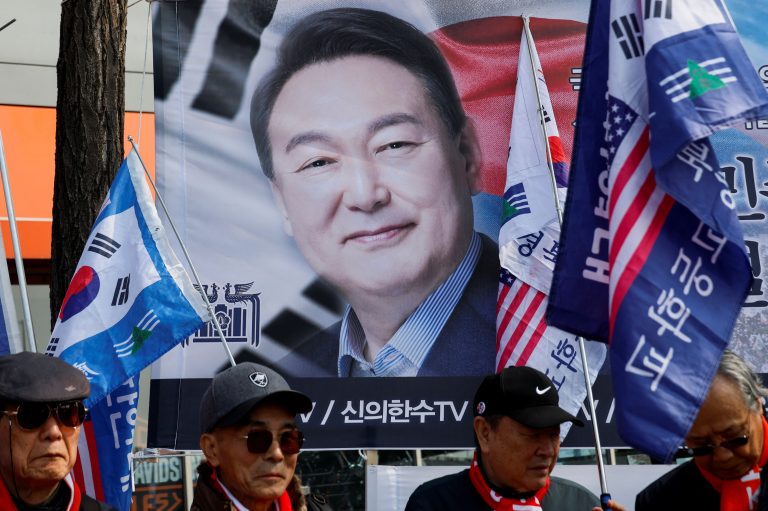
The Constitutional Court of the Republic of Korea (ROK) on Friday, April 4, issued a unanimous verdict upholding the impeachment of President Yoon Suk-yeol, meaning that a snap election will be held in 60 days. The opposition Democratic Party of Korea (DPK) is likely to prevail in that race, which is for a full five-year term.
Yoon was suspended from his role after his botched attempt at imposing martial law in the evening of Dec. 3, 2024, a move that the now former president defended as a necessary measure against “communist infiltration” by North Korea and China.
While previous ROK presidents have been impeached, it took a suprisingly long 38 days for the Constitutional Court to announce its ruling on Yoon, with many observers saying that the delay was due to the court wanting to reach a unanimous consensus so as to minimize political uncertainty. Some of the justices were believed to oppose impeachment.
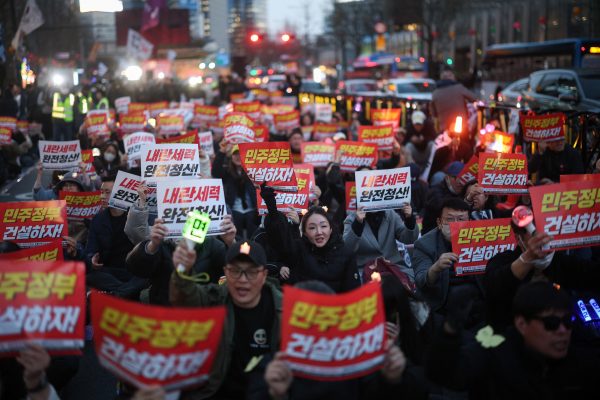
Tens of thousands of people routinely turned out for protests in Seoul, the South Korean capital, for and against Yoon.
The ruling caps months of political turmoil that have overshadowed efforts to deal with the administration of U.S. President Donald Trump at a time of slowing growth in Asia’s fourth-largest economy.
Success
You are now signed up for our newsletter
Success
Check your email to complete sign up
“I am deeply grateful to all of you who supported and encouraged me, despite my shortcomings,” Yoon said in a written message released by his lawyers. “I am so sorry and regretful that I couldn’t live up to your expectations.”
The decision now sets in motion a race to elect the next president within 60 days as required by the constitution. Prime Minister Han Duck-soo, whom the opposition also impeached, but successfully, will stay on as acting president until a new leader is sworn in.
Yoon Suk-yeol’s administration had faced constant challenges from the DPK and other opposition forces, who hold a majority over the conservative People Power Party (PPP) in the South Korean legislature.
In his statements regarding the attempt at martial law, Yoon cited the opposition’s incessant blockage of policy and impeachment of his cabinet members as consistituting “anti-state” acts that endangered national security — arguments that the courts found unconvincing.
Mobilizing the military against parliament to disrupt its functions was a grave violation of Yoon’s constitutional duty to safeguard the independence of the three branches of government, the Constritutional Court’s acting Chief Justice Moon Hyung-bae said. The court had rejected most of Yoon’s argument that he declared martial law to sound the alarm over the main opposition party’s abuse of its parliamentary majority, saying there were legal avenues to address disagreements.
The 64-year-old former President Yoon also faces a separate criminal trial on insurrection charges.
In the short term, South Korea is likely to remain highly polarized, perhaps even more so than before, since Yoon’s impeachment has divided the country. However, the official PPP position has been to accept the impeachment decision, Hankuk University professor Mason Richey said.
Lee Jae-myung, the populist leader of the liberal Democratic Party who had lost to Yoon by a razor-thin margin in 2022, is a clear front-runner but faces legal challenges of his own under multiple trials for corruption.
Political crisis, international upheaval
The political shakeup in the ROK comes as the U.S. Trump administration rolls out tariffs against dozens of countries around the world.
People were seen waving placards emblazoned with the slogan “Let’s build a democratic government” as they chanted and danced in jubilation. At the pro-Yoon camp, the mood was more subdued, with at least one person crying and others looking visibly upset.
“I know that the state of martial law caused a lot of economic and cultural damage,” said Kim Yu-bin, a 23-year-old South Korean. “So, in that regard, I think it is fortunate that the impeachment was upheld. However, it is unfortunate that during such a politically chaotic time in South Korea, this development might add further chaos.”
The DPK favors more progressive socioeconomic policies, in contrast to Yoon’s conservative, pro-business domestic platform. Under Yoon’s presidency, the South Korean birthrate — the lowest in the world — hit its nadir of 0.72 children per woman, but saw a slight boost to 0.75 last year.
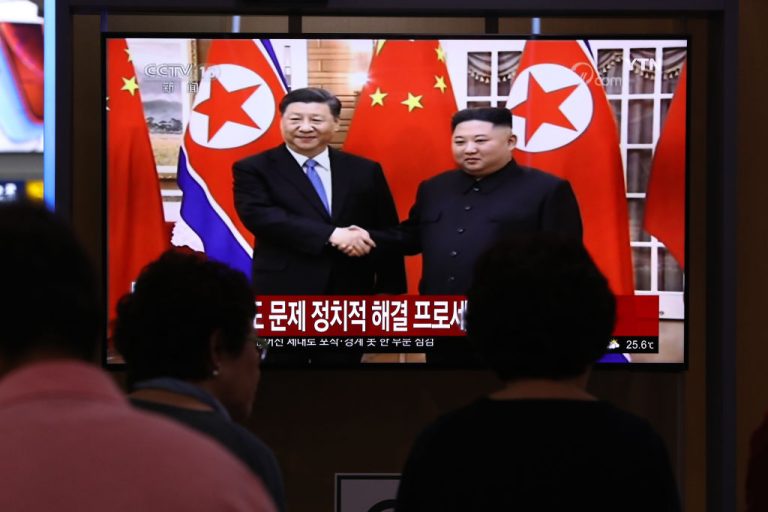
On foreign policy, the Yoon administration looked to strengthen ties with its U.S. ally, back Taiwan, and improve relations with Japan while adopting a hardline stance on the nuclear-armed North Korea. It also warned against Chinese economic and political influence as a threat to South Korea’s national interests.
Lee and the DPK are noted for their concilatory approach to Pyongyang, desire to deepen relations with China, and hostility towards Japan owing to the latter’s colonization of and abuses in Korea prior to and during World War II.
On April 3, the U.S. said it would impose 25 percent reciprocal tariffs on South Korea as part of its new trade policy, which also includes other measures that will affect key sectors in the country from autos to chips.
With many of its companies contributing to global supply chains, South Korea relies heavily on international commerce to drive its economic growth.
“For the next two months, Seoul will not be able to properly respond to Trump’s fast-paced decisions, let alone coordinate with Washington on key foreign policy challenges, which could impact South Korea’s national security and economic security in significant ways,” said Duyeon Kim, of the U.S.-based Center for a New American Security.