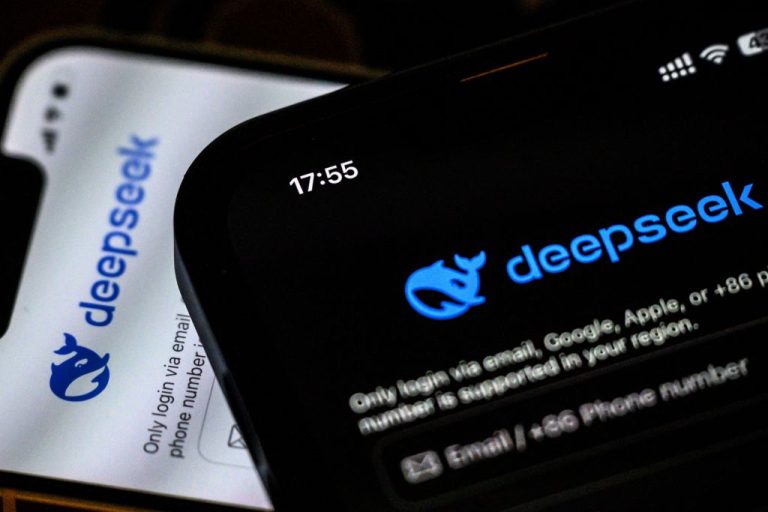
On Wednesday, April 16, the U.S. House of Representatives’ Select Committee on the CCP (Chinese Communist Party) released a report identifying Chinese AI startup DeepSeek as a “profound threat” to U.S. national security.
It alleges that DeepSeek not only helps the CCP collect user data from American and other foreign users, but may also be using advanced Nvidia chips restricted under U.S. export controls.
According to the Select Committee, the DeepSeek is a “weapon in the Chinese Communist Party’s arsenal, designed to spy on Americans, steal our technology, and subvert US law.”
While DeepSeek is privately held, its founder Liang Wenfeng has received public backing from top CCP senior officials. In February, Liang met with Chinese leader Xi Jinping, following an earlier meeting with Premier Li Qiang.
The report alleges that the data collected by DeepSeek is sent to China “through backend
Success
You are now signed up for our newsletter
Success
Check your email to complete sign up
infrastructure connected to a U.S. government-designated Chinese military company,” China Mobile.
While China Mobile is one of the country’s main telecommunications firms, it is also heavily linked to the Chinese People’s Liberation Army (PLA).
The DeepSeek app is reportedly used by multiple Chinese government agencies, and training programs involving it have already been launched within China’s public security system and CCP committees.
Apart from harvesting Americans’ data, the report also calls out DeepSeek for “covertly manipulat[ing] the results it presents to align with CCP propaganda,” noting that “the company operates within “a government initiative explicitly guided by ‘Xi Jinping Thought,’ the guiding ideology of the CCP.”
DeepSeek and Nvidia chips
Since launching its generative AI model in the U.S. earlier this year, DeepSeek has exploded in popularity, claiming its chatbot outperforms OpenAI’s ChatGPT while using far fewer resources and costing significantly less. The announcement caused Nvidia’s stock to plummet, wiping out nearly $600 billion in market value in a single day. DeepSeek is now seen as a key piece in the CCP’s push to catch up with or surpass the U.S. in the AI arms race.
As reported by the Financial Times, the Select Committee on the CCP has formally sent an inquiry to Nvidia demanding clarity on whether DeepSeek obtained restricted high-performance AI chips, and if so, how.
DeepSeek “exploited US AI models and reportedly used advanced Nvidia chips that should never have ended up in Chinese Communist party hands,” committee chairman John Moolenaar said. “That’s why we’re sending a letter to Nvidia to demand answers” about the firm’s sales to China and Southeast Asia.
On April 16, Nvidia said that it was in full compliance with U.S. government export restrictions.
Reports have indicated that DeepSeek used Nvidia’s H800 chips to train its AI models. These chips, made specifically for the Chinese market and less powerful than the H100, were eventually also included in the Biden administration’s 2023 export ban.
The investigation comes as the U.S. intensifies its oversight of AI chip exports. Recently, the U.S. expanded its restrictions on Nvidia’s exports of H20 chips to China, a move that caught the company off guard. In a regulatory filing, Nvidia stated it expects a $5.5 billion revenue loss in the quarter ending April 27 due to the new limits.
Nvidia’s chip sales depend on a complex supply chain involving companies like Dell and Supermicro, which integrate the chips into servers and then resell them.
The House report said that in addition to being linked to China Mobile, DeepSeek’s data transmission infrastructure includes tracking tools from CCP-controlled tech giants such as ByteDance, Baidu, and Tencent. This further exposes users’ data to collection by China.
Several countries, such as Australia, have already begun banning DeepSeek from government devices, citing it as a national security risk.
The New York Times reported April 16 that the White House is considering a ban on DeepSeek in the United States, citing three anonymous sources.
The U.S. Navy and NASA have also restricted DeepSeek use, citing “potential security and ethical concerns,” and similar bans are being pursued in Italy, Taiwan, and South Korea.