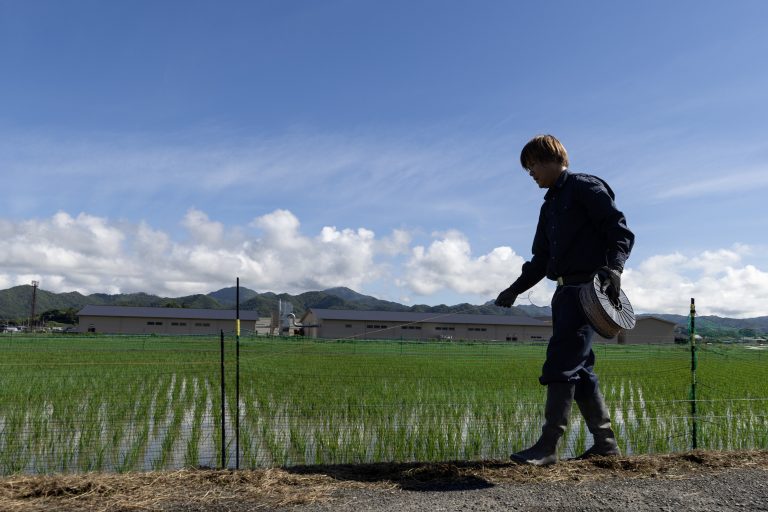
One of the wealthiest nations on earth, Japan has been having difficulty keeping its people supplied with the nation’s most important staple food — domestically grown rice.
While the crisis has its immediate factors, the recent trouble is also largely the result of decadeslong efforts by the Japanese government to maintain a delicate balancing act of maintaining steady prices and yields whilst also ensuring national self-sufficiency.
Japan’s declining population and the diversification of its people’s dietary habits to include a greater portion of other crops has seen a drop in demand for rice between 2014 and 2024. But a millions-strong influx of tourists, bad weather reducing harvests, and an aging workforce, have contributed to rising demand for rice and lowered production in the last two years.
By this spring, consumers in Japan were paying twice as much for a standard 5-kg bag — about 11 lb — of white rice than they were last year. Many stores limited shoppers to just one bag, and videos posted to social media showed lengthy queues forming outside supermarkets.
In May, Japanese could expect to pay over 4,000 yen, or about US$30, for just a single 5-kg bag of rice. By contrast, a normal 50-lb bag (about 23 kg) of rice costs between $20 and $50 in the U.S.
Success
You are now signed up for our newsletter
Success
Check your email to complete sign up
The price hike led to the resignation that month of Japan’s agriculture minister, Taku Eto, who stepped away from his post following public outrage at the minister’s remarks that he had “never had to buy rice” on his own thanks to gifts from supporters.
Replacing him on May 21 at the Ministry of Agriculture, Forestry and Fisheries (MAFF) was Shinjiro Koizumi, who once served as Japan’s environmental minister and is the son of former prime minister Junichiro Koizumi.
One of Koizumi’s first public comments upon assuming his new role was that as a husband and father, he buys “all kinds of rice.”
Emergency rice distribution reveals bureaucratic weakness
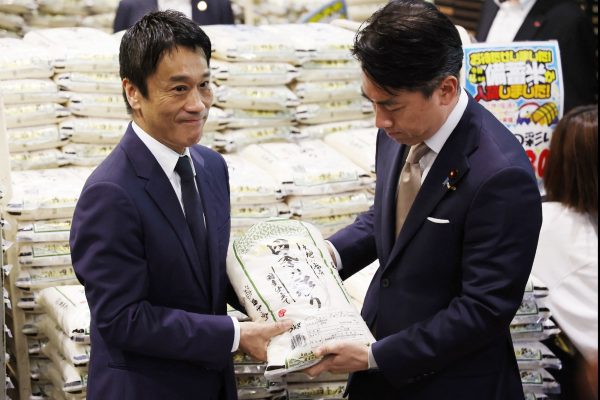
Under Koizumi, the MAFF has acted to bring down prices by distributing Japan’s emergency rice stockpiles, releasing hundreds of thousands of tons from the 2022 and 2021 harvests.
By June, prices had gone down significantly. In late May, Koizumi posted a photo on his X account of rice going for less than 3,000 yen a bag at a supermarket in the northern Hokkaido region.
Polling data released by Japanese state broadcaster NHK on June 9 showed a 6.8-point increase in popularity for the cabinet of prime minister Shigeru Ishiba, whose Liberal Democratic Party (LDP) has suffered from low approval ratings in recent years due to a series of scandals. Its approval rating now stands at 34.4 percent, while 46.4 percent of respondents said they disapprove of Ishiba’s leadership.
- Trump Says There Will Be a ‘Planned Partnership’ Between Nippon Steel and US Steel
- Japan in Uncharted Political Waters After Ruling Party Suffers Rare Loss (October 2024)
Observers credited Koizumi’s actions as contributing to the rebound. Notably, 72 percent of those polled by NHK say they approve of the government’s measures to tackle the rice crisis.
What set Koizumi’s redistribution plan apart from previous schemes was his decision to have the government sell its rice reserves directly to retailers across Japan, rather than the conventional approach of auctioning product to the country’s massive farming union, Japan Agricultural Cooperatives (JA).
Though not a government organization, JA has its roots in Imperial Japan, when the wartime government took over the agricultural industry until its defeat in 1945. A group of nearly 700 co-ops, JA has been used by the postwar Japanese authorities as an important tool for regulating the rice market and protecting traditional farming.
However, the system has come under increasing criticism for its inefficiency and inflexibility in the face of unforeseen events, as Japan’s current experience shows.
“To farmers, JA offers financial, marketing, insurance, welfare, real estate, travel, and educational services. Rice farmers are not obligated to sell their rice to JA, but have effectively no choice because JA provides all their insurance and financing,” observes YouTuber Jon Yu, on his channel, Asianometry.
Additionally, when previous Japanese administrations released emergency rice reserves, the product was auctioned to JA, rather than going directly to retailers, prolonging the time it took for the rice to reach shoppers.
Masayuki Ogawa, an assistant professor at Utsunomiya University, told NHK on a May 30 program that he sees The MAFF’s measures as only a temporary fix for the rice crisis, and does not solve the underlying issue of low production. “The retailers do not have to sell the rice back to the government,” Ogawa notes. “That effectively means that the [government] reserves will shrink, so in the long term we will have smaller stockpiles during times of crisis.”
Japanese rice: a traditional industry facing modern challenges
Jon Yu, whose channel focuses on economics, semiconductors, and history, said in a June 1 video on the Japanese rice crisis that while he believes the Japanese government will succeed in “blunting the trend” given that the situation “is so nationally prominent,” he is less confident about Tokyo’s ability to reform the underlying system, which is built around price controls and protecting the country’s large — but decreasing — number of small farmers.
For centuries, Japan has consumed rice as its most important staple grain. Despite its large population of over 120 million and limited farmland, Japan manages to produce nearly all the 7 million tons of rice it requires for human consumption annually.
- US Seeks to Revive Dormant Shipyards With Help From South Korea and Japan (March 2024)
- Are Japan’s Abandoned Houses Turning Into Goldmines? Why Investors Are Reviving the Rural ‘Akiya’ Gems
To protect small farmers in the wake of World War II, the Japanese government pursued policies to prevent the formation of large landowning families and companies, resulting in the country’s rice plots being small, numbering the millions, and usually worked by a single household.
While other countries in Asia saw rice yields grow by three to five times in the latter half of the 1900s, Japanese rice production peaked in 1961 at 16 million tons.
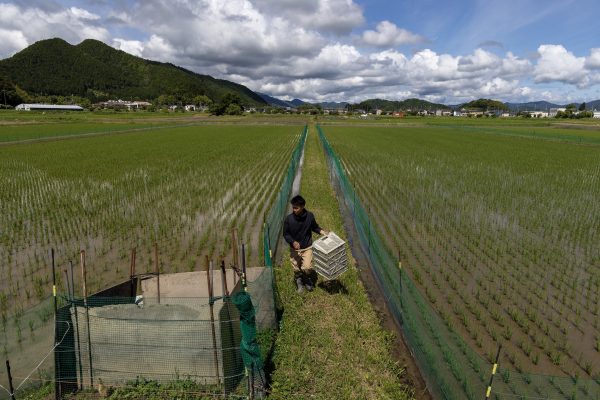
In order to subsidize the nation’s farmers, the Japanese government stepped in to control rice prices. In the 1970s, it instituted the “gentan” (減反) system to encourage farmers to plant other crops or even keep their fields fallow.
Meanwhile, almost all Japanese farms are too small to operate the large-scale machinery and methods that would increase production and which are used in other countries.
Comparing Japan with other Asian rice producers, Yu suggests that the singular focus on maintaining just the right amount of rice production and preventing absentee landlordism has not only made Japan vulnerable to supply shocks, but is also a “missed opportunity” to improve yields and export some of the national surplus.
Japanese consumers also prefer rice grown in their country to foreign-produced rice, which often tastes different. While Japan is obligated by the World Trade Organization (WTO) to allow a degree of rice imports from countries such as the United States, Tokyo typically stockpiles the rice until it is unfit for human consumption, then uses it for animal feed.
Rice farming, like many other traditional occupations in Japan, is also increasingly becoming a job for the elderly, as the children of farmers seek professions in more prestigious and comfortable lines of work.