By Janet Huang, Vision Times
Signs continue to emerge that Xi Jinping’s hold on power is slipping. On June 28, the Chinese regime announced the establishment of three major military academies in an institutional move that analysts see as a sign of significant shift in control over the armed forces. On the same day, reports surfaced of China’s Ministry of Commerce entering tariff negotiations, raising speculation that the rumored “Xishan Four-Point Consensus” may already be shaping policy decisions behind the scenes.
Just one day earlier, on June 27, the 16th session of the 14th National People’s Congress announced the removal of several delegates, including General He Weidong — a high-ranking Xi loyalist and Vice Chairman of the Central Military Commission (CMC) since 2022.
He remains missing from public view amid unconfirmed reports of his death. Whether or not these claims are true, He’s absence signals the sidelining of a core Xi proxy in the military.
A strategic break from Xi?
China’s current information environment remains deeply fragmented. Unofficial reports mix with state-sanctioned narratives, and media sources critical of Beijing are often dismissed as unreliable, contributing to a murky atmosphere of uncertainty.
Success
You are now signed up for our newsletter
Success
Check your email to complete sign up
Still, official channels offer telling indicators. On June 28, CCTV confirmed the creation of the Army Combined Arms University, Information Support Force Engineering University, and Joint Logistics Support Force Engineering University, detailing their academic missions and curricula.
Military shake-up
Coinciding with this announcement, longtime defense ministry spokesperson Wu Qian — once considered Xi’s mouthpiece in the military — was replaced.

On May 15, Senior Colonel Jiang Bin, deputy director of the Ministry of National Defense Information Office, made his first public appearance as the new spokesman. This transition marked not just a personnel change, but what many see as a broader pivot away from Xi’s control.
Jiang’s appointment, along with the restructured academies, signals an effort to “rebuild the military from the ground up.” Observers agree: the Xi Jinping era of military dominance has effectively ended.
Xi’s military doctrine set aside
In Jiang Bin’s public remarks, the military reforms were said to reflect the “spirit of the Third Plenary Session of the 20th Party Congress”—a marked shift from previous language. Under Xi, major military initiatives were always framed around “Xi Jinping Thought on strengthening the military.” Now, that language is conspicuously absent.
The current Central Military Commission, led by Zhang Youxia, appears to be intentionally moving away from Xi’s ideological imprint. The omission of Xi’s name suggests his influence over the armed forces has been significantly curtailed.
These newly reorganized academies came just six weeks after an undisclosed Politburo meeting (China’s top ruling body) on May 15, which reportedly marked Xi’s formal internal exit. The speed with which these institutions were stood up reflects a decisive campaign to dismantle Xi’s military base.
The fall of the army faction
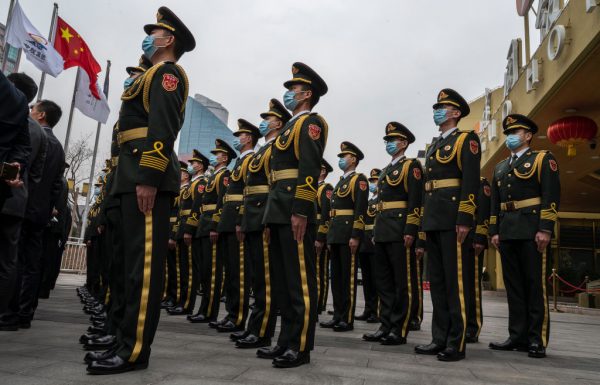
Observers note that the use of the term “Army” across all three new academies is no accident. Xi had built his military strength primarily through the 31st Group Army, sometimes referred to online as his “Praetorian Guard.” Now, that very faction appears to be collapsing.
RELATED: Behind China’s Military Parade: Zhang Youxia’s Purge and Xi’s Struggle for Survival
Investigations have reportedly targeted high-ranking officers loyal to Xi, including He Weidong, Miao Hua, Zhao Keshi, and Qin Shutang, as well as younger generals at the lieutenant and major general level, especially from the Fujian base. Additional incidents involving commanders from the Western and Eastern Theater Commands have further fueled the perception that Xi’s core military units are being systematically dismantled.
Analyst Zhao Lanjian, who previously warned that Xi planned a Taiwan invasion, recently claimed that key figures — including Zhao Lei, Yang Yi, Kong Jun, and Li Hanjun — are under active investigation. These reports suggest that Xi’s military loyalists are falling one by one.
With Xi’s faction uprooted, the military is now viewed as both leaderless and in transition. The new academies represent an urgent effort to rebuild and stabilize leadership. At the same time, the total purge of Xi’s supporters leaves little chance for his return to military control.
Could a broader power shift be underway?
Rumors beyond the military reinforce this narrative. Reports suggest:
- Xi may skip the upcoming BRICS summit.
- Peng Liyuan, Xi’s wife, has appeared alone on diplomatic visits.
- Xi’s mother Qi Xin may have passed away, a fact that allegedly remains secret.
- Former DIA Director Lt. Gen. Michael Flynn posted on June 27, hinting at a transfer of top power in China.
These developments add to speculation that Xi’s departure is not only imminent; it may already be in motion.
The Xishan consensus
Amid this uncertainty, the so-called Xishan Four-Point Consensus has also gained attention as a possible framework for managing Xi’s exit. “Xishan” (literally meaning “West Mountain”) is interpreted symbolically as a reference to the sun setting on Xi’s rule.

The consensus centers on four points. The first: Xi’s future as General Secretary will be addressed at the Fourth Plenary Session in August, a moment increasingly seen as pivotal.
Who will lead China through the transition?
One key question looms: If Xi leaves, who will take over? The consensus offers a solution — a Central Advisory Committee. Though it hasn’t been formally established, leaked details suggest the plan is already circulating among top party elders.
Normally, creating such a committee would require constitutional amendments, Politburo votes, and nomination of eligible retirees. Leaked speeches attributed to Hu Jintao and Wen Jiabao endorse restoring collective leadership and prohibiting personality cults — core themes behind the push for this transitional body.

The guiding idea: former leaders, particularly Hu, would oversee the transition to ensure the party’s survival.
Elders take charge
Whether or not the Central Advisory Committee is formalized, its influence appears real. Sources claim it already has the power to attend Politburo Standing Committee meetings and shape decisions. In effect, Xi has become a symbolic figurehead, sidelined by what some describe as the “Four Elders Faction.”
This group — consisting of Hu Jintao, Wen Jiabao, Li Ruihuan, and Zeng Qinghong — is said to wield influence comparable to that of official Standing Committee members. Though unofficial, they are reportedly calling the shots behind the scenes.

Trade talks and global watchdogs
The fourth point of the Xishan Consensus centers on diplomacy — particularly China-U.S. relations. A leaked summary of a rumored trade deal outlines major U.S. demands, including:
- Allowing free operation of Twitter/X, Facebook, and YouTube in China.
- Equal treatment for foreign and private businesses.
- Unrestricted rare earth exports.
In exchange, the U.S. would reduce tariffs to 20 percent. However, on June 28, the Ministry of Commerce rejected the idea outright, stating: “China resolutely opposes any party reaching an agreement at the expense of China’s interests in exchange for so-called tariff reductions.” The strong language suggests that unblocking foreign platforms remains a red line.
Whether a deal is reached before the July 9 expiration of the reciprocal tariff pause may serve as the first true test of the Central Advisory Committee’s ability to act independently and decisively.
In short, China appears to be entering a post-Xi era. The military academies, the removal of Xi’s loyalists, and the rise of a consensus among party elders all point to a carefully managed power transition already underway. Whether Xi remains as a symbolic leader, is retired formally, or fades into political obscurity will be decided in the coming weeks.
We will continue monitoring the political shifts in China. This is a developing story; updates will be added as new developments unfold. The views expressed in this article are those of the author alone.