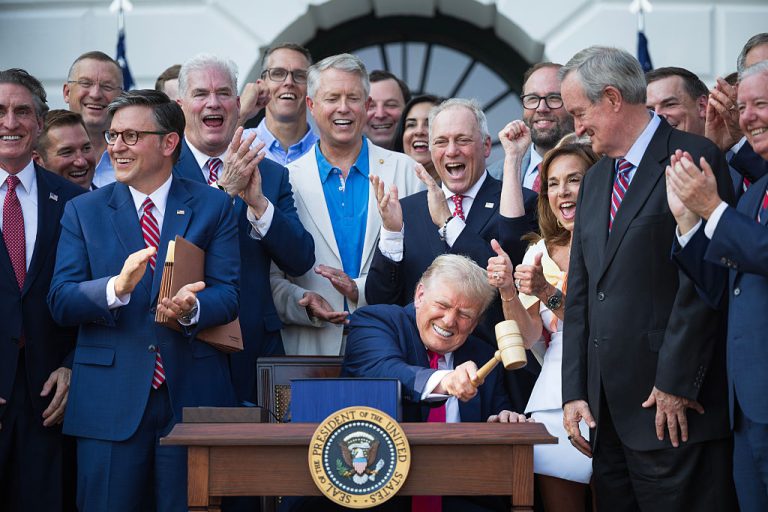
On July 4, during an Independence Day event, President Donald Trump gathered with several members of his administration on the South Lawn of the White House to sign into law the “Big Beautiful Bill,” a sweeping piece of legislation that has been the centerpiece of his second-term domestic agenda.
Lawmakers passed the nearly 900-page bill by a narrow 51-50 vote in the Republican controlled chamber, after Vice President JD Vance broke a tie vote before the bill was sent to the House.
The successful vote, which saw three Republicans and all Democrats vote against, ended 27 hours of debate in the upper chamber.
The bill includes Trump’s 2017 tax cuts, a reduction in spending on some safety net programs, tax cuts, and an increase on border enforcement and deportations, among other things.
Critics, from across the political spectrum, have taken aim at the bill, saying it will add an estimated $3.3 trillion to the national debt.
Success
You are now signed up for our newsletter
Success
Check your email to complete sign up
Others argue that the bill goes too far by cutting funding to programs like Medicaid and the Supplemental Nutrition Assistance Program (SNAP).
Trump however pushed to have the bill signed into law by July 4, calling it “the most popular bill ever signed in the history of our country.”
“America’s winning, winning, winning like never before,” Trump insisted. “Promises made, promises kept, and we’ve kept them,” he added.
READ MORE:
Tax breaks
A number of Republicans in support of the bill argued that the bill was crucial because there would have been a massive tax hike after December this year when tax breaks from Trump’s first term were set to expire.
Now that the bill has been signed into law, the existing tax rates and brackets are permanent.
In total, the bill contains an estimated $4.5 trillion in tax cuts.
It also temporarily adds new tax deductions on tips, overtime hours and auto loans in addition to a $6,000 deduction for older adults who earn more than $75,000 a year, a step in the right direction to fulfil his promise of ending taxes on Social Security benefits.
It also boosts the child tax credit from $2,000 to $2,200. However many argue that millions of American families, earning a lower income, will not be eligible for the full credit.
In addition, the bill places a cap on state and local deductions, called SALT, which will quadruple to $40,000 for five years. This provision is especially important for high tax states like New York. Originally the House wanted it to last for 10 years, however only the five year term was passed in the bill.
In a move that proponents say will boost economic growth, the bill includes a number of business-related tax cuts, including a provision that will allow businesses to write off 100 percent of the cost of equipment and research.
According to a Congressional Budget Office analysis lower income families will need to fork over an additional $1,600 per year in Medicaid and food aid, however the budget office has been known to get things wrong.
READ MORE:
- China’s ‘Internal Circulation’ Trade Policy Invites Backlash for Maximizing Exports, Restricting Imports
- The Two-Decade Decline of Florida’s Citrus Industry
- 36 Years After Tiananmen, Chinese Democracy Activists Reflect on the Past and See Hope for Future Change
Border security and the ‘Golden Dome’
The bill earmarks a massive $350 billion to fuel Trump’s border and national security agenda, including funding for a border wall and a migrant detention facility that could hold upwards of 100,000 people.
At the same time, Trump continues to promise the largest mass deportation operation in American history.
Some of these funds will go to hiring 10,000 new immigration and Customs Enforcement officers, with $10,000 signing bonuses. Trump has set the lofty goal of deporting at least one million people per year.
To partially fund the initiative, migrants will face a wave of new fees, including fees on migrants seeking asylum protections.
A number of quality of life measures for servicemen and women are included in the bill in addition to funds for ship building and munitions systems.
In addition, the bill provides $25 billion for the development of the Golden Dome missile defense system.
Another $1 billion is earmarked for the Defense Department for border security.
READ MORE:
Health care and food assistance
To offset the costs associated with the bill a number of programs will face renewed scrutiny including Medicaid and food assistance programs like SNAP.
Proponents of the bill say the changes are long overdue and realign safety net programs to support the types of Americans they were originally intended for, like pregnant women, the disabled and children, while rooting out waste, fraud and abuse.
For many adults receiving Medicaid and food stamps, including adults up to age 65, a new 80-hour-a-month work requirement will be implemented, including for parents of children 14-years-old or older.
A $35 co-payment will also be charged to patients using Medicaid services.
In the United States, more than 71 million people rely on Medicaid — which was expanded under Obama’s Affordable Care Act — and an estimated 40 million Americans access SNAP benefits.
Analysts say that the majority of people receiving these benefits already work.
Lawmakers are looking to have states supplement the cost of SNAP benefits, benefits that are currently 100 percent funded federally.
Beginning in 2028 states will be required to contribute a set percentage of these costs if their payment error rate — both over- and underpayments — exceeds six percent.
However, the Senate bill delays the start date of this cost-sharing scheme for states with the highest SNAP error rates, like Alaska.
READ MORE:
Miscellaneous measures
On the chopping block are a series of clean energy tax breaks designed to boost clean energy projects fueled by renewable resources including solar and wind.
The bill eliminates a number of Biden era policies implemented in an attempt to address climate change and lower health care costs.
Tax breaks for people who choose to purchase an electric vehicle will no longer be available as of Sept. 30 this year. These tax breaks were originally scheduled to expire at the end of 2032.
In addition, a tax credit for companies who produce critical materials will be expanded, including for companies working in the metallurgical and steelmaking industries.
The bill establishes a “children’s savings program” called “Trump Accounts” which have the potential to see a deposit of upwards of $1,000 from the Treasury.
Upwards of $40 million is also set aside to establish a pet project of Trumps; his long-sought after “National Garden of American Heroes.”
New taxes are also being introduced, including an excise tax on university endowments and a tax on remittances, or money sent to people abroad. This tax will be equal to one percent of the amount of money transferred.
A $200 tax on gun silencers, short-barreled rifles and shotguns was eliminated.
In a pro-life move, another provision bars a year’s worth of Medicaid payments to family planning providers that provide abortions, a provision many believe directly targets Planned Parenthood.
Billions have been set aside for the Artemis moon mission and the exploration of Mars and $88 million has been allocated for a pandemic response accountability committee.